
A vacuum hot press furnace acts as the primary densification engine for fabricating Zinc Sulfide (ZnS) infrared ceramics. By applying simultaneous heat (900–1000°C) and high uniaxial mechanical pressure (greater than 100 MPa) within a vacuum, the furnace forces the raw powder to compact into a solid, optically clear material.
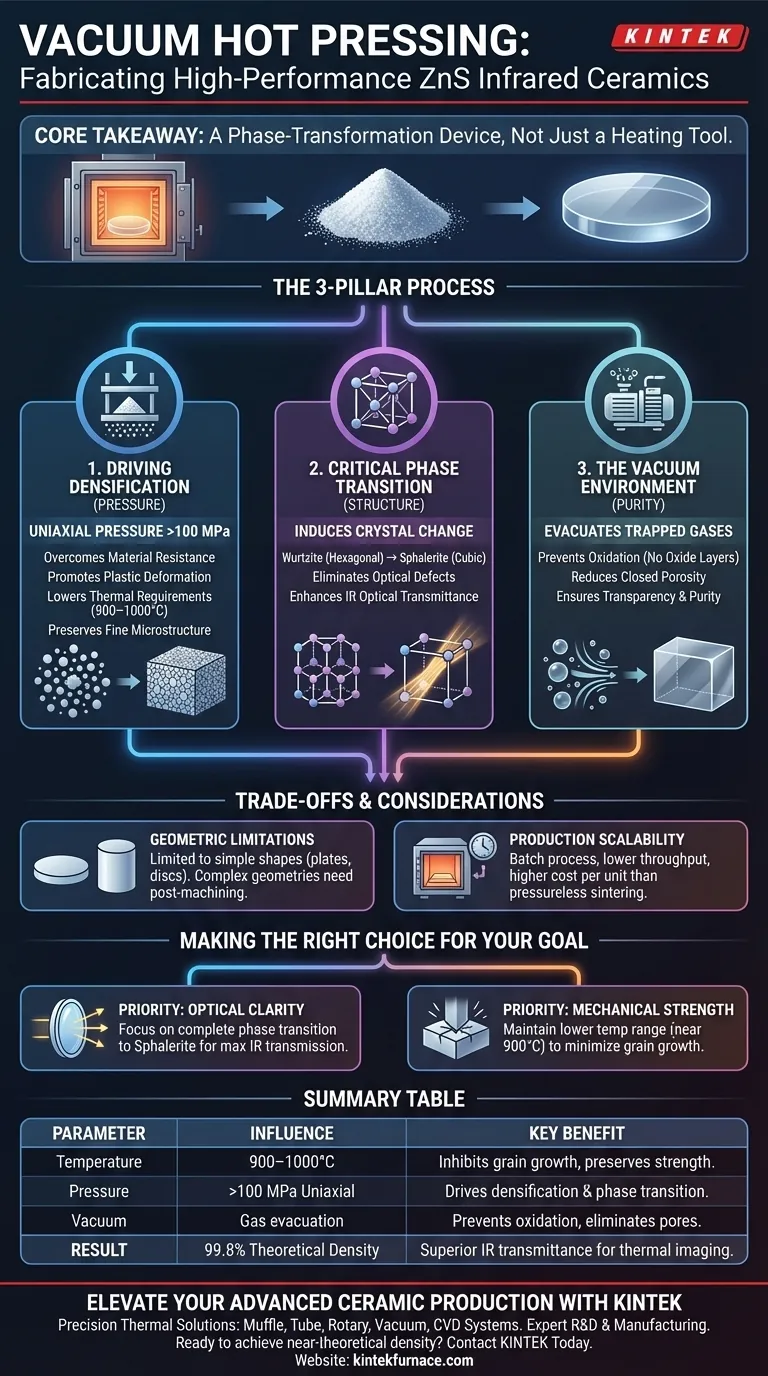
Core Takeaway The vacuum hot press is not merely a heating tool; it is a phase-transformation device. It utilizes mechanical pressure to drive densification and induce a critical crystal structure change (wurtzite to sphalerite) at temperatures low enough to prevent grain growth, ensuring the final ceramic combines high mechanical strength with superior infrared transmission.
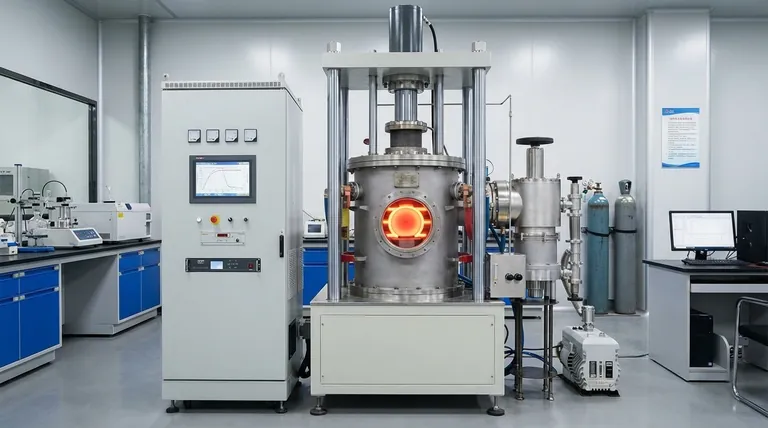
Driving Densification Through Pressure
Overcoming Material Resistance
ZnS powders naturally resist consolidation. The furnace overcomes this by applying significant uniaxial pressure, which promotes plastic deformation and diffusion creep. This mechanical force physically rearranges particles and closes voids that heat alone cannot eliminate.
Lowering Thermal Requirements
Traditional sintering requires extreme heat to achieve density, which often leads to oversized grains and poor mechanical strength. The added pressure allows ZnS to reach near-theoretical density (e.g., 99.8%) at much lower temperatures (typically 900–1000°C).
Preserving Fine Microstructure
By operating at these lower temperatures, the process inhibits excessive grain growth. This results in a fine-grained microstructure, which is essential for maximizing the mechanical properties and durability of the final ceramic component.
The Critical Phase Transition
Inducing Crystal Structure Changes
For ZnS to function effectively as an infrared window, it must possess a specific crystal structure. The high-pressure environment (often >100 MPa) induces a phase transition from the wurtzite phase to the sphalerite phase.
Eliminating Optical Defects
This transition is not just structural; it is optical. The shift to sphalerite is essential for eliminating residual pores and scattering centers. This directly enhances the material's infrared optical transmittance, making it suitable for high-performance thermal imaging and sensor applications.
The Role of the Vacuum Environment
Evacuating Trapped Gases
The vacuum atmosphere plays a vital role in purity. It evacuates air trapped between powder particles and removes volatile gases generated during the heating process.
Preventing Oxidation
ZnS and potential sintering additives are sensitive to oxygen at high temperatures. The vacuum environment prevents oxidation, which would otherwise form opaque oxide layers (impurities) at the grain boundaries and degrade optical performance.
Reducing Closed Porosity
By removing adsorbed gases before the material seals up, the vacuum minimizes the formation of closed pores inside the ceramic. This reduction in porosity is the final key to achieving a fully dense, transparent sintered body.
Understanding the Trade-offs
Geometric Limitations
Because the pressure is applied uniaxially (from top and bottom), hot pressing is generally limited to simple shapes like flat plates, discs, or cylinders. Complex 3D geometries often require post-process machining, which adds cost.
Production Scalability
Vacuum hot pressing is inherently a batch process. While it produces superior quality materials compared to pressureless sintering, it generally has lower throughput and higher operational costs per unit.
Making the Right Choice for Your Goal
To maximize the potential of ZnS ceramics, align your processing parameters with your specific application requirements:
- If your primary focus is Optical Clarity: Prioritize pressure parameters that ensure a complete phase transition to sphalerite, as this is the dominant factor in infrared transmission.
- If your primary focus is Mechanical Strength: Focus on maintaining the lower end of the temperature range (near 900°C) to minimize grain growth while relying on higher pressure for densification.
The vacuum hot press furnace transforms ZnS from a loose powder into a sophisticated optical component by substituting thermal excess with mechanical force.
Summary Table:
| Parameter | Influence on ZnS Ceramics | Key Benefit |
|---|---|---|
| Temperature | 900–1000°C range | Inhibits grain growth, preserving mechanical strength. |
| Pressure | >100 MPa Uniaxial | Drives densification and wurtzite-to-sphalerite phase transition. |
| Vacuum | Gas evacuation | Prevents oxidation and eliminates internal scattering pores. |
| Result | 99.8% Theoretical Density | Superior IR transmittance for thermal imaging components. |
Elevate Your Advanced Ceramic Production with KINTEK
Precision in vacuum hot pressing is the difference between an opaque material and a high-performance optical component. KINTEK provides industry-leading thermal solutions, including customizable Muffle, Tube, Rotary, Vacuum, and CVD systems, backed by expert R&D and manufacturing.
Whether you are refining ZnS infrared ceramics or developing specialized alloys, our high-temp furnaces are engineered to meet your unique material requirements.
Ready to achieve near-theoretical density and superior optical clarity?
Contact KINTEK Today for a Expert Consultation
Visual Guide
Related Products
- Dental Porcelain Zirconia Sintering Ceramic Vacuum Press Furnace
- Vacuum Hot Press Furnace Machine for Lamination and Heating
- Vacuum Hot Press Furnace Machine Heated Vacuum Press Tube Furnace
- Vacuum Hot Press Furnace Machine Heated Vacuum Press
- 600T Vacuum Induction Hot Press Vacuum Heat Treat and Sintering Furnace
People Also Ask
- What factors determine the quality of sintered zirconia restorations? Master Material, Equipment, and Technique
- How do conventional vs rapid sintering in dental furnaces affect zirconia? Optimize Efficiency Without Sacrificing Strength
- What is the purpose of dental sintering furnaces? Transform Zirconia into Durable, High-Quality Dental Restorations
- What precautions should be taken when sintering zirconia in the Fast Slow Dental Sintering Furnace? Master Key Steps for Perfect Results
- What temperature range is used for sintering zirconia ceramics? Achieve Optimal Strength and Translucency



















