
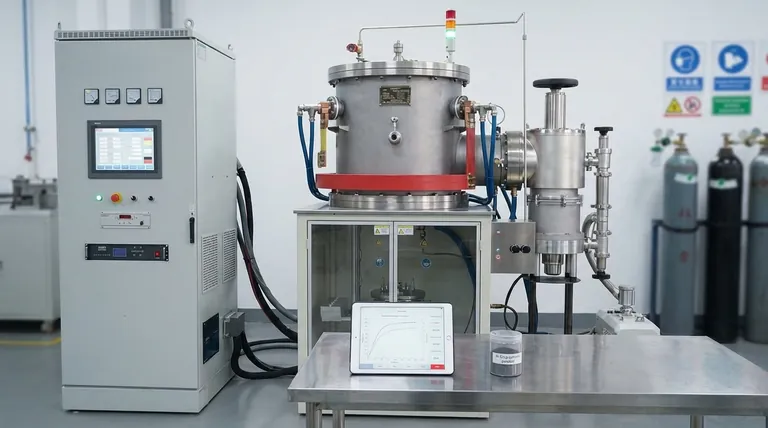
The primary role of a vacuum hot press furnace in processing nanocomposites like Al-Sn/graphene is to achieve near-theoretical density through the simultaneous application of heat and mechanical force. By subjecting the material to temperatures around 540°C and uniaxial pressure of approximately 40 MPa within a vacuum, the furnace forces the metal matrix to flow plastically, eliminating pores that standard pressureless sintering cannot close.
Core Takeaway The vacuum hot press furnace overcomes the natural sintering barriers introduced by nanoparticles (like graphene) by using mechanical pressure to physically force particle rearrangement and plastic flow, while the vacuum environment is essential to prevent oxidation that would otherwise degrade the metal matrix.
The Mechanisms of Densification
The Synergy of Heat and Force
Standard sintering relies on thermal energy alone to bond particles. A vacuum hot press furnace introduces a critical second variable: uniaxial mechanical pressure.
By applying pressure (e.g., 30–50 MPa) while the material is softened by heat (e.g., 540°C for Aluminum-based systems), the furnace utilizes a "synergistic effect." This combination provides the energy necessary to densify materials that are otherwise difficult to sinter.
Eliminating Microscopic Pores
The primary physical goal is the removal of voids between powder particles. The applied external pressure triggers plastic flow and creep mechanisms in the metal matrix.
This forces the softened aluminum to flow into and fill the interstitial spaces between the graphene and tin (Sn) inclusions. This process is significantly more effective at removing porosity than the passive diffusion processes found in pressureless sintering.
Controlling the Chemical Environment
The "vacuum" component is as critical as the pressure. Heating aluminum powders makes them highly susceptible to high-temperature oxidation.
Oxides form brittle layers that prevent particles from bonding. The vacuum environment removes oxygen, ensuring that the aluminum matrix can bond metallurgically with itself and the graphene reinforcement without defect-causing oxide inclusions.
Solving the Nanocomposite Challenge
Overcoming Sintering Barriers
Nanocomposites, particularly those containing carbon-based reinforcements like graphene or carbon nanotubes, are notoriously difficult to densify. The addition of these nanomaterials often creates sintering barriers that inhibit grain growth and pore closure.
The vacuum hot press furnace overcomes this by physically forcing particle rearrangement. It ensures that the metal matrix wraps tightly around the nanomaterials, creating a dense, cohesive structure close to theoretical density.
Enhancing Interface Quality
For a composite like Al-Sn/graphene to perform well, the interface between the metal and the reinforcement must be strong.
The combination of pressure and vacuum promotes atomic diffusion at these interfaces. This facilitates strong bonding between the aluminum matrix and the graphene, which is essential for transferring load and enhancing mechanical properties.
Understanding the Trade-offs
Process Constraints vs. Material Quality
While vacuum hot pressing produces superior density compared to pressureless sintering, it introduces complexity. The process requires balancing high pressure with precise temperature control to avoid melting the matrix entirely or damaging the graphene.
Dimensional Limitations
Unlike pressureless sintering, which can handle complex net shapes, hot pressing is generally limited to simple geometries defined by the die. This is the necessary trade-off to achieve the plastic deformation required for high-density nanocomposites.
Making the Right Choice for Your Goal
To maximize the performance of your Al-Sn/graphene composite, consider these specific processing objectives:
- If your primary focus is Maximum Density: Prioritize higher uniaxial pressure (up to 40-50 MPa) to mechanically force the elimination of pores that result from nanoparticle agglomeration.
- If your primary focus is Matrix Purity: Ensure your vacuum system is capable of maintaining a deep vacuum to prevent oxidation of the aluminum, which is critical for ductility.
- If your primary focus is Interface Strength: Utilize precise temperature control (around 540°C) to promote atomic diffusion without triggering unwanted chemical reactions between the carbon and the metal.
Ultimately, the vacuum hot press furnace is not just a heating element; it is a mechanical tool that forces difficult-to-process nanomaterials into a defect-free, structural state.
Summary Table:
| Key Process Factor | Role in Densification | Benefit for Nanocomposites |
|---|---|---|
| Uniaxial Pressure | Triggers plastic flow and creep | Eliminates pores blocked by nanoparticles |
| High Temperature | Softens the metal matrix | Promotes atomic diffusion and bonding |
| Vacuum Environment | Removes oxygen/impurities | Prevents oxidation for high-purity interfaces |
| Mechanical Force | Physically rearranges particles | Ensures matrix wraps tightly around graphene |
Optimize Your Nanocomposite Synthesis with KINTEK
Achieving the perfect balance of density and purity in materials like Al-Sn/graphene requires precision-engineered thermal equipment. KINTEK provides the high-performance solutions your research demands.
Backed by expert R&D and manufacturing, we offer a wide range of customizable systems, including:
- Vacuum & Vacuum Hot Press Furnaces for high-density sintering.
- CVD Systems for advanced coating and synthesis.
- Muffle, Tube, and Rotary Furnaces for versatile lab applications.
Whether you need a standard setup or a fully customized high-temperature furnace, KINTEK ensures your materials reach their full potential.
Ready to upgrade your lab’s capabilities? Contact us today to find the perfect solution for your unique needs!
Visual Guide

Related Products
- Vacuum Hot Press Furnace Machine for Lamination and Heating
- 600T Vacuum Induction Hot Press Vacuum Heat Treat and Sintering Furnace
- Vacuum Hot Press Furnace Machine Heated Vacuum Press Tube Furnace
- Vacuum Hot Press Furnace Machine Heated Vacuum Press
- High Pressure Laboratory Vacuum Tube Furnace
People Also Ask
- What are the primary components of a vacuum hot press furnace? Master the Core Systems for Precise Material Processing
- What safety features are incorporated in vacuum hot press furnaces? Ensure Operator and Equipment Protection
- What are the benefits of the vacuum environment system in a vacuum hot press furnace? Unlock High-Density Sintering
- What industries benefit from the use of vacuum hot press furnaces? Unlock High-Performance Materials for Your Industry
- How does the uniaxial pressure applied by a vacuum hot press furnace affect the microstructure of ZrC-SiC materials?



















