
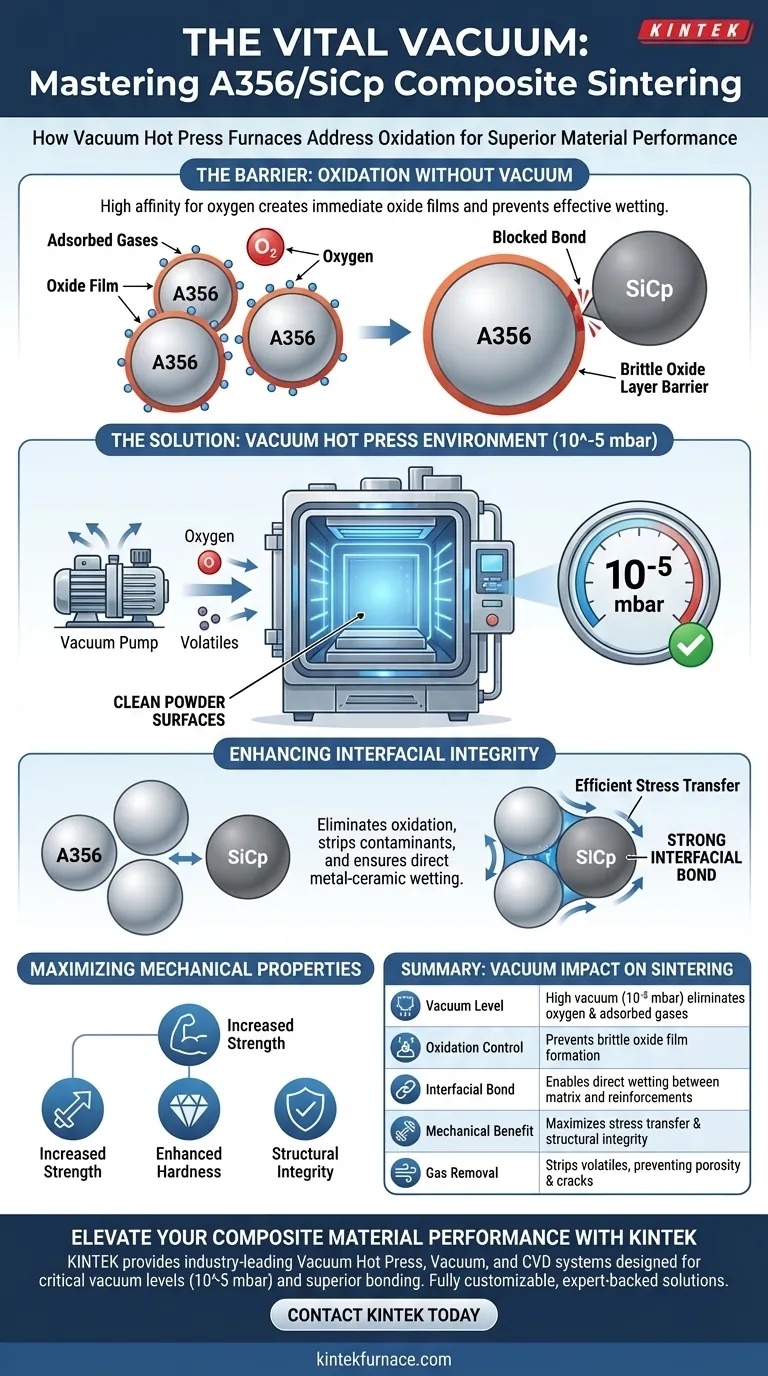
The primary issue addressed by the vacuum environment in a Vacuum Hot Press furnace is the oxidation of the aluminum alloy matrix (A356) at high sintering temperatures.
Because aluminum has a high affinity for oxygen, processing it without a vacuum would create an oxide film on the powder surfaces. The vacuum environment—typically reaching levels around 10^-5 mbar—eliminates oxygen and removes adsorbed gases, ensuring that the metal matrix can bond effectively with the silicon carbide (SiCp) reinforcement particles.
Core Insight By removing oxygen and volatile impurities, the vacuum environment prevents the formation of brittle oxide layers that act as barriers within the material. This purification is the prerequisite for creating a strong interfacial bond, which is the defining factor in the composite's final mechanical strength and structural integrity.
The Barrier of Oxidation
The Sensitivity of A356 Aluminum
The A356 alloy matrix is highly susceptible to oxidation when heated. If oxygen is present during sintering, the aluminum powder surfaces essentially rust instantly, forming a thin but stubborn oxide film.
Blocking the Bond
This oxide film acts as a physical barrier. It prevents the aluminum matrix from wetting and adhering to the Silicon Carbide (SiCp) particles. Without direct contact between the metal and the ceramic, the composite fails to act as a unified material.
Evacuating Adsorbed Gases
The issue is not just the air in the chamber; the raw powders themselves often carry adsorbed gases and volatiles on their surfaces. The vacuum environment actively strips these contaminants away before the material reaches critical sintering temperatures.
Enhancing Interfacial Integrity
Creating a Clean Interface
The vacuum environment functions as a purification step. By maintaining a pressure as low as 10^-5 mbar, the furnace ensures that the environment surrounding the composite is chemically inert.
Minimizing Harmful Reactions
Beyond simple oxidation, the vacuum minimizes complex, harmful interfacial reactions between the matrix and the reinforcements. This stability is crucial for maintaining the purity of the A356 alloy.
Maximizing Mechanical Properties
The ultimate goal of this "clean" processing is mechanical performance. When the oxide barrier is removed, a clean, strong interfacial bond forms. This allows stress to transfer efficiently from the ductile aluminum matrix to the rigid SiC particles, significantly enhancing the composite's strength and hardness.
Understanding the Trade-offs
Process Complexity vs. Material Quality
While the vacuum environment is essential for quality, it introduces complexity. Achieving and maintaining high vacuum levels (10^-5 mbar) requires sophisticated sealing and pumping systems, which increases the cycle time compared to non-vacuum methods.
The Necessity of "clean" Powders
The vacuum is effective, but it is not magic. It relies on the raw materials having a baseline level of purity. If the initial powder is heavily contaminated or pre-oxidized beyond what the vacuum can strip away, the resulting interface will still be compromised.
Making the Right Choice for Your Goal
If your primary focus is Maximum Mechanical Strength: Ensure your process maintains a high vacuum (10^-5 mbar) throughout the heating cycle to guarantee a defect-free, oxide-free interface between the A356 and SiCp.
If your primary focus is Microstructural Uniformity: Leverage the combination of vacuum and hot pressing to prevent porosity and gas entrapment, which eliminates defects that commonly lead to crack initiation.
The vacuum environment is not merely a feature of the furnace; it is the fundamental enabler that allows aluminum composites to achieve their theoretical performance limits.
Summary Table:
| Feature | Impact on A356/SiCp Sintering |
|---|---|
| Vacuum Level | High vacuum (approx. 10^-5 mbar) eliminates oxygen & adsorbed gases. |
| Oxidation Control | Prevents brittle oxide film formation on aluminum powder surfaces. |
| Interfacial Bond | Enables direct wetting between metal matrix and SiC reinforcements. |
| Mechanical Benefit | Maximizes stress transfer, hardness, and structural integrity. |
| Gas Removal | Strips volatiles to prevent porosity and internal crack initiation. |
Elevate Your Composite Material Performance
Achieving the theoretical strength of A356/SiCp composites requires more than just heat; it demands a contamination-free environment. KINTEK provides industry-leading Vacuum Hot Press, Vacuum, and CVD systems designed to reach the critical vacuum levels (10^-5 mbar) necessary to eliminate oxidation and ensure superior interfacial bonding.
Backed by expert R&D and precision manufacturing, our lab high-temp furnaces are fully customizable to meet your unique sintering and material synthesis needs.
Ready to optimize your sintering process? Contact KINTEK today to discuss your custom furnace solution with our technical experts.
Visual Guide
Related Products
- 600T Vacuum Induction Hot Press Vacuum Heat Treat and Sintering Furnace
- Vacuum Heat Treat Sintering Furnace with Pressure for Vacuum Sintering
- Vacuum Hot Press Furnace Machine Heated Vacuum Press Tube Furnace
- 9MPa Air Pressure Vacuum Heat Treat and Sintering Furnace
- Vacuum Hot Press Furnace Machine Heated Vacuum Press
People Also Ask
- Why use Vacuum Hot Press (VHP) for ZnS Ceramics? Achieve Superior IR Transparency and Mechanical Strength
- How does a vacuum hot press sintering furnace mitigate copper sintering swelling? Solve Fe-Cu Expansion Issues
- What are the benefits of using a vacuum hot press sintering furnace for the preparation of SiCw/2024 aluminum matrix composites? Achieve High-Performance Aerospace Materials
- How does the vacuum environment in a vacuum hot press sintering furnace protect chromium-containing ceramics? Find out.
- What are the key advantages of vacuum hot press sintering furnaces? Achieve Superior Density and Purity in Materials



















