
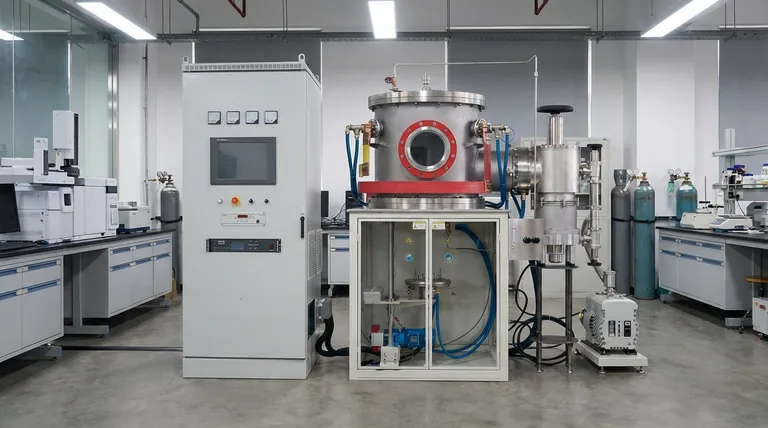
A vacuum hot pressing furnace serves as a synchronized processing environment that applies simultaneous high heat and uniaxial mechanical pressure to raw materials. For Cr2AlC ceramics, its core function is to mechanically force powder particles into close contact to accelerate densification, while the vacuum atmosphere strictly prevents the oxidation of the reactive Chromium and Aluminum components.
The synergistic application of heat and pressure overcomes the natural sintering resistance of MAX phase ceramics like Cr2AlC. This process achieves near-theoretical density and superior mechanical properties at temperatures significantly lower than those required for conventional pressureless sintering.
Driving Densification Through Mechanical Pressure
The primary advantage of this technology is the application of axial pressure during the heating phase. This mechanical force acts as a catalyst for physical changes that heat alone cannot easily achieve.
Facilitating Particle Rearrangement
Before the ceramic particles bond chemically, they must physically pack together. The applied pressure forces the loose powder particles to rearrange, significantly reducing the volume of empty spaces (pores) between them early in the process.
Inducing Plastic Flow
Under high temperature and pressure, the Cr2AlC ceramic particles undergo plastic flow. The solid material effectively deforms to fill the remaining voids, leading to a rapid increase in density.
Lowering Thermal Requirements
By adding mechanical energy to the system, the furnace reduces the thermal energy required for densification. This allows Cr2AlC to reach high relative densities (often exceeding 95.5%) at temperatures lower than standard sintering would require, which helps preserve the material's microstructure.
The Critical Role of the Vacuum Environment
While pressure drives the physical densification, the vacuum environment is essential for the chemical integrity of Cr2AlC ceramics.
Preventing Oxidation of Reactive Elements
Cr2AlC contains Chromium and Aluminum, both of which are highly susceptible to oxidation at sintering temperatures. The vacuum environment removes oxygen, ensuring these elements remain in their pure metallic or ceramic forms rather than degrading into unwanted oxides.
Eliminating Pore-Forming Gases
Residual gases trapped within the powder pores can inhibit densification and create weak points. The vacuum acts to extract these gases, allowing the pores to close completely and resulting in a pore-free, near-theoretical density.
Enhancing Atomic Diffusion
The combination of a clean vacuum environment and high pressure promotes atomic diffusion. Atoms move across the boundaries of the powder particles more freely, fusing them together to create a solid, cohesive material with superior mechanical strength.
Understanding the Trade-offs
While vacuum hot pressing is superior for densification, it requires rigorous process control to avoid defects.
Sensitivity to Process Parameters
Success is not automatic; it relies on the precise tailoring of parameters. The heating rate, pressure levels (e.g., 28–40 MPa), and holding times must be synchronized. Incorrect settings can lead to incomplete densification or microstructural damage.
Uniaxial Limitations
The pressure applied is uniaxial (from one direction). While excellent for simple shapes like discs or plates, this directional force can sometimes result in density gradients or anisotropy (different properties in different directions) if the aspect ratio of the sample is too high.
Grain Growth Management
While the process generally suppresses grain growth due to lower processing temperatures, leaving the material at peak temperature for too long—even under pressure—can still result in excessive grain coarsening, which reduces strength.
Making the Right Choice for Your Goal
To maximize the utility of a vacuum hot pressing furnace for Cr2AlC ceramics, align your process parameters with your specific end goals.
- If your primary focus is maximum density: Prioritize the synchronization of peak temperature with maximum axial pressure (e.g., up to 40 MPa) to maximize plastic flow and eliminate final porosity.
- If your primary focus is compositional purity: Ensure the vacuum level is established and stable (e.g., 10^-1 Pa or better) before heating begins to fully protect the Aluminum and Chromium content from oxidation.
- If your primary focus is mechanical strength: Carefully control the cooling rate and dwell time to inhibit grain growth, as a finer microstructure yields better toughness.
By leveraging the dual-action of pressure and vacuum, you transform loose powder into a high-performance ceramic that is both chemically pure and mechanically robust.
Summary Table:
| Core Function | Mechanism | Impact on Cr2AlC Ceramics |
|---|---|---|
| Uniaxial Pressure | Facilitates particle rearrangement & plastic flow | Achieves >95.5% density at lower temperatures |
| Vacuum Environment | Removes oxygen and residual gases | Prevents oxidation of Cr/Al & eliminates internal pores |
| Heat Treatment | Promotes atomic diffusion across boundaries | Fuses particles into a cohesive, high-strength solid |
| Process Control | Precise synchronization of ramp rates & dwell | Preserves microstructure and inhibits grain growth |
Elevate Your Material Research with KINTEK Precision
Unlock the full potential of MAX phase ceramics like Cr2AlC with KINTEK’s advanced thermal solutions. Backed by expert R&D and world-class manufacturing, we provide high-performance Vacuum, Muffle, Tube, Rotary, and CVD systems—all fully customizable to meet your specific densification and sintering requirements.
Whether you need to eliminate porosity or prevent oxidation in reactive materials, our technical team is ready to design the perfect furnace for your laboratory or industrial application. Contact us today to discuss your unique needs and see how KINTEK can enhance your lab's efficiency.
References
- Zhihui Li, Min Du. Reduced graphene oxide/MXene hybrid decorated graphite felt as an effective electrode for vanadium redox flow battery. DOI: 10.1039/d4ra01306a
This article is also based on technical information from Kintek Furnace Knowledge Base .
Related Products
- 600T Vacuum Induction Hot Press Vacuum Heat Treat and Sintering Furnace
- Vacuum Hot Press Furnace Machine for Lamination and Heating
- Vacuum Hot Press Furnace Machine Heated Vacuum Press
- Vacuum Hot Press Furnace Machine Heated Vacuum Press Tube Furnace
- High Pressure Laboratory Vacuum Tube Furnace
People Also Ask
- Why use Vacuum Hot Press (VHP) for ZnS Ceramics? Achieve Superior IR Transparency and Mechanical Strength
- How does a vacuum hot press sintering furnace mitigate copper sintering swelling? Solve Fe-Cu Expansion Issues
- What are the key advantages of vacuum hot press sintering furnaces? Achieve Superior Density and Purity in Materials
- What is the core function of a vacuum hot press sintering furnace in the preparation of high-density RuTi alloys? Achieve Maximum Density and Purity
- How does the vacuum environment in a vacuum hot press sintering furnace protect chromium-containing ceramics? Find out.



















