
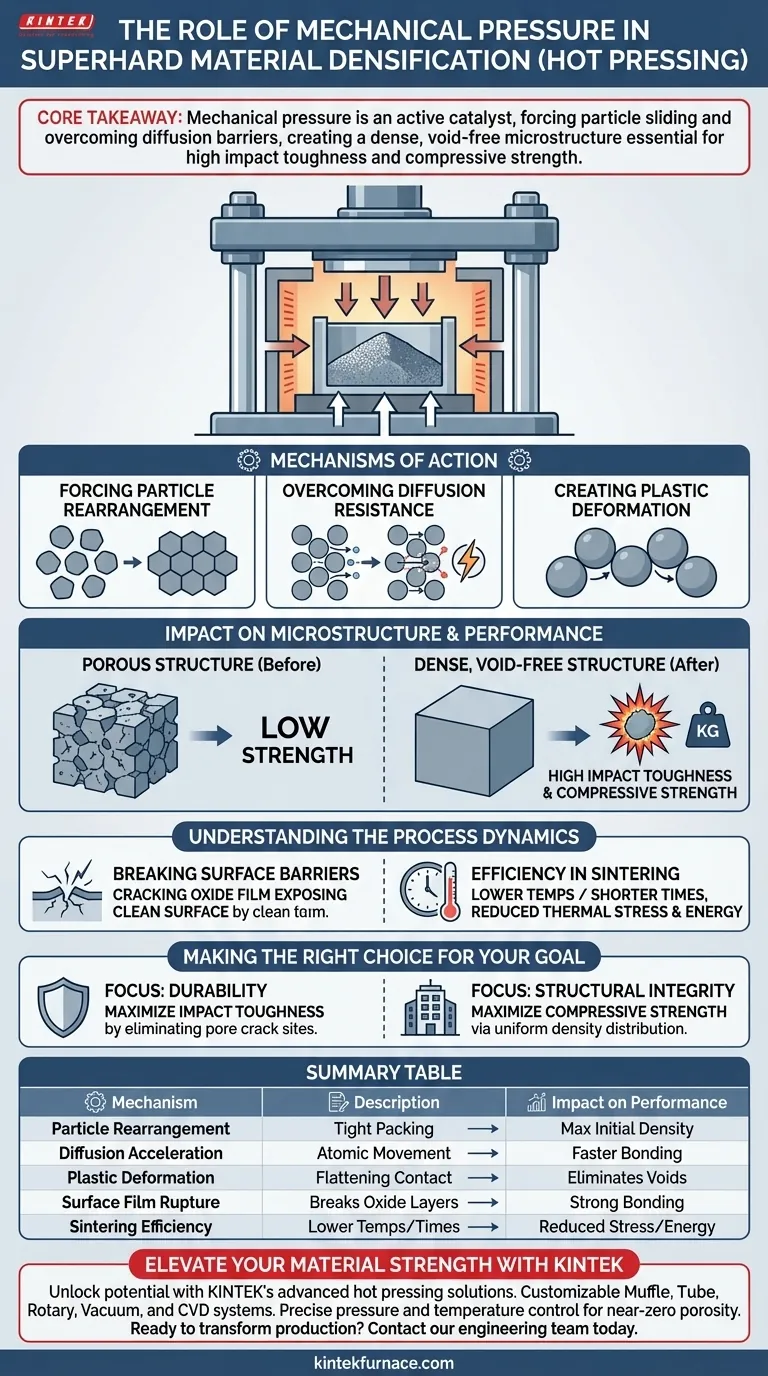
The mechanical pressure applied by the hot pressing mechanism acts as a critical driver for densification, moving beyond simple heating to actively force physical changes within the material. By compressing the powder matrix during high-temperature sintering, this pressure forces particles to rearrange and overcomes the natural resistance to diffusion. The immediate result is the effective elimination of microscopic pores, pushing the material toward near-zero porosity.
Core Takeaway Mechanical pressure serves as an active catalyst that forces particle sliding and overcomes diffusion barriers, rather than waiting for passive sintering to occur. This direct force creates a dense, void-free microstructure that is essential for achieving high impact toughness and compressive strength in superhard materials.
Mechanisms of Action
Forcing Particle Rearrangement
The primary function of the applied mechanical pressure is to physically compel the powder particles to move. During the initial stages of sintering, particles often sit in a loose arrangement. The external force overcomes friction, causing the particles to slide and rearrange into a significantly tighter packing configuration.
Overcoming Diffusion Resistance
Diffusion—the movement of atoms to bond particles together—naturally faces resistance. Mechanical pressure provides the necessary energy to overcome this resistance. This ensures that atoms can migrate effectively across particle boundaries, accelerating the bonding process.
Creating Plastic Deformation
Beyond simple movement, the pressure is strong enough to cause plastic deformation in the particles. This deformation increases the contact area between individual granules. By flattening contact points, the process eliminates gaps that would otherwise remain as voids.
Impact on Microstructure and Performance
Elimination of Microscopic Pores
The most significant structural outcome of this pressure is the eradication of porosity. The force squeezes out voids and compels the material matrix (whether solid or semi-solid) to flow into any remaining gaps. This results in a microstructure with porosity levels close to zero, effectively creating a solid, continuous block.
Enhancing Mechanical Properties
The density achieved through this method directly translates to superior performance. Because the microstructure lacks the weak points caused by pores, the material exhibits significantly higher impact toughness. Additionally, the compact structure dramatically improves compressive strength, allowing the product to withstand immense loads without failure.
Understanding the Process Dynamics
Breaking Surface Barriers
In many material systems, particles are coated in oxide films that hinder bonding. The shear force generated by mechanical pressure helps rupture these films. This exposes clean surfaces, promoting direct particle-to-particle contact and stronger diffusion bonding.
Efficiency in Sintering
Pressure-assisted sintering is not just more effective; it is often more efficient. The application of force allows for densification at lower temperatures or shorter holding times compared to pressureless methods. This reduces the thermal stress on the material and lowers energy consumption while still achieving high relative density.
Making the Right Choice for Your Goal
Mechanical pressure is the defining factor in distinguishing high-performance superhard materials from standard sintered products.
- If your primary focus is Durability: High mechanical pressure is essential to eliminate pores that act as crack initiation sites, thereby maximizing impact toughness.
- If your primary focus is Structural Integrity: The forced rearrangement ensures a uniform density distribution, which is critical for achieving maximum compressive strength.
By integrating mechanical pressure, you transform a loose powder assembly into a cohesive, high-strength component capable of surviving extreme operational environments.
Summary Table:
| Mechanism of Action | Description | Impact on Performance |
|---|---|---|
| Particle Rearrangement | Forces loose powders into a tighter packing configuration | Maximizes initial density |
| Diffusion Acceleration | Overcomes resistance to atomic movement across boundaries | Accelerates particle bonding |
| Plastic Deformation | Flattens contact points to increase granule contact area | Eliminates residual voids |
| Surface Film Rupture | Breaks oxide layers through mechanical shear force | Promotes clean, strong bonding |
| Sintering Efficiency | Enables densification at lower temperatures/shorter times | Reduces thermal stress & energy |
Elevate Your Material Strength with KINTEK
Unlock the full potential of your superhard materials with KINTEK’s advanced hot pressing solutions. Backed by expert R&D and world-class manufacturing, KINTEK offers customizable Muffle, Tube, Rotary, Vacuum, and CVD systems tailored to your specific lab and high-temperature furnace needs.
Whether you are aiming for near-zero porosity or superior impact toughness, our systems provide the precise pressure and temperature control necessary for mission-critical densification.
Ready to transform your production? Contact our engineering team today to discuss your unique project requirements and see how our tailored thermal technology can optimize your results.
Visual Guide
Related Products
- Vacuum Hot Press Furnace Machine Heated Vacuum Press
- Vacuum Hot Press Furnace Machine for Lamination and Heating
- Vacuum Hot Press Furnace Machine Heated Vacuum Press Tube Furnace
- 600T Vacuum Induction Hot Press Vacuum Heat Treat and Sintering Furnace
- Vacuum Heat Treat Sintering Furnace with Pressure for Vacuum Sintering
People Also Ask
- What are the primary components of a vacuum hot press furnace? Master the Core Systems for Precise Material Processing
- What safety features are incorporated in vacuum hot press furnaces? Ensure Operator and Equipment Protection
- What are the benefits of the vacuum environment system in a vacuum hot press furnace? Unlock High-Density Sintering
- What types of heating elements are used in vacuum hot press furnaces? Optimize for High-Temp Performance
- What are the core advantages of using a vacuum hot press furnace? Achieve Near-Forged Density for Ti-6Al-4V Alloys






