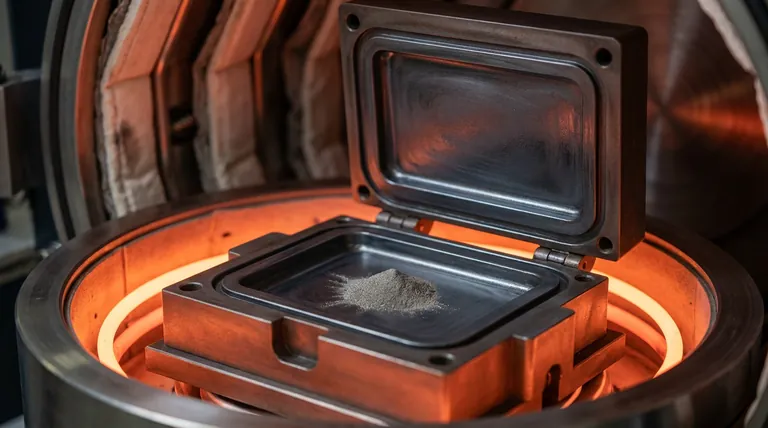
Molybdenum Disulfide (MoS2) functions primarily as a high-temperature solid lubricant and distinct isolation barrier within the sintering environment. Applied to the inner walls of molds and press heads, it creates a physical shield that prevents the sintering powder from bonding chemically or physically to the mold under extreme heat and pressure.
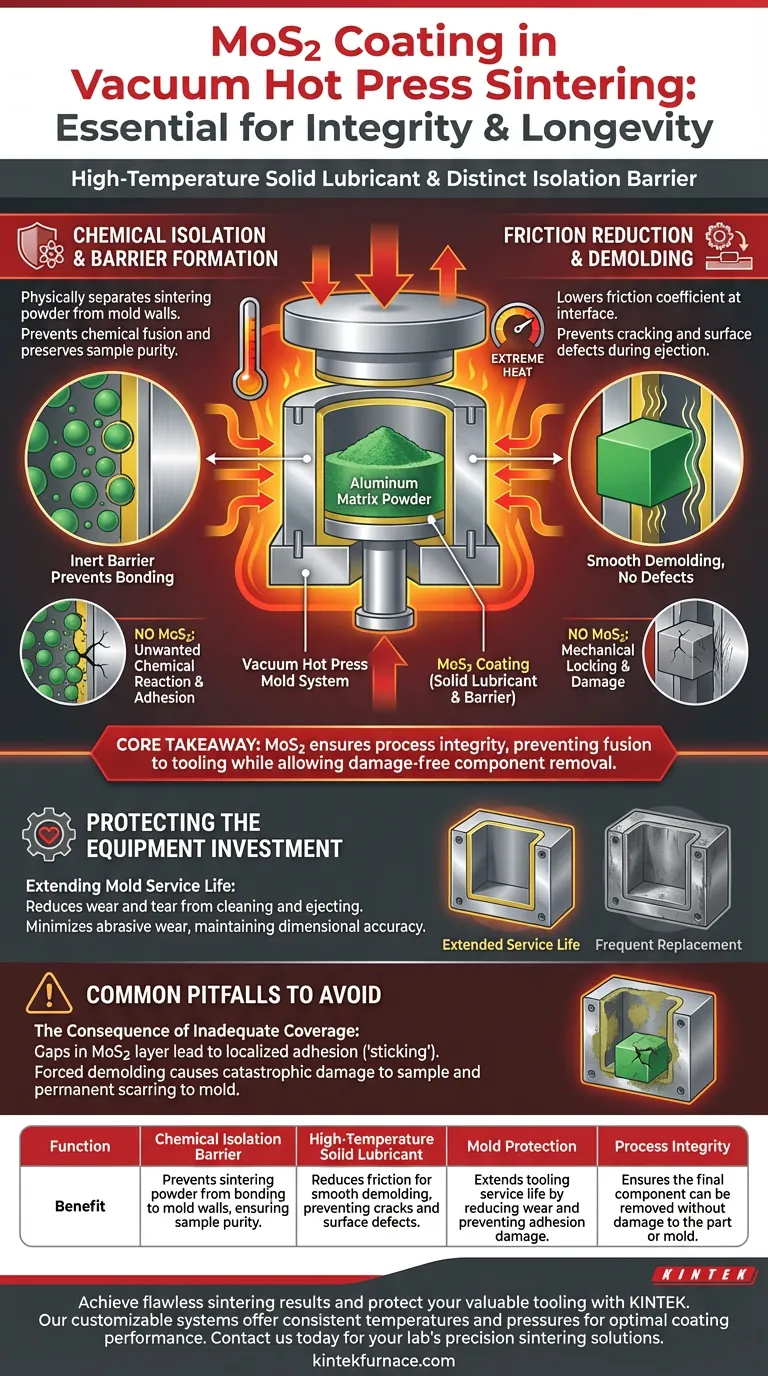
Core Takeaway: MoS2 is essential for process integrity; it prevents the chemical fusion of the workpiece to the tooling while simultaneously lowering friction to ensure the final component can be removed without damage.
The Mechanisms of Protection
Chemical Isolation and Barrier Formation
In vacuum hot press sintering, high temperatures and pressures create an environment ripe for unwanted chemical reactions.
MoS2 acts as an inert barrier. It physically separates the sintering powder—specifically materials like aluminum matrix powders—from the mold walls.
Without this isolation, the matrix powder would likely react with or adhere to the mold material, compromising both the sample's purity and the mold's surface.
Friction Reduction and Demolding
Beyond chemical isolation, MoS2 serves a critical mechanical function as a solid lubricant.
During the sintering process, materials densify and can become mechanically locked against the tooling.
The coating lowers the coefficient of friction at the interface, ensuring smooth demolding. This allows the sintered sample to be ejected cleanly, preventing cracking or surface defects on the finished part.
Protecting the Equipment Investment
Extending Mold Service Life
Molds used in hot pressing are often precision-machined and expensive components.
By preventing the adhesion of metal powders, MoS2 reduces the wear and tear associated with cleaning and ejecting stuck parts.
This protective layer effectively extends the service life of the mold, reducing the frequency of tooling replacement and maintaining dimensional accuracy over time.
Common Pitfalls to Avoid
The Consequence of Inadequate Coverage
The primary risk in this process is failing to achieve a uniform coating.
If gaps exist in the MoS2 layer, the aluminum matrix powder will directly contact the mold.
This leads to localized adhesion or "sticking." Once adhesion occurs, forced demolding can cause catastrophic damage to the sample and permanent scarring to the mold surface, rendering it unusable for future precision work.
Making the Right Choice for Your Goal
To maximize the success of your sintering run, focus on what you need the coating to protect most.
- If your primary focus is Sample Integrity: Ensure thorough coverage to prevent chemical reactions between the aluminum matrix and the mold, which guarantees a pure surface finish.
- If your primary focus is Equipment Longevity: Prioritize consistent re-application of MoS2 between cycles to minimize abrasive wear and prevent powder adhesion that degrades mold tolerance.
By treating the MoS2 coating as a critical process step rather than an afterthought, you safeguard both your product and your tooling assets.
Summary Table:
| Function | Benefit |
|---|---|
| Chemical Isolation Barrier | Prevents sintering powder from bonding to mold walls, ensuring sample purity. |
| High-Temperature Solid Lubricant | Reduces friction for smooth demolding, preventing cracks and surface defects. |
| Mold Protection | Extends tooling service life by reducing wear and preventing adhesion damage. |
| Process Integrity | Ensures the final component can be removed without damage to the part or mold. |
Achieve flawless sintering results and protect your valuable tooling. The right furnace system is crucial for applying consistent temperatures and pressures where coatings like MoS2 perform optimally. Backed by expert R&D and manufacturing, KINTEK offers Muffle, Tube, Rotary, Vacuum, and CVD systems, all customizable for unique needs. Contact us today (#ContactForm) to find the perfect high-temperature furnace solution for your lab's precision sintering applications.
Visual Guide
Related Products
- Molybdenum Disilicide MoSi2 Thermal Heating Elements for Electric Furnace
- Molybdenum Vacuum Heat Treat Furnace
- Vacuum Heat Treat Sintering Furnace Molybdenum Wire Vacuum Sintering Furnace
People Also Ask
- What are the typical application temperatures for molybdenum disilicide (MoSi2) heating elements? Master High-Temp Performance
- What is the primary use of molybdenum disilicide? Ideal for High-Temp Heating Elements
- What are the characteristics of molybdenum disilicide heating elements? Unlock High-Temp Performance
- What are the properties of molybdenum disilicide (MoSi2) that make it suitable for high-temperature applications? Discover Its High-Temp Resilience
- What are the applications of molybdenum disilicide heating elements? Achieve Extreme Heat Stability for Industrial Processes