
High-vacuum hot press sintering fundamentally transforms the consolidation of Al2O3/TiC ceramics by integrating three critical variables: high temperature, a controlled vacuum, and uniaxial mechanical pressure. While traditional equipment relies solely on thermal energy to bond particles, this method uses physical force to drive material densification, resulting in superior mechanical properties that are difficult to achieve through pressureless sintering.
Core Insight: The primary advantage of this technology is the ability to achieve near-theoretical density at lower temperatures. By substituting thermal energy with mechanical pressure, you bypass the high-heat thresholds that trigger abnormal grain growth, ensuring the final ceramic is not only denser but significantly tougher and harder.
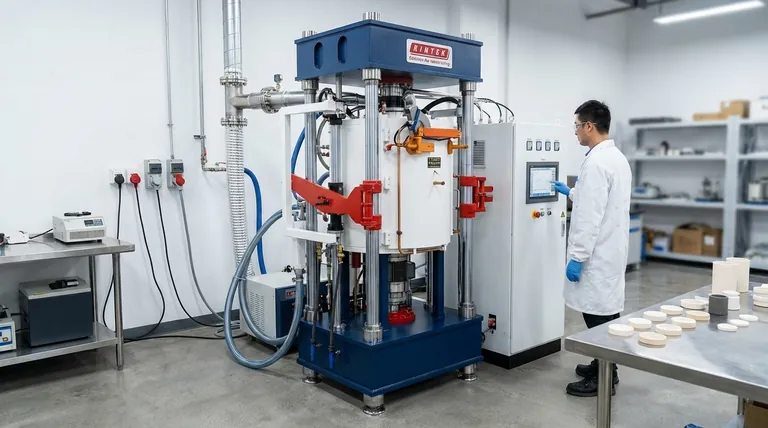
The Mechanics of Superior Densification
Driving Plastic Flow and Rearrangement
In traditional sintering, densification relies on the slow process of diffusion. A hot press furnace applies direct mechanical pressure, acting as an additional driving force for sintering.
This pressure forces particles to rearrange physically and induces plastic flow at the microscopic level. This mechanism effectively closes internal pores and voids that thermal energy alone often fails to eliminate.
Lowering the Sintering Temperature
Because mechanical pressure assists in bonding, the material does not require extreme thermal loads to densify.
This allows the Al2O3/TiC ceramic to reach full density at significantly lower temperatures than traditional methods require. Reducing the thermal load is critical for preserving the integrity of the material's microstructure.
Optimizing Microstructure and Purity
Suppressing Abnormal Grain Growth
High temperatures in traditional furnaces often cause grains to grow uncontrollably, which drastically reduces the fracture toughness of the ceramic.
By enabling low-temperature densification, the hot press method effectively suppresses abnormal grain growth. This results in a fine-grained structure, which is directly correlated with higher hardness and improved wear resistance.
Protecting Non-Oxide Components
Al2O3/TiC composites contain non-oxide elements (Titanium Carbide) that are highly susceptible to degradation when exposed to oxygen.
The high-vacuum environment inhibits oxidation and decarburization during the heating cycle. This preserves the chemical stoichiometry of the TiC phase, ensuring the material retains its intended hardness and conductive properties.
Enhancing Interfacial Bonding
The vacuum actively removes residual gases trapped in the sintering necks (the contact points between particles).
By eliminating these gas pockets and preventing surface contamination, the furnace ensures stronger interfacial bonding between the alumina and titanium carbide layers. This creates a more cohesive internal structure that is less prone to cracking under stress.
Process Efficiency and Control
Integrating Forming and Sintering
Traditional powder metallurgy often requires separate steps for pressing (forming) and heating (sintering), sometimes involving binders that must be burned out.
Vacuum hot pressing combines these into a single integrated operation. This streamlines the workflow, reducing cycle times and eliminating the need for complex multi-step annealing processes.
Precision and Repeatability
These systems utilize advanced automation to monitor pressure and temperature with high accuracy.
The vacuum environment, combined with insulation, ensures uniform heating across the sample. This eliminates thermal gradients that can cause warping or inconsistent mechanical properties in the final part.
Understanding the Trade-offs
Geometry Limitations
The uniaxial nature of the pressure means this method is best suited for simple geometries, such as plates, discs, or cylinders. Complex, net-shape parts with undercuts are generally not feasible without extensive post-process machining.
Throughput and Cost
Hot pressing is inherently a batch process, limiting production volume compared to continuous belt furnaces. Additionally, the graphite tooling required for the molds wears out over time and adds to the operational cost.
Making the Right Choice for Your Goal
This technology is not a universal replacement for all sintering but is the specific solution for high-performance requirements.
- If your primary focus is Maximum Fracture Toughness: The suppression of grain growth provided by this method is essential for critical structural applications.
- If your primary focus is Material Purity: The vacuum environment is non-negotiable for preventing the oxidation of the TiC component.
- If your primary focus is Geometric Complexity: You may need to consider pressureless sintering or HIP (Hot Isostatic Pressing) instead, as hot pressing is limited to simple shapes.
Summary: Use high-vacuum hot press sintering when the mechanical integrity and theoretical density of your Al2O3/TiC ceramic are more critical than high-volume throughput or geometric complexity.
Summary Table:
| Feature | Traditional Sintering | High-Vacuum Hot Pressing |
|---|---|---|
| Driving Force | Thermal energy only | Thermal energy + Mechanical pressure |
| Operating Temp | High (triggers grain growth) | Lower (preserves fine grain) |
| Environment | Ambient or inert gas | High vacuum (prevents oxidation) |
| Porosity | Higher residual porosity | Near-zero (theoretical density) |
| Grain Structure | Prone to abnormal growth | Fine-grained & uniform |
| Complexity | High geometric flexibility | Limited to simple shapes |
Elevate Your Material Performance with KINTEK
Precision engineering in Al2O3/TiC production demands absolute control over temperature, pressure, and atmosphere. Backed by expert R&D and manufacturing, KINTEK offers high-performance Vacuum, Muffle, Tube, and CVD systems, specifically optimized for advanced ceramic sintering. Whether you require standard solutions or a customizable system tailored to your unique research needs, our lab high-temp furnaces provide the uniform heating and repeatability necessary for theoretical density.
Ready to optimize your sintering process? Contact our technical experts today to find your perfect furnace solution.
References
- Alejandro Padilla-González, I.A. Figueroa. Development and Mechanical Characterization of a CoCr-Based Multiple-Principal-Element Alloy. DOI: 10.1007/s13632-024-01111-z
This article is also based on technical information from Kintek Furnace Knowledge Base .
Related Products
- 9MPa Air Pressure Vacuum Heat Treat and Sintering Furnace
- 600T Vacuum Induction Hot Press Vacuum Heat Treat and Sintering Furnace
- 2200 ℃ Tungsten Vacuum Heat Treat and Sintering Furnace
- 2200 ℃ Graphite Vacuum Heat Treat Furnace
- Vacuum Heat Treat Sintering Furnace with Pressure for Vacuum Sintering
People Also Ask
- What are the key features of vacuum pressure sintering furnaces? Unlock High-Purity, Dense Materials
- What materials can be processed using vacuum pressure sintering furnaces? Unlock High-Performance Material Densification
- What safety features are integrated into vacuum pressure sintering furnaces? Ensure Operator and Equipment Protection
- What are the key components of a vacuum pressure sintering furnace? Essential Systems for High-Performance Materials
- What are the main technical parameters of vacuum pressure sintering furnaces? Key Specs for Advanced Materials



















