
Spark Plasma Sintering (SPS) fundamentally outperforms traditional hot-pressing for Al2O3-TiC composites by utilizing a pulsed electric current to generate heat directly within the mold and sample. This internal heating mechanism enables exceptionally rapid heating rates and short holding times. By densifying the material faster than the grains can coarsen, SPS produces an ultra-fine grain structure that significantly enhances both hardness and fracture toughness.
The core advantage of SPS lies in breaking the traditional trade-off between density and grain size; it achieves near-theoretical density while "freezing" the microstructure in a fine-grained state.
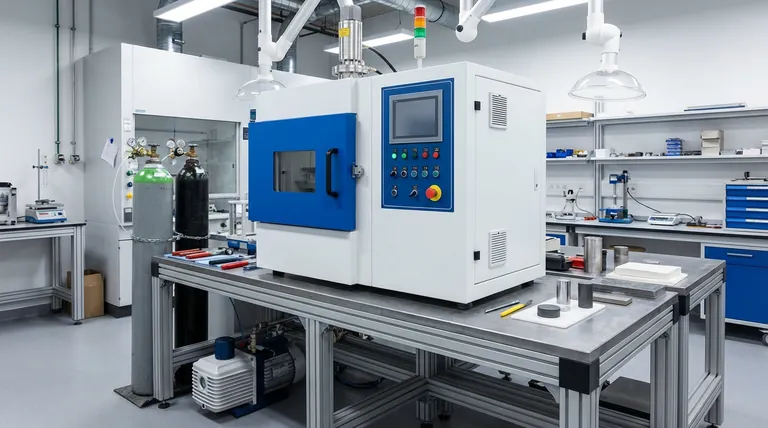
The Mechanism: Internal Joule Heating vs. External Conduction
Direct Energy Transfer
Unlike traditional hot-pressing, which relies on external heating elements to slowly warm the chamber, SPS passes a pulsed electric current directly through the graphite mold and the sample itself.
The Joule Heating Effect
This current generates Joule heat internally throughout the material volume. Because the heat is generated from within rather than conducted from the outside, the process achieves extreme thermal efficiency.
Rapid Temperature Escalation
Consequently, SPS achieves extremely high heating rates that are unattainable with conventional hot-pressing. This dramatically reduces the total cycle time, often completing densification in minutes rather than hours.
Impact on Microstructure
Inhibiting Grain Growth
The most critical technical benefit for Al2O3 (Aluminum Oxide) matrices is the suppression of grain coarsening. In traditional slow-heating processes, Al2O3 grains tend to grow significantly, which can weaken the material.
Preserving Ultra-Fine Structures
Because the sintering time in SPS is so short, the material reaches full density before the grains have time to expand. This retains an ultra-fine grain structure that is nearly impossible to reproduce with standard hot-pressing.
High-Density Consolidation
Despite the speed, SPS utilizes mechanical pressure (similar to hot-pressing) to ensure particle rearrangement and plastic flow. This ensures the composite maintains high material density, eliminating porosity without sacrificing microstructural integrity.
Resulting Mechanical Properties
Enhanced Hardness
The reduction in grain size directly correlates to increased material hardness (Hall-Petch relationship). By keeping the Al2O3 grains small, the composite resists deformation more effectively.
Improved Fracture Toughness
SPS-produced Al2O3-TiC exhibits superior fracture toughness compared to hot-pressed variants. The fine microstructure creates a more tortuous path for crack propagation, making the ceramic composite more durable under stress.
Understanding the Trade-offs
Scalability Limitations
While SPS offers superior material properties, it often faces challenges with scaling. The requirement to pass high current through the mold can make producing very large or complex-shaped components more difficult compared to the uniform thermal environment of a large vacuum hot press.
Equipment Complexity
SPS systems are generally more complex and can be more expensive per unit of volume than standard resistance-heated hot presses. This makes SPS best suited for high-performance applications where the specific mechanical gains justify the processing cost.
Making the Right Choice for Your Goal
When selecting between SPS and Hot Pressing for Al2O3-TiC production, consider your specific performance requirements:
- If your primary focus is Maximum Mechanical Performance: Choose SPS. The internal Joule heating guarantees the finest grain size, yielding the highest possible hardness and fracture toughness for critical wear parts.
- If your primary focus is Large-Scale Bulk Production: Consider Vacuum Hot Pressing. While grain size may be coarser, it allows for larger batch processing and sufficient density for less critical applications where the ultimate mechanical limits are not required.
For high-performance Al2O3-TiC composites, SPS is the definitive choice for maximizing longevity and structural integrity.
Summary Table:
| Feature | Spark Plasma Sintering (SPS) | Traditional Hot-Pressing |
|---|---|---|
| Heating Mechanism | Internal Joule Heating (Pulsed Current) | External Radiant/Conductive Heating |
| Heating Rate | Extremely Rapid | Slow and Gradual |
| Process Duration | Minutes | Hours |
| Grain Structure | Ultra-Fine (Grain Growth Inhibited) | Coarser (Due to Long Heat Exposure) |
| Mechanical Result | Maximum Hardness & Toughness | Standard Industrial Properties |
Unlock the Full Potential of Your Material Science with KINTEK
Are you looking to break the trade-off between material density and grain size? KINTEK provides industry-leading thermal solutions, including advanced SPS, Vacuum Hot Press, and CVD systems, engineered to deliver precision for your most demanding applications.
Backed by expert R&D and world-class manufacturing, our customizable high-temperature furnaces empower researchers and manufacturers to achieve near-theoretical density and superior microstructures.
Ready to elevate your production quality? Contact our technical experts today to find the perfect sintering solution for your Al2O3-TiC composites and beyond.
References
- Zara Cherkezova‐Zheleva, Radu Robert Piticescu. Green and Sustainable Rare Earth Element Recycling and Reuse from End-of-Life Permanent Magnets. DOI: 10.3390/met14060658
This article is also based on technical information from Kintek Furnace Knowledge Base .
Related Products
- Spark Plasma Sintering SPS Furnace
- Chairside Dental Porcelain Zirconia Sintering Furnace with Transformer for Ceramic Restorations
- 9MPa Air Pressure Vacuum Heat Treat and Sintering Furnace
- Dental Porcelain Zirconia Sintering Ceramic Vacuum Press Furnace
- Small Vacuum Heat Treat and Tungsten Wire Sintering Furnace
People Also Ask
- Why is it necessary to maintain a high vacuum environment during the SPS of SiC? Key to High-Density Ceramics
- How does the heating mechanism of Spark Plasma Sintering (SPS) function? Enhance TiC/SiC Composite Fabrication
- What are the steps in the discharge plasma sintering process? Master Fast, High-Density Material Consolidation
- What are the advantages of spark plasma sintering (SPS) over traditional forging? Precision Microstructural Control
- What is unique about the heating mechanism of a Spark Plasma Sintering (SPS) furnace when preparing nanostructured h-BN ceramics? Achieve Ultra-Fast Densification and Suppress Grain Growth



















