
Beyond merely defining geometry, a graphite mold functions as the primary interface for transferring both mechanical force and thermal energy to the sample. It acts as a robust transmission vessel that converts hydraulic power into material densification while ensuring the uniform heat distribution necessary for structural integrity.
Core Insight The graphite mold is not a passive shape-holder; it is an active tool responsible for driving densification through precise pressure transmission and thermal conduction. Its ability to maintain structural stability under extreme heat directly dictates whether the material achieves a dense, uniform microstructure or suffers from porosity and defects.
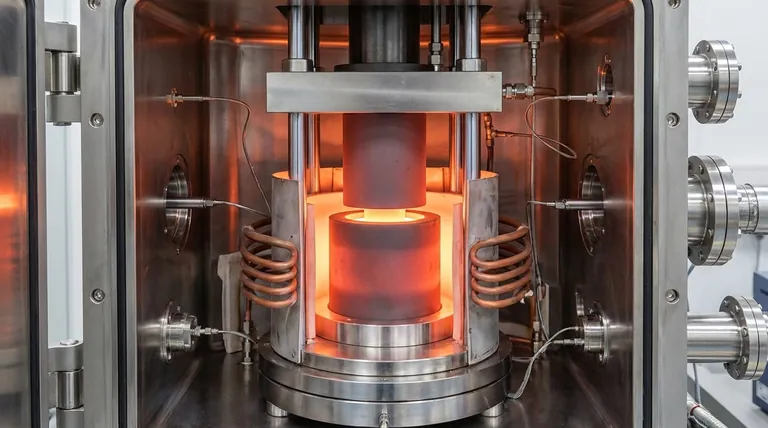
Transmitting Mechanical Force for Densification
The Medium for Axial Pressure
In vacuum hot pressing, the mold serves as the critical link between the machine's hydraulic system and the powder body. It must effectively transmit significant uniaxial pressure (often ranging from 20 to 30 MPa) directly to the material.
Driving Particle Rearrangement
This transmission of pressure is not static; it is an active driver of the sintering process. The force applied by the mold induces particle rearrangement and plastic deformation within the powder.
Achieving High Density
By forcing particles closer together while they are thermally softened, the mold facilitates the elimination of voids. This mechanical assistance is essential for achieving high densification that thermal sintering alone cannot provide.
Ensuring Thermal Uniformity
Acting as a Thermal Conduit
Graphite possesses superior thermal conductivity, which allows the mold to act as an efficient heat transfer medium. It ensures that thermal energy is conducted uniformly into the center of the sample, preventing thermal gradients.
The Role of Heating Element
In specific setups, such as induction heating modes, the graphite mold effectively acts as the heating element itself. It couples with the electromagnetic field to generate heat, which is then transferred to the non-conductive ceramic or powder inside.
Stability at Extreme Temperatures
The mold must maintain its dimensional stability and strength at sintering temperatures that can exceed 1500°C. This high-temperature resistance prevents the mold from deforming, ensuring the sample retains its intended shape and density throughout the thermal cycle.
Understanding the Trade-offs: Carbon Diffusion
The Mold as a Carbon Source
While graphite is excellent for thermal and mechanical transfer, it introduces a chemical variable: carbon. At high temperatures, the mold acts as a carbon source, where carbon ions may diffuse into the sample.
Risk of Impurity Bands
This diffusion is particularly critical at grain boundaries, where carbon accumulation can form impurity bands. If left unchecked, this can alter the chemical composition and mechanical properties of the sintered material.
Necessity of Process Control
Operators must balance the benefits of graphite against this diffusion effect. Controlling grain growth and sintering time is often required to suppress carbon migration and maintain material purity.
Making the Right Choice for Your Goal
To optimize your vacuum hot pressing process, consider how the mold's functions align with your specific material requirements:
- If your primary focus is Maximum Density: Prioritize the mold's structural strength to ensure it can withstand and transmit the maximum required pressure (e.g., >30 MPa) without deformation.
- If your primary focus is Material Purity: You must account for the mold acting as a carbon source; consider using barrier coatings or optimizing thermal cycles to minimize carbon diffusion at grain boundaries.
- If your primary focus is Structural Homogeneity: Rely on the high thermal conductivity of the graphite to prevent thermal shock, ensuring the core and surface of the sample sinter at the same rate.
The graphite mold is the engine of the hot pressing process, bridging the gap between raw powder and a fully dense, high-performance solid.
Summary Table:
| Function | Role in Sintering Process | Impact on Material Quality |
|---|---|---|
| Pressure Transmission | Converts hydraulic power into uniaxial axial force. | Drives particle rearrangement and eliminates voids for high density. |
| Thermal Conduction | Distributes heat uniformly into the sample core. | Prevents thermal gradients and ensures structural homogeneity. |
| Induction Heating | Acts as a heating element in electromagnetic fields. | Enables rapid and efficient heating of non-conductive materials. |
| Carbon Source | Provides carbon ions that can diffuse into the sample. | Influences chemical purity; requires control of grain boundary migration. |
| Structural Stability | Maintains shape and strength at temperatures >1500°C. | Ensures dimensional accuracy and prevents sample deformation. |
Elevate Your Material Precision with KINTEK
Don't let subpar tooling compromise your sintering results. KINTEK’s high-performance vacuum hot pressing systems are designed to work in perfect harmony with precision-engineered graphite molds, ensuring maximum densification and thermal uniformity for your most demanding lab applications.
Backed by expert R&D and manufacturing, KINTEK offers Muffle, Tube, Rotary, Vacuum, and CVD systems, all customizable to your unique research needs. Whether you are aiming for maximum density or high-purity grain structures, our technical team is ready to provide the right solution.
Contact KINTEK today to optimize your sintering process!
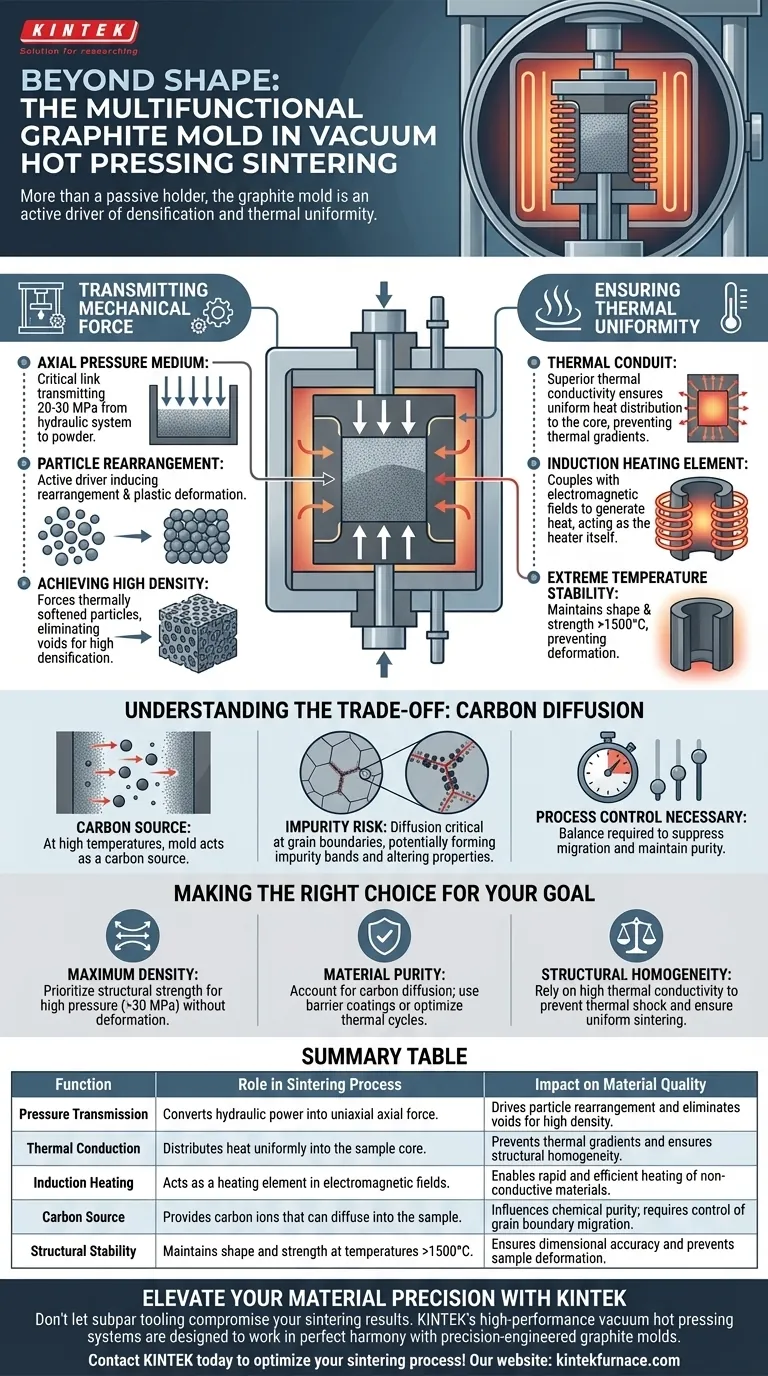
Visual Guide
Related Products
People Also Ask
- Why are vacuum heat treating furnaces essential for aerospace? Ensure Superior Material Integrity for High-Stakes Applications
- What is the primary application of vacuum heat treating furnaces in aerospace? Enhance Component Performance with Precision
- What is the process of vacuum heat treating? Achieve Superior Metallurgical Properties
- How does vacuum heat treating work in terms of temperature and time control? Master Precise Material Transformations
- How does a vacuum heat treating furnace improve the condition of metal alloys? Achieve Superior Metal Performance
