
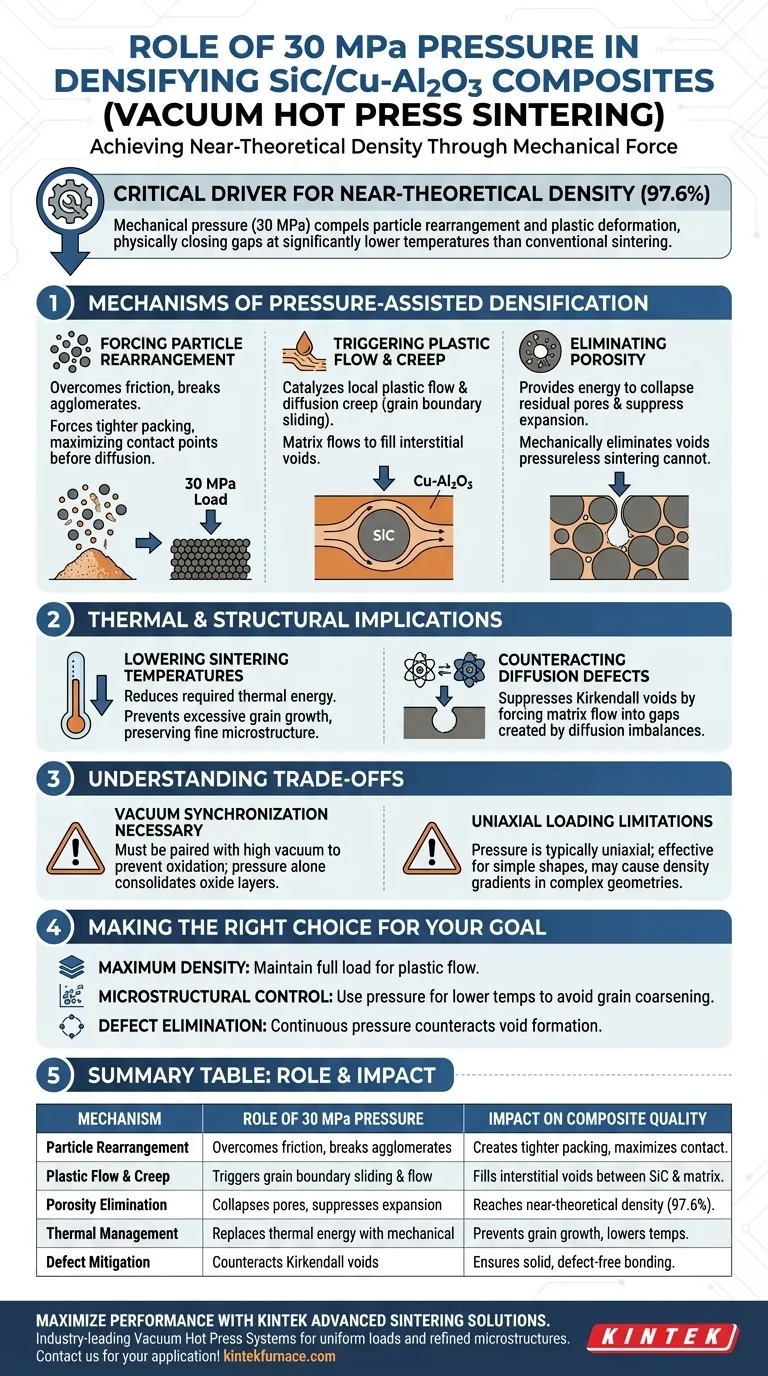
The application of 30 MPa of mechanical pressure is the critical driver for achieving near-theoretical density in SiC/Cu-Al2O3 composites. This external force mechanically compels powder particles to rearrange and undergo plastic deformation. By physically closing the gaps between particles, the pressure allows the material to reach a density of 97.6% at temperatures significantly lower than those required for conventional sintering methods.
Core Takeaway Mechanical pressure does not merely compress the powder; it fundamentally alters the sintering kinetics by triggering diffusion creep and grain boundary sliding. This force actively eliminates porosity and counteracts expansion defects, enabling high-density consolidation that pressureless sintering cannot achieve.
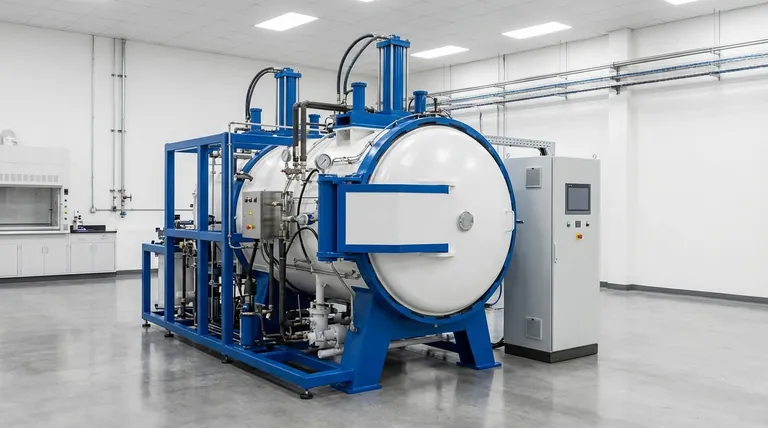
Mechanisms of Pressure-Assisted Densification
Forcing Particle Rearrangement
The initial role of the 30 MPa pressure load is to physically overcome friction between powder particles.
In the early stages of sintering, the applied force breaks down bridges and agglomerates in the powder mixture. This forces the SiC and Cu-Al2O3 particles into a tighter packing configuration, maximizing the number of contact points between them before atomic diffusion even begins.
Triggering Plastic Flow and Creep
As the temperature rises, the mechanical pressure acts as a catalyst for local plastic flow.
The primary reference indicates that this pressure induces "diffusion creep," specifically caused by grain boundary sliding. The material yields under the unidirectional force, flowing effectively like a viscous fluid to fill the interstitial spaces (voids) that exist between the rigid SiC particles and the matrix.
Eliminating Porosity
Pressureless sintering often leaves residual pores because the driving force (surface energy) is insufficient to close them.
The external 30 MPa pressure provides the necessary energy to collapse these voids. By keeping particles in forced contact, the process mechanically eliminates pores that might otherwise remain due to volume expansion or atomic diffusion imbalances.
Thermal and Structural Implications
Lowering Sintering Temperatures
A distinct advantage of applying this pressure is the reduction in required thermal energy.
Because the mechanical pressure assists in mass transport and densification, the composite does not need to be held at extreme temperatures for extended periods. This mitigates the risk of excessive grain growth, preserving the fine microstructure of the material.
Counteracting Diffusion Defects
In composite materials, different elements diffuse at different rates, which can create vacancies known as Kirkendall voids.
Continuous mechanical pressure counteracts this phenomenon. It suppresses the formation of these voids by forcing the matrix material to flow into any gaps created during the reaction diffusion process, ensuring a solid, defect-free preform.
Understanding the Trade-offs
The Necessity of Vacuum Synchronization
Pressure alone is insufficient if the environment is not controlled.
While 30 MPa drives densification, it must be paired with a high-vacuum environment to prevent the oxidation of the aluminum and copper matrix. If oxidation occurs, the pressure will merely consolidate oxide layers rather than creating a true metallurgical bond, severely compromising the material's strength.
Uniaxial Loading Limitations
The pressure in a hot press is typically uniaxial (applied in one direction).
While effective for flat or simple geometries, this can theoretically lead to density gradients in complex shapes. The pressure is most effective when the mold geometry allows for uniform transmission of force throughout the powder bed.
Making the Right Choice for Your Goal
When optimizing the fabrication of SiC/Cu-Al2O3 composites, consider your specific performance targets:
- If your primary focus is maximum density (structural integrity): Prioritize maintaining the full 30 MPa load throughout the high-temperature dwell time to maximize plastic flow and grain boundary sliding.
- If your primary focus is microstructural control: Leverage the pressure to sinter at lower temperatures, which helps avoid grain coarsening while still achieving high densification (97.6%).
- If your primary focus is defect elimination: Ensure the pressure application is continuous to actively counteract void formation caused by diffusion imbalances between the matrix elements.
By replacing thermal energy with mechanical energy, you achieve a denser, more robust composite with fewer microscopic defects.
Summary Table:
| Mechanism | Role of 30 MPa Pressure | Impact on Composite Quality |
|---|---|---|
| Particle Rearrangement | Overcomes friction and breaks down agglomerates | Creates tighter packing and maximizes contact points |
| Plastic Flow & Creep | Triggers grain boundary sliding and viscous-like flow | Fills interstitial voids between rigid SiC and matrix |
| Porosity Elimination | Collapses residual pores and suppresses expansion | Reaches near-theoretical density (97.6%) |
| Thermal Management | Replaces thermal energy with mechanical energy | Prevents grain growth by lowering sintering temperatures |
| Defect Mitigation | Counteracts Kirkendall voids and diffusion vacancies | Ensures solid, defect-free metallurgical bonding |
Maximize Material Performance with KINTEK Advanced Sintering Solutions
Achieving near-theoretical density in complex composites like SiC/Cu-Al2O3 requires more than just heat—it requires precise, synchronized mechanical force and vacuum control. KINTEK provides industry-leading Vacuum Hot Press Sintering Systems specifically engineered to deliver the uniform 30 MPa (and higher) loads necessary to eliminate porosity and refine microstructures.
Backed by expert R&D and manufacturing, KINTEK offers customizable Muffle, Tube, Rotary, Vacuum, and CVD systems tailored to your unique laboratory or production needs. Whether you are aiming to prevent grain coarsening or optimize diffusion kinetics, our high-temperature furnaces provide the reliability you need.
Ready to elevate your material science? Contact our experts today to find the perfect sintering system for your application!
Visual Guide
Related Products
- 600T Vacuum Induction Hot Press Vacuum Heat Treat and Sintering Furnace
- 9MPa Air Pressure Vacuum Heat Treat and Sintering Furnace
- Vacuum Hot Press Furnace Machine Heated Vacuum Press Tube Furnace
- Vacuum Heat Treat Sintering Furnace with Pressure for Vacuum Sintering
- 2200 ℃ Tungsten Vacuum Heat Treat and Sintering Furnace
People Also Ask
- Why use Vacuum Hot Press (VHP) for ZnS Ceramics? Achieve Superior IR Transparency and Mechanical Strength
- How does a vacuum hot press sintering furnace mitigate copper sintering swelling? Solve Fe-Cu Expansion Issues
- How does the vacuum environment in a vacuum hot press sintering furnace protect chromium-containing ceramics? Find out.
- What are the key advantages of vacuum hot press sintering furnaces? Achieve Superior Density and Purity in Materials
- What are the benefits of using a vacuum hot press sintering furnace for the preparation of SiCw/2024 aluminum matrix composites? Achieve High-Performance Aerospace Materials



















