
The primary purpose is to transform loose Bismuth Telluride nanopowders into a cohesive, structurally sound "green body" with uniform density. A laboratory hydraulic press applies precise, multi-ton axial loads to force particle rearrangement, while high-strength stainless steel molds provide the necessary rigidity to define precise geometric dimensions without deforming under the massive pressure.
The core value of this setup is consistency: by mechanically eliminating large pores and internal density gradients now, you create the physical conditions required to prevent cracking and ensure uniform densification during the subsequent Hot Isostatic Pressing (HIP) sintering stage.
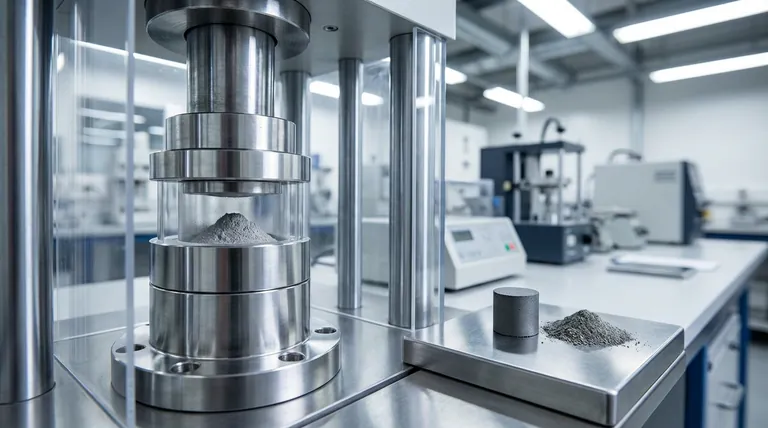
The Mechanics of Densification
Forcing Particle Rearrangement
Loose Bismuth Telluride nanopowders naturally contain significant void space and air gaps.
The hydraulic press applies axial pressure reaching hundreds of megapascals. This forces the particles to overcome friction, slide past one another, and pack tightly into a dense arrangement.
Eliminating Density Gradients
A major challenge in powder metallurgy is creating a pellet that is equally dense in the center and at the edges.
High-precision presses often utilize closed-loop control systems to apply stable pressure. This ensures that localized stress concentrations are minimized, effectively removing internal density gradients that would otherwise cause warping.
The Role of the Stainless Steel Mold
Withstanding Massive Axial Loads
The pressure required to compact Bismuth Telluride is significant. Standard mold materials would bulge or deform under these multi-ton loads.
High-strength stainless steel is essential because it remains rigid. This ensures that the pressure is directed entirely into compressing the powder, rather than expanding the mold walls.
Ensuring Geometric Precision
For thermoelectric applications, the dimensions of the semiconductor material are critical for performance.
The rigidity of the stainless steel mold guarantees that the resulting green body matches the target dimensions—such as a specific 13mm diameter and 3mm thickness—with high repeatability.
Preparing for Sintering (HIP)
Establishing Green Strength
Before sintering, the powder must be formed into a solid shape that can be handled without crumbling.
The plastic deformation caused by the press creates "green strength." This allows the pellet to be ejected from the mold and transferred to the sintering furnace intact.
Preventing Sintering Defects
The quality of the final sintered product is determined by the quality of the green body.
By ensuring optimal inter-particle contact and removing large pores during the pressing stage, you significantly reduce the risk of uneven shrinkage, deformation, or cracking when the material is later subjected to heat.
Understanding the Trade-offs
Mold Material Limitations
While high-strength stainless steel is excellent for cold pressing green bodies, it is generally not suitable for the high-temperature sintering step itself.
Unlike graphite molds, which can withstand sintering temperatures and prevent chemical reactions, stainless steel is used strictly for the initial shaping and compaction phase.
The Risk of Over-Pressurization
While high pressure promotes density, excessive or uncontrolled pressure can be detrimental.
If pressure is applied too rapidly without allowing air to escape, it can lead to lamination (horizontal cracking) or entrapped air pockets, which will expand and destroy the sample during sintering.
Making the Right Choice for Your Goal
When configuring your pressing process for Bismuth Telluride:
- If your primary focus is Geometric Accuracy: Prioritize the hardness and tolerance of the stainless steel mold to ensure the 13mm/3mm dimensions are held exactly under load.
- If your primary focus is Sintering Success: Prioritize the stability of the hydraulic press controls to ensure uniform pressure distribution and the elimination of internal density gradients.
Uniformity in the green stage is the single biggest predictor of integrity in the final sintered material.
Summary Table:
| Component | Primary Function | Key Benefit |
|---|---|---|
| Hydraulic Press | Applies precise, multi-ton axial loads | Eliminates density gradients & internal pores |
| Stainless Steel Mold | Provides rigid geometric confinement | Ensures dimensional accuracy & resists deformation |
| Bismuth Telluride | Nanopowder compaction | Establishes green strength for handleability |
| Process Outcome | Uniform green body formation | Prevents cracking and warping during HIP sintering |
Elevate Your Thermoelectric Research with KINTEK
Precise material densification starts with superior equipment. Backed by expert R&D and world-class manufacturing, KINTEK provides the high-precision laboratory hydraulic presses and specialized tooling required for demanding applications like Bismuth Telluride compaction.
Our range of customizable Muffle, Tube, Rotary, Vacuum, and CVD systems, alongside our high-strength mold solutions, ensure your lab achieves the exact consistency needed for advanced material science. Whether you are aiming for geometric precision or flawless sintering results, KINTEK offers the technology to get you there.
Ready to optimize your green body production? Contact our experts today to find the perfect system for your unique research needs.
References
- Mohamed Abdelnaser Mansour, Ahmed Abdelmoneim. Enhancing the thermoelectric properties for hot-isostatic-pressed Bi2Te3 nano-powder using graphite nanoparticles. DOI: 10.1007/s10854-024-12389-8
This article is also based on technical information from Kintek Furnace Knowledge Base .
Related Products
- High Pressure Laboratory Vacuum Tube Furnace
- Vacuum Hot Press Furnace Machine for Lamination and Heating
- Vacuum Hot Press Furnace Machine Heated Vacuum Press
- Vacuum Hot Press Furnace Machine Heated Vacuum Press Tube Furnace
- 600T Vacuum Induction Hot Press Vacuum Heat Treat and Sintering Furnace
People Also Ask
- What role does a high vacuum tube furnace play in Co-Al sintering? Master High-Purity Porous Material Synthesis
- What are the different types of tube furnaces available? Find the Perfect Fit for Your Lab's Needs
- What are the main advantages of vacuum tube furnaces in the market? Achieve Purity and Precision in Material Processing
- What is the role of a vacuum tube furnace during the final thermal treatment stage of Fe3O4@CSAC catalysts?
- What conditions do tube furnaces provide for Au-Seeded TiO2 nanowires? Master Precision Thermal Synthesis










