
Synchronous axial pressure acts as a critical mechanical catalyst during the sintering process of MgTiO3-CaTiO3 ceramics. By applying a constant physical force alongside the pulsed electric current, the Spark Plasma Sintering (SPS) furnace drives particle rearrangement and plastic flow, effectively eliminating micro-pores. This allows the material to reach near-theoretical density at significantly lower temperatures than conventional methods, directly enhancing its final dielectric performance.
By introducing mechanical pressure as a driving force for densification, SPS technology overcomes the limitations of relying on thermal energy alone. This results in a pore-free, highly dense ceramic structure that optimizes the balance between dielectric constant and quality factor.
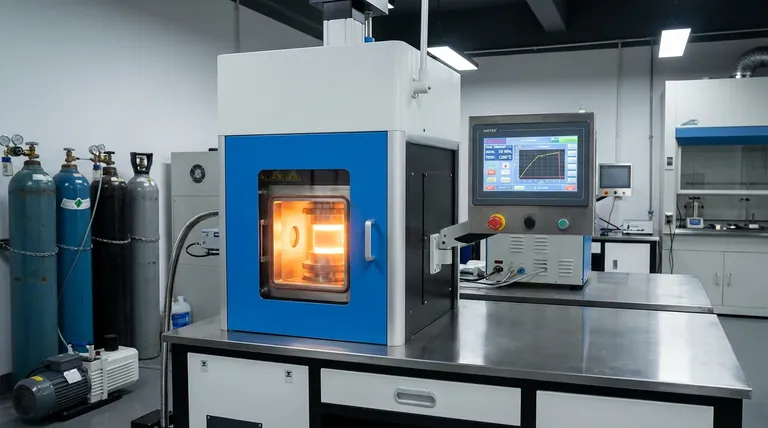
The Mechanics of Pressure-Assisted Sintering
The Role of Physical Driving Force
In traditional sintering, densification is driven primarily by thermal energy and surface energy reduction. SPS changes this dynamic by introducing synchronous axial pressure.
This pressure provides an additional physical driving force. It works in tandem with the thermal energy generated by the pulsed current to accelerate the consolidation of the ceramic powder.
Mechanisms of Material Movement
The application of axial pressure triggers three specific mechanisms that are essential for MgTiO3-CaTiO3 ceramics.
First, it promotes particle rearrangement, forcing powder grains into a tighter packing configuration immediately.
Second, it induces plastic flow and diffusion creep at high temperatures. These mechanisms allow the material to deform and fill voids that thermal expansion alone might not resolve.
Impact on Microstructure and Properties
Achieving Theoretical Density
The primary structural goal for these ceramics is high density. The axial pressure effectively squeezes out air pockets during the heating phase.
This process eliminates micro-pores within the green body. Consequently, the ceramic achieves a density that is incredibly close to its theoretical limit.
Lowering Process Temperatures
Because pressure assists in densification, the process requires less thermal energy to achieve the same result.
SPS allows the ceramic to densify at temperatures much lower than those required by traditional sintering methods. This preserves the grain structure and prevents excessive grain growth often caused by overheating.
Optimizing Dielectric Performance
The physical density of the material is directly linked to its electrical capabilities.
By eliminating porosity, the axial pressure enhances the dielectric constant. Furthermore, the dense, uniform structure optimizes the quality factor, which is critical for the performance of MgTiO3-CaTiO3 in electronic applications.
Understanding the Trade-offs
Tooling Limitations
While axial pressure is beneficial, it places significant stress on the sintering tooling.
The graphite dies typically used in SPS have a mechanical strength limit. Exceeding this pressure limit to force densification can result in die fracture or deformation.
Geometrical Constraints
Synchronous axial pressure is highly effective for simple shapes, like discs or cylinders.
However, because the pressure is uniaxial (applied in one direction), achieving uniform density in complex, 3D geometries can be challenging. Gradients in density may occur if the pressure distribution is not perfectly even across the mold.
Making the Right Choice for Your Goal
To leverage the full potential of synchronous axial pressure in SPS for your MgTiO3-CaTiO3 projects, consider the following:
- If your primary focus is Structural Integrity: Utilize the axial pressure to drive plastic flow and diffusion creep, ensuring the total elimination of micro-pores for maximum density.
- If your primary focus is Electrical Efficiency: Balance the pressure and temperature settings to achieve high density at the lowest possible temperature, thereby maximizing the quality factor and dielectric constant.
The synchronous axial pressure in SPS is not just a feature; it is the fundamental lever that allows you to achieve superior ceramic properties closer to theoretical limits than ever before.
Summary Table:
| Feature | Impact on MgTiO3-CaTiO3 Ceramics | Benefit |
|---|---|---|
| Particle Rearrangement | Forces powder grains into tighter packing | Higher initial green body density |
| Plastic Flow & Creep | Deforms material to fill internal voids | Elimination of micro-pores |
| Pressure-Assisted Heating | Reduces reliance on pure thermal energy | Lower sintering temperatures |
| Density Optimization | Reaches near-theoretical limits | Enhanced dielectric constant & Q-factor |
Elevate Your Material Research with KINTEK SPS Technology
Unlock the full potential of your electronic ceramics with our high-performance Spark Plasma Sintering (SPS) systems. Backed by expert R&D and manufacturing, KINTEK offers precision-engineered Muffle, Tube, Rotary, Vacuum, and CVD systems, along with customizable lab high-temp furnaces designed to meet your unique sintering requirements.
Whether you need to achieve theoretical density or preserve grain structure through low-temperature sintering, our technical team is ready to provide a tailored solution for your lab.
Ready to optimize your sintering process?
Contact KINTEK Today to Speak with an Expert
References
- Wega Trisunaryanti, Satriyo Dibyo Sumbogo. Characteristic and Performance of Ni, Pt, and Pd Monometal and Ni-Pd Bimetal onto KOH Activated Carbon for Hydrotreatment of Castor Oil. DOI: 10.22146/ijc.84640
This article is also based on technical information from Kintek Furnace Knowledge Base .
Related Products
- Spark Plasma Sintering SPS Furnace
- 9MPa Air Pressure Vacuum Heat Treat and Sintering Furnace
- Vacuum Heat Treat Sintering Furnace with Pressure for Vacuum Sintering
- 600T Vacuum Induction Hot Press Vacuum Heat Treat and Sintering Furnace
- Small Vacuum Heat Treat and Tungsten Wire Sintering Furnace
People Also Ask
- How does the heating mechanism of Spark Plasma Sintering (SPS) function? Enhance TiC/SiC Composite Fabrication
- Why is it necessary to maintain a high vacuum environment during the SPS of SiC? Key to High-Density Ceramics
- What are the technical advantages of using an SPS sintering furnace? Elevate Al2O3-TiC Material Performance
- What are the steps in the discharge plasma sintering process? Master Fast, High-Density Material Consolidation
- What are the advantages of spark plasma sintering (SPS) over traditional forging? Precision Microstructural Control



















