
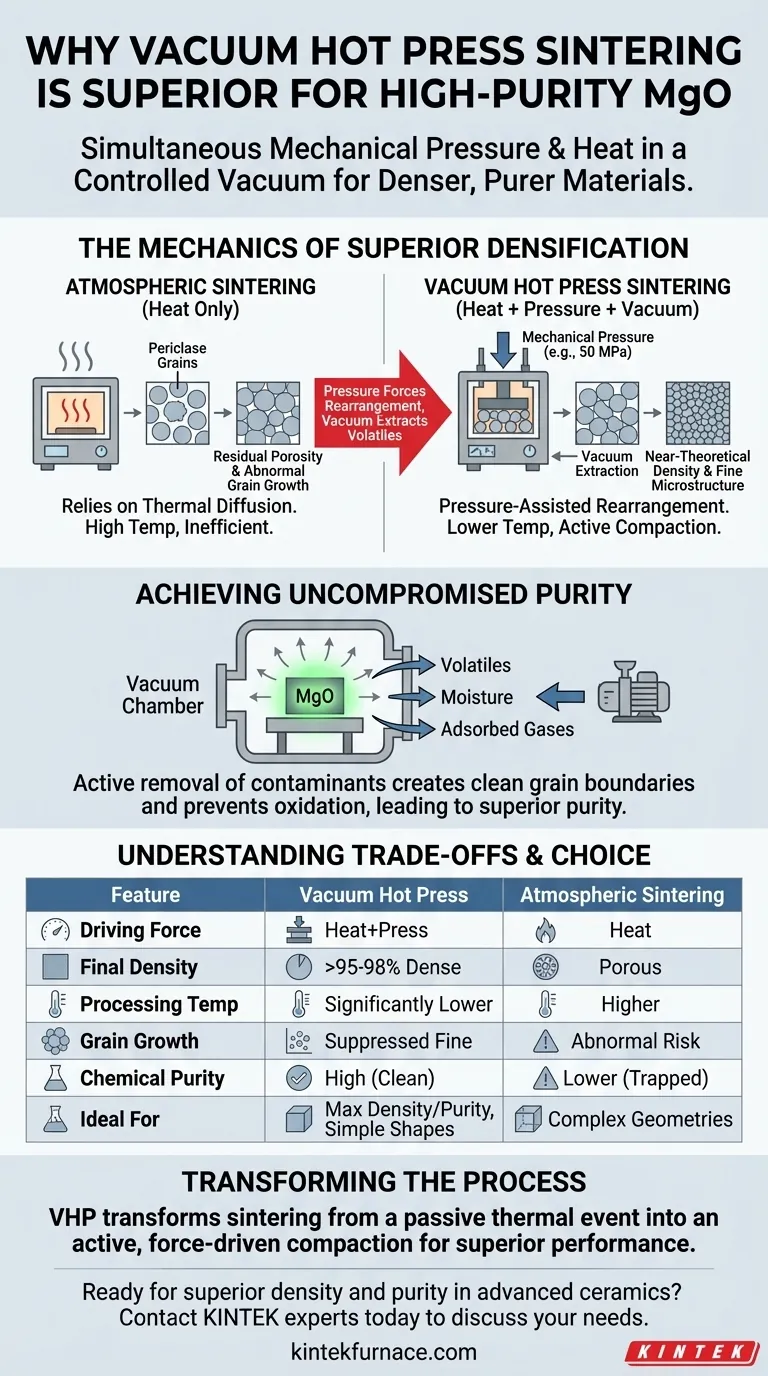
A vacuum hot press sintering furnace outperforms atmospheric methods because it applies mechanical pressure simultaneously with heat in a controlled environment. While atmospheric sintering relies solely on thermal diffusion to bond particles, vacuum hot pressing utilizes external force to physically rearrange magnesium oxide (periclase) grains, achieving near-theoretical density at significantly lower temperatures while actively removing impurities.
Core Takeaway The superiority of vacuum hot pressing lies in its ability to decouple densification from temperature. By using pressure to force grain rearrangement and vacuum to extract volatiles, you achieve a denser, purer material structure without the excessive heat that causes abnormal grain growth in atmospheric sintering.
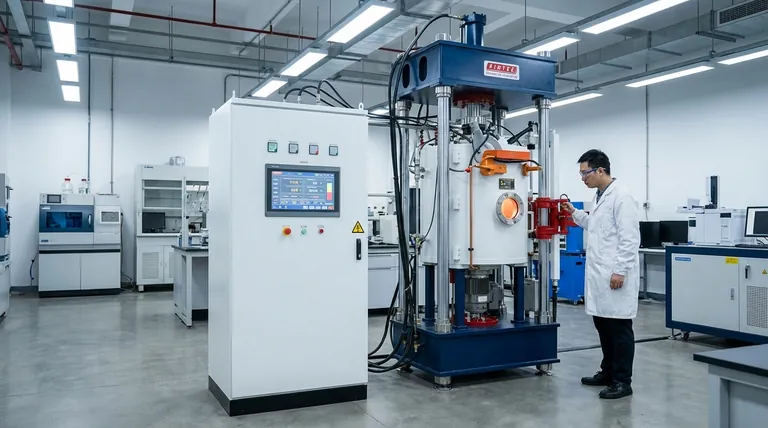
The Mechanics of Superior Densification
The Role of Mechanical Pressure
In atmospheric sintering, you rely on high temperatures to induce densification, which can be inefficient for difficult-to-sinter materials. A vacuum hot press applies mechanical pressure (e.g., 50 MPa) during the heating stage. This external force significantly increases the rearrangement rate of periclase grains, physically closing gaps that thermal energy alone cannot easily bridge.
Lower Temperatures, Better Microstructure
Because mechanical pressure provides an additional driving force, densification occurs at temperatures significantly lower than those required for atmospheric sintering. Lower processing temperatures are critical because they suppress abnormal grain growth. This results in a fine-grained microstructure, which directly correlates to higher hardness and fracture toughness.
Elimination of Micro-Pores
Atmospheric sintering often leaves residual porosity inside the material. The pressure-assisted method effectively eliminates micro-pores located in powder gaps and grain boundaries. This leads to a relative density that can exceed 95% to 98%, levels that are often unattainable with pressureless atmospheric methods.
Achieving Uncompromised Purity
Active Removal of Volatiles
High-purity magnesium oxide requires chemically clean grain boundaries. The vacuum environment actively removes adsorbed gases, moisture, and volatiles from the powder surfaces before sintering initiates. In an atmospheric furnace, these contaminants can become trapped within the closed pores, degrading the material's final properties.
Prevention of Contamination
Operating in a vacuum eliminates the presence of reactive gases found in air, such as oxygen and carbon dioxide. This prevents unwanted chemical reactions, oxidation of reinforcement phases, or the formation of oxide inclusions. The result is a "clean" atmosphere that improves the wettability between the matrix and any reinforcement phases, facilitating strong interfacial bonding.
Understanding the Trade-offs
Complexity vs. Quality
While vacuum hot pressing yields superior material properties, it introduces higher process complexity compared to atmospheric sintering. Atmospheric furnaces are generally simpler and allow for continuous processing. Vacuum hot pressing is typically a batch process that requires precise management of vacuum levels, hydraulic pressure, and thermal gradients.
Geometry Constraints
The application of mechanical pressure generally limits the geometry of the final product. Vacuum hot pressing is ideal for simple shapes like plates, disks, or cylinders. If your project requires complex, net-shape components with intricate geometries, atmospheric sintering (potentially followed by Hot Isostatic Pressing) might be a necessary logistical compromise despite the lower initial density.
Making the Right Choice for Your Goal
To ensure you select the correct processing method for your specific application, consider the following:
- If your primary focus is maximum density and mechanical strength: Choose vacuum hot pressing. The mechanical pressure is essential for eliminating micro-pores and achieving high fracture toughness.
- If your primary focus is ultra-high chemical purity: Choose vacuum hot pressing. The active removal of volatiles and isolation from atmospheric contaminants ensures the cleanest possible grain boundaries.
- If your primary focus is complex part geometry: Acknowledge that atmospheric sintering may be required for shaping, but be prepared for lower density or the need for secondary post-processing.
Vacuum hot pressing transforms the sintering process from a passive thermal event into an active, force-driven compaction that guarantees superior material performance.
Summary Table:
| Feature | Vacuum Hot Press Sintering | Atmospheric Sintering |
|---|---|---|
| Driving Force | Heat + Mechanical Pressure | Heat Only |
| Final Density | >95-98% (Near-Theoretical) | Lower (Residual Porosity) |
| Processing Temp | Significantly Lower | Higher |
| Grain Growth | Suppressed (Fine Microstructure) | Risk of Abnormal Growth |
| Chemical Purity | High (Volatiles & Contaminants Removed) | Lower (Risk of Trapped Impurities) |
| Ideal For | Maximum Density/Purity, Simple Shapes | Complex Geometries, Simpler Process |
Ready to achieve superior density and purity in your advanced ceramics?
For projects requiring maximum performance from materials like magnesium oxide, the controlled environment of a vacuum hot press is essential. Backed by expert R&D and manufacturing, KINTEK offers a range of high-temperature furnaces, including customizable Vacuum Hot Press systems, designed to meet your unique research and production needs.
Contact our experts today to discuss how our sintering solutions can enhance your material's properties.
Visual Guide
Related Products
- 600T Vacuum Induction Hot Press Vacuum Heat Treat and Sintering Furnace
- 9MPa Air Pressure Vacuum Heat Treat and Sintering Furnace
- Vacuum Hot Press Furnace Machine Heated Vacuum Press Tube Furnace
- Vacuum Heat Treat Sintering Furnace with Pressure for Vacuum Sintering
- 2200 ℃ Tungsten Vacuum Heat Treat and Sintering Furnace
People Also Ask
- Why use Vacuum Hot Press (VHP) for ZnS Ceramics? Achieve Superior IR Transparency and Mechanical Strength
- How does a vacuum hot press sintering furnace mitigate copper sintering swelling? Solve Fe-Cu Expansion Issues
- What are the key advantages of vacuum hot press sintering furnaces? Achieve Superior Density and Purity in Materials
- What are the benefits of using a vacuum hot press sintering furnace for the preparation of SiCw/2024 aluminum matrix composites? Achieve High-Performance Aerospace Materials
- What is the core function of a vacuum hot press sintering furnace in the preparation of high-density RuTi alloys? Achieve Maximum Density and Purity



















