
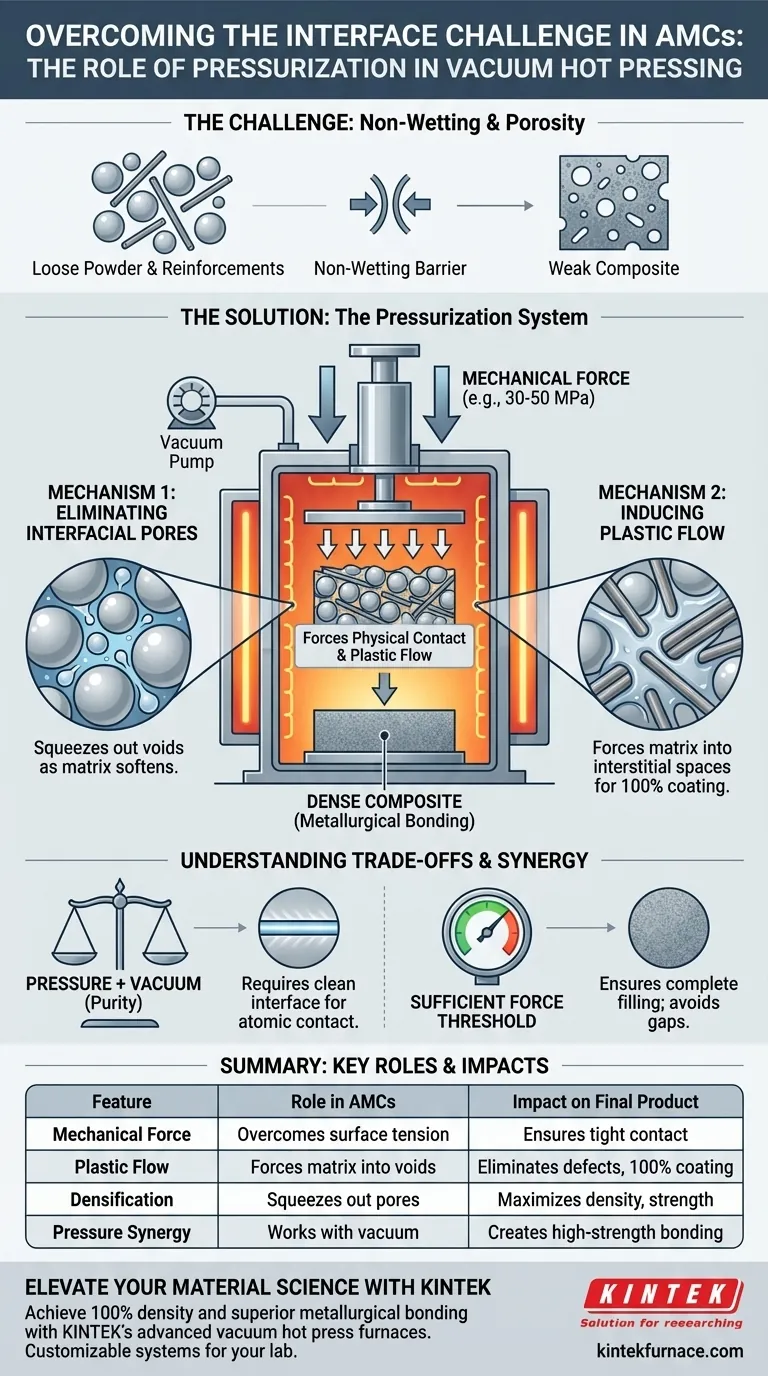
The pressurization system is the decisive mechanical factor in solving the inherent "non-wetting" issues often found in aluminum matrix composites (AMCs). While thermal energy softens the material, the application of mechanical force at high temperatures physically compels the aluminum matrix and reinforcements—such as carbon nanotubes or silicon carbide fibers—into tight contact, overcoming the natural interfacial tension that leads to porosity.
The Core Mechanism Pressure acts as the bridge between loose powder and a solid composite. By forcing the matrix material to undergo intense plastic flow, the pressurization system eliminates interfacial voids that diffusion alone cannot close, driving the transition from simple physical contact to strong metallurgical bonding.
Overcoming the Non-Wetting Barrier
The Challenge of Natural Repulsion
In many AMCs, particularly those combining aluminum powder with carbon nanotubes, the materials exhibit non-wetting phenomena.
This means the molten or semi-solid aluminum resists spreading over the reinforcement surface. In a pressureless sintering environment, this resistance results in a porous, weak interface where the materials fail to adhere.
Forcing Physical Contact
The pressurization system counteracts non-wetting behavior by applying significant mechanical force (e.g., 30-50 MPa).
This external pressure physically forces the powder particles against the reinforcements. It overcomes the surface tension that keeps the materials apart, ensuring that the aluminum matrix surrounds the reinforcement rather than pulling away from it.
Mechanisms of Densification
Eliminating Interfacial Pores
The primary role of the pressurization system is the mechanical elimination of voids.
As the temperature rises and the matrix softens, the applied pressure squeezes out the empty spaces (pores) located at the interface between the matrix and the reinforcement. This densification process is critical for preventing structural weaknesses within the final composite.
Inducing Plastic Flow
Beyond simple compression, the system drives intense plastic flow within the aluminum matrix (or foil, in the case of fiber composites).
The pressure forces the softened aluminum to flow into the microscopic interstitial spaces between reinforcements, such as the voids between SiC fibers. Without this active squeezing, the matrix cannot penetrate these tight gaps, leading to incomplete coating and internal defects.
Understanding the Trade-offs
The Interdependence of Pressure and Purity
While pressure is the driver of density, it cannot function in isolation; it requires a clean interface to create a bond.
If the vacuum system fails to remove oxide layers or adsorbed gases, the pressure will simply trap these contaminants inside the composite. Therefore, the pressurization system is only effective when the vacuum environment has sufficiently purified the aluminum surface to allow for direct atomic contact.
The Risk of Insufficient Force
There is a critical threshold for applied pressure.
If the pressure is insufficient, the plastic flow will be too weak to fully coat the fibers or fill the voids, resulting in a bonding rate below 100%. Conversely, accurate pressure regulation ensures the complete filling of voids without damaging the reinforcement structure.
Making the Right Choice for Your Goal
- If your primary focus is Maximum Density: Ensure your system can deliver sufficient pressure (e.g., 30-50 MPa) to force plastic flow into the smallest interstitial voids, particularly for fiber-reinforced composites.
- If your primary focus is Interface Strength: Prioritize the synchronization of pressure application with peak temperature, ensuring physical contact occurs exactly when the matrix is soft enough for diffusion but not so hot that it degrades.
Ultimately, the pressurization system transforms the theoretical potential of the composite materials into realized mechanical strength by physically enforcing the contact that chemistry alone fails to achieve.
Summary Table:
| Feature | Role in Aluminum Matrix Composites (AMCs) | Impact on Final Product |
|---|---|---|
| Mechanical Force | Overcomes natural surface tension and non-wetting | Ensures tight contact between matrix and reinforcements |
| Plastic Flow | Forces softened matrix into microscopic interstitial spaces | Eliminates internal defects and ensures 100% coating |
| Densification | Squeezes out empty spaces and interfacial pores | Prevents structural weakness and maximizes material density |
| Pressure Synergy | Works with vacuum to remove oxides and trap-free bonds | Creates high-strength, metallurgical bonding at the interface |
Elevate Your Material Science with KINTEK
Don't let interface voids compromise the integrity of your aluminum matrix composites. KINTEK’s advanced vacuum hot press furnaces provide the precise pressure control and high-vacuum environments necessary to achieve 100% density and superior metallurgical bonding.
Backed by expert R&D and manufacturing, we offer customizable Muffle, Tube, Rotary, Vacuum, and CVD systems tailored to your specific lab and production requirements. Whether you are working with carbon nanotubes or SiC fibers, our high-temp furnaces deliver the performance you need.
Ready to optimize your composite production? Contact KINTEK today to discuss your unique needs and find the perfect high-temperature solution for your lab.
Visual Guide
Related Products
- Vacuum Hot Press Furnace Machine for Lamination and Heating
- 600T Vacuum Induction Hot Press Vacuum Heat Treat and Sintering Furnace
- Vacuum Hot Press Furnace Machine Heated Vacuum Press Tube Furnace
- Vacuum Hot Press Furnace Machine Heated Vacuum Press
- High Pressure Laboratory Vacuum Tube Furnace
People Also Ask
- What are the primary components of a vacuum hot press furnace? Master the Core Systems for Precise Material Processing
- What safety features are incorporated in vacuum hot press furnaces? Ensure Operator and Equipment Protection
- What are the benefits of the vacuum environment system in a vacuum hot press furnace? Unlock High-Density Sintering
- What industries benefit from the use of vacuum hot press furnaces? Unlock High-Performance Materials for Your Industry
- How does the uniaxial pressure applied by a vacuum hot press furnace affect the microstructure of ZrC-SiC materials?



















