
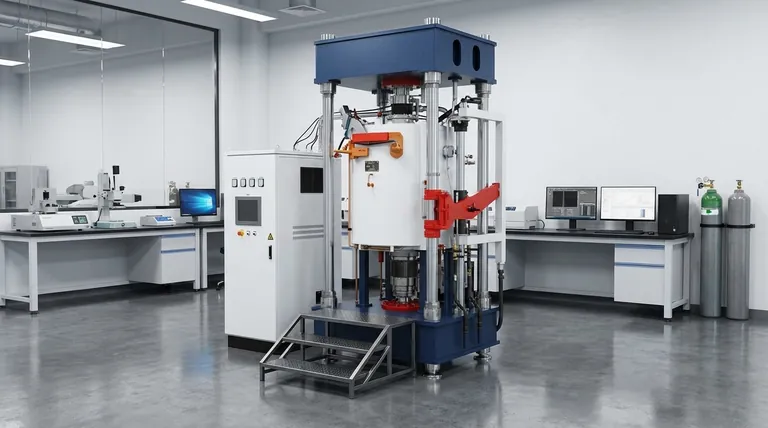
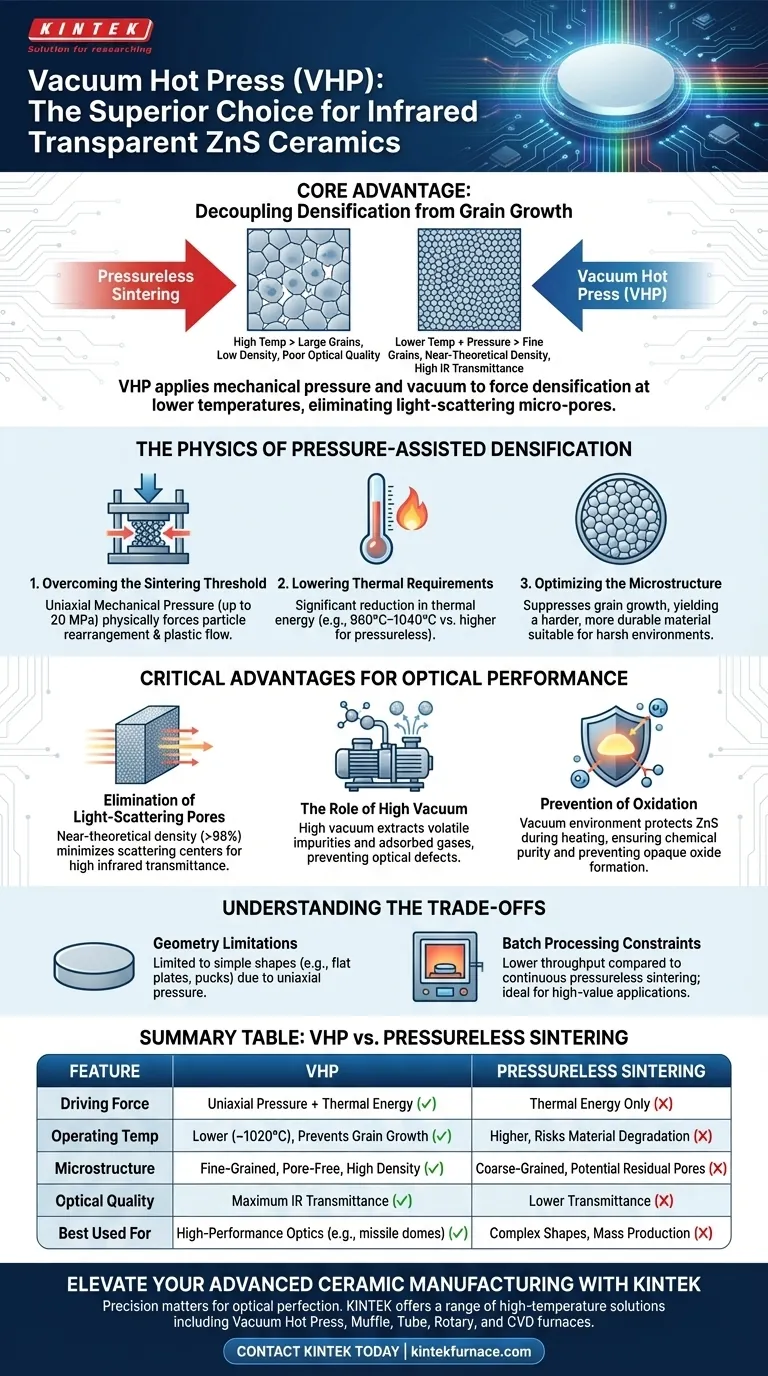
The core advantage of using a Vacuum Hot Press (VHP) furnace for Zinc Sulfide (ZnS) ceramics lies in its ability to decouple densification from grain growth. By applying simultaneous mechanical pressure (up to 20 MPa) and high vacuum ($10^{-3}$ mtorr) at approximately 1020°C, VHP forces the material to reach near-theoretical density at significantly lower temperatures than pressureless sintering, effectively eliminating the micro-pores that destroy infrared transparency.
Core Takeaway Achieving optical transparency in ceramics requires a pore-free microstructure, but high temperatures usually cause grains to grow, reducing strength. VHP solves this by using mechanical force—not just heat—to drive densification. This allows for the production of ZnS with superior infrared transmission and mechanical strength without the extreme thermal loads required by pressureless methods.
The Physics of Pressure-Assisted Densification
Overcoming the Sintering Threshold
In pressureless sintering, densification relies entirely on thermal energy to diffuse atoms and close gaps between particles. This requires extremely high temperatures. VHP introduces an external driving force: uniaxial mechanical pressure (typically around 15–20 MPa). This pressure physically forces particles to rearrange and undergo plastic flow, mechanically closing the voids between them.
Lowering Thermal Requirements
Because mechanical pressure assists the process, the thermal energy required is significantly reduced. VHP allows ZnS to sinter effectively at moderate temperatures (e.g., 960°C–1040°C). Pressureless sintering would require higher temperatures to achieve similar density, which often leads to material degradation or uncontrolled microstructural changes.
Optimizing the Microstructure
The combination of lower temperatures and mechanical pressure results in a fine-grained microstructure. By avoiding the excessive heat of pressureless sintering, VHP suppresses grain growth. This is critical because large grains can reduce the mechanical strength of the ceramic. VHP yields a harder, more durable material suitable for harsh environments, such as missile domes.
Critical Advantages for Optical Performance
Elimination of Light-Scattering Pores
For a ceramic to be transparent in the infrared spectrum, it must be virtually free of porosity. Even microscopic pores act as scattering centers, blocking light transmission. The VHP exerts a densification force that squeezes out residual pores that pressureless sintering often leaves behind. This results in a material density that is near-theoretical (e.g., >98%), directly translating to high infrared transmittance.
The Role of High Vacuum
Temperature and pressure are supported by a high vacuum environment ($10^{-3}$ mtorr or better). This vacuum is essential for extracting volatile impurities and adsorbed gases trapped within the powder interstices. Without the vacuum, these gases would be trapped inside the closing pores, preventing full densification and causing optical defects.
Prevention of Oxidation
ZnS is sensitive to oxidation at high temperatures, which creates opaque oxides that ruin transparency. The vacuum environment protects the material during the heating cycle, ensuring the chemical purity of the Zinc Sulfide is maintained throughout the densification process.
Understanding the Trade-offs
Geometry Limitations
While VHP offers superior material properties, it applies pressure uniaxially (from top and bottom). This generally limits part geometries to simple shapes like flat plates, discs, or pucks. Complex, near-net-shape components are difficult to manufacture directly with VHP compared to pressureless sintering or other methods like Hot Isostatic Pressing (HIP).
Batch Processing Constraints
VHP is inherently a batch process. The equipment must be loaded, evacuated, heated, pressed, cooled, and unloaded for every cycle. This generally results in lower throughput compared to continuous pressureless sintering furnaces, making VHP better suited for high-value, high-performance applications rather than mass commodity production.
Making the Right Choice for Your Goal
To determine if VHP is the correct manufacturing route for your specific ZnS application, consider your performance priorities:
- If your primary focus is Optical Transmittance: VHP is superior because the combination of vacuum and pressure creates the pore-free, high-density structure required to minimize infrared light scattering.
- If your primary focus is Mechanical Durability: VHP is the optimal choice as it achieves full density while suppressing grain growth, yielding harder and stronger ceramics than pressureless methods.
- If your primary focus is Complex Geometry: You may need to consider that VHP produces simple shapes that require post-process machining, unlike pressureless sintering which can accommodate more complex green body shapes.
Summary: VHP effectively replaces thermal energy with mechanical energy, allowing you to manufacture ZnS ceramics that are optically clear and mechanically robust without the grain-coarsening effects of high-temperature pressureless sintering.
Summary Table:
| Feature | Vacuum Hot Press (VHP) | Pressureless Sintering |
|---|---|---|
| Driving Force | Uniaxial Pressure + Thermal Energy | Thermal Energy Only |
| Operating Temp | Lower (~1020°C); prevents grain growth | Higher; risks material degradation |
| Microstructure | Fine-grained, pore-free, high density | Coarse-grained, potential residual pores |
| Optical Quality | Maximum IR transmittance | Lower transmittance due to scattering |
| Best Used For | High-performance optics (e.g., missile domes) | Complex shapes, mass production |
Elevate Your Advanced Ceramic Manufacturing with KINTEK
Precision matters when your goal is optical perfection. Backed by expert R&D and manufacturing, KINTEK offers a comprehensive range of high-temperature solutions, including Vacuum Hot Press systems, Muffle, Tube, Rotary, and CVD furnaces.
Whether you are scaling production for infrared optics or developing next-generation materials, our customizable systems ensure you achieve the exact density and microstructure your application demands.
Ready to optimize your sintering process? Contact KINTEK today to discuss your unique needs with our technical specialists.
Visual Guide
Related Products
- Vacuum Hot Press Furnace Machine Heated Vacuum Press Tube Furnace
- Vacuum Hot Press Furnace Machine for Lamination and Heating
- 600T Vacuum Induction Hot Press Vacuum Heat Treat and Sintering Furnace
- Vacuum Hot Press Furnace Machine Heated Vacuum Press
- 9MPa Air Pressure Vacuum Heat Treat and Sintering Furnace
People Also Ask
- What safety features are incorporated in vacuum hot press furnaces? Ensure Operator and Equipment Protection
- What are the benefits of the vacuum environment system in a vacuum hot press furnace? Unlock High-Density Sintering
- What is the significance of the vacuum environment for sintering stainless steel? Unlock High-Density Purity
- How does a vacuum hot press furnace promote densification in the manufacturing of graphite flake/copper composites? Achieve Superior Composite Materials
- What considerations guide the selection of heating elements and pressurization methods for a vacuum hot press furnace?



















