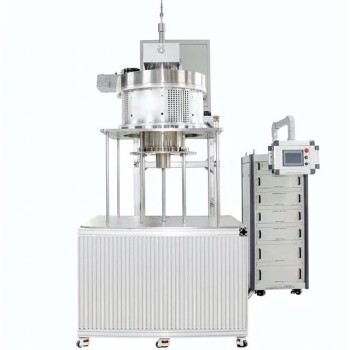
Spark Plasma Sintering (SPS) acts as the definitive consolidation technique for transforming loose powder into high-performance half-Heusler thermoelectric bulk materials. It utilizes a combination of pulsed direct current and uniaxial mechanical pressure to achieve rapid densification, ensuring the final material retains critical microstructural features that would otherwise be lost during slower processing methods.
Core Takeaway SPS technology solves the conflict between achieving high material density and maintaining fine microstructures. By densifying powders in minutes rather than hours, it secures over 94% of theoretical density while preserving the specific grain structures necessary for optimized electrical transport.
The Mechanism of Rapid Densification
Internal Heating via Pulsed DC
Unlike conventional sintering, which heats materials from the outside in, SPS generates heat internally. The equipment applies a pulsed direct current specifically between the powder particles.
This discharge creates plasma heat directly at the particle contact points. The result is an extremely efficient transfer of thermal energy that accelerates the bonding process.
Application of Uniaxial Pressure
Simultaneous with the heating process, the equipment applies significant mechanical force. Systems typically utilize axial pressure, often reaching levels around 50 MPa.
This combination of internal thermal energy and physical compression forces the particles to fuse. It allows the material to reach over 94% of its theoretical density, a critical threshold for functional bulk materials.
Preserving Microstructural Integrity
Retaining Rapid Solidification Benefits
Half-Heusler materials often undergo Rapid Solidification Processing (RSP) to create a fine, advantageous microstructure. Preserving this structure is essential for performance.
SPS protects these features by completing the sintering process in a very short timeframe, often as quickly as five minutes. This speed prevents the material from "soaking" in heat, which would otherwise degrade the fine structure achieved during RSP.
Inhibiting Grain Growth
Prolonged exposure to high temperatures typically causes grains within the material to grow abnormally large. This growth can negatively impact the material's properties.
The rapid heating and cooling cycles of SPS effectively inhibit this abnormal grain growth. By locking in the microstructure quickly, the equipment maximizes the retention of microscopic features like nano-precipitates and dislocations.
Impact on Thermoelectric Performance
Optimizing Electrical Transport
The primary goal of using SPS in this context is to enhance the electrical properties of the bulk material. High density is a prerequisite for efficient electron flow.
By achieving high density without altering the fine microstructure, SPS significantly optimizes the electrical transport properties. This ensures the final thermoelectric device operates at peak efficiency.
Understanding the Process Constraints
The Time-Temperature Sensitivity
While SPS is powerful, its success relies on the strict control of processing time. The advantage of the technology lies entirely in its speed.
If the sintering window is extended unnecessarily, even with SPS, you risk losing the benefits of the RSP microstructure. The process must be kept strictly within the short timeframe (minutes) to prevent the diffusion that leads to grain coarsening.
The Necessity of Internal Heating
Achieving high density in such a short window is impossible with external heating alone. Relying on methods that do not utilize pulsed current for internal heating will fail to densify the material fast enough to save the microstructure.
Making the Right Choice for Your Goal
To maximize the potential of your half-Heusler materials, apply SPS with specific targets in mind:
- If your primary focus is Electrical Conductivity: Target a sintering protocol that achieves >94% theoretical density to ensure robust electrical transport paths.
- If your primary focus is Microstructural Retention: Minimize the dwell time at peak temperature to preserve the fine grains and defects created during Rapid Solidification Processing.
SPS is not just a forming tool; it is a microstructural preservation strategy that bridges the gap between raw powder and high-efficiency thermoelectric devices.
Summary Table:
| Feature | Conventional Sintering | Spark Plasma Sintering (SPS) |
|---|---|---|
| Heating Method | External (Radiative) | Internal (Pulsed DC/Plasma) |
| Processing Time | Hours | Minutes (Typically ~5 min) |
| Material Density | Varied | >94% Theoretical Density |
| Grain Growth | High (Coarsening) | Inhibited (Preserves Nano-features) |
| Mechanical Pressure | Low/None | High Uniaxial (e.g., 50 MPa) |
Elevate Your Materials Research with KINTEK
Unlock the full potential of your thermoelectric research with high-performance Spark Plasma Sintering (SPS) systems from KINTEK. Whether you are working on half-Heusler alloys, advanced ceramics, or nanostructured composites, our equipment provides the precision control over pulsed DC and uniaxial pressure required to achieve maximum density without sacrificing microstructural integrity.
Why partner with KINTEK?
- Expert R&D & Manufacturing: Our systems are designed for the most demanding lab environments.
- Versatile Solutions: Beyond SPS, we offer Muffle, Tube, Rotary, Vacuum, and CVD systems.
- Customizable for Your Needs: We tailor our high-temp furnace solutions to your unique material specifications.
Contact our specialists today to find the perfect sintering solution!
References
- Effect of Sb Doping on the Thermoelectric Properties of MNiSn (M=Ti, Zr, Hf) Half-Heusler Alloys Fabricated by a Rapid Solidification Process. DOI: 10.3365/kjmm.2025.63.4.243
This article is also based on technical information from Kintek Furnace Knowledge Base .
Related Products
- Spark Plasma Sintering SPS Furnace
- Dental Porcelain Zirconia Sintering Ceramic Vacuum Press Furnace
- Chairside Dental Porcelain Zirconia Sintering Furnace with Transformer for Ceramic Restorations
- 600T Vacuum Induction Hot Press Vacuum Heat Treat and Sintering Furnace
- Vacuum Hot Press Furnace Machine Heated Vacuum Press Tube Furnace
People Also Ask
- Why is it necessary to maintain a high vacuum environment during the SPS of SiC? Key to High-Density Ceramics
- How does the heating mechanism of Spark Plasma Sintering (SPS) function? Enhance TiC/SiC Composite Fabrication
- What are the technical advantages of using an SPS sintering furnace? Elevate Al2O3-TiC Material Performance
- What are the steps in the discharge plasma sintering process? Master Fast, High-Density Material Consolidation
- What are the advantages of spark plasma sintering (SPS) over traditional forging? Precision Microstructural Control