
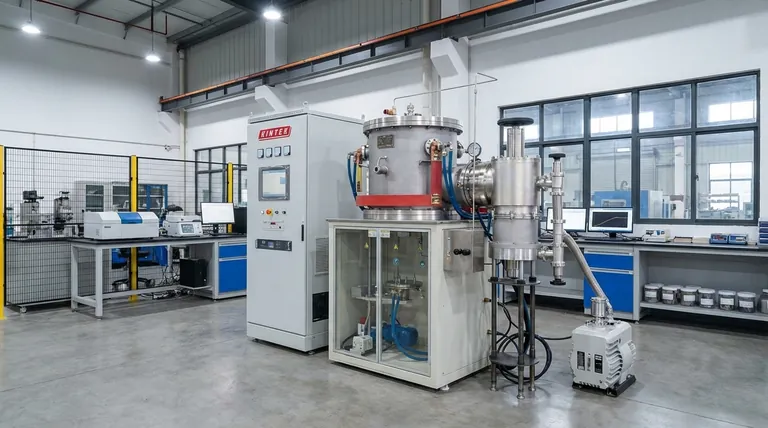
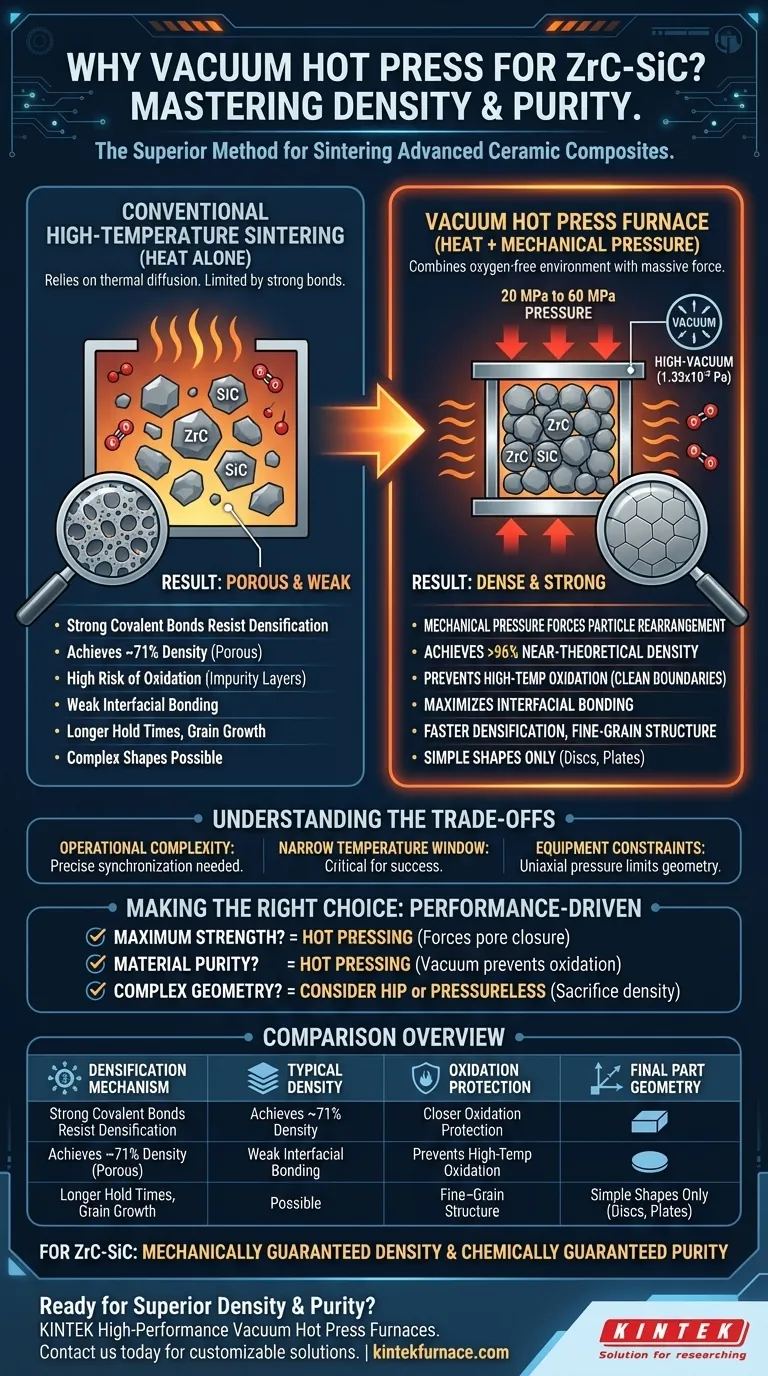
The preference for a vacuum hot press furnace stems from its ability to simultaneously overcome the chemical instability and the physical resistance of ZrC-SiC composites. While conventional sintering relies solely on thermal diffusion, a vacuum hot press combines an oxygen-free environment with massive mechanical force to achieve results that heat alone cannot produce.
Core Takeaway Processing ZrC-SiC composites requires overcoming strong covalent bonds that naturally resist densification. A vacuum hot press furnace is the definitive solution because it forces particle rearrangement through mechanical pressure while protecting the material from oxidation, allowing you to achieve near-theoretical density and superior interfacial bonding.
Overcoming the Sinterability Barrier
The Challenge of Covalent Bonds
ZrC (Zirconium Carbide) and SiC (Silicon Carbide) are characterized by strong covalent bonds and low diffusion coefficients.
In a conventional furnace, these particles resist coalescing even at extreme temperatures. Relying on heat alone often results in a porous material with weak structural integrity.
The Power of Mechanical Pressure
Vacuum hot pressing applies significant external pressure (e.g., 20 MPa to 60 MPa) directly to the powder during the heating cycle.
This pressure is the critical differentiator. It forces plastic flow and the rearrangement of particles, physically crushing voids that thermal energy cannot eliminate.
Achieving Near-Theoretical Density
Standard vacuum sintering often relies on atomic diffusion, which may only achieve relative densities around 71% for difficult materials.
By introducing mechanical force, hot pressing can drive density to over 96%, approaching a fully dense state (99.8%). This eliminates internal pores that would otherwise act as failure points in the finished composite.
Ensuring Chemical Purity and Structural Integrity
Preventing High-Temperature Oxidation
At sintering temperatures (often exceeding 1650°C), ZrC and SiC are highly susceptible to oxidation.
A high-vacuum environment (e.g., 1.33x10^-2 Pa) is mandatory to strip oxygen from the chamber. This prevents the degradation of the raw powders and ensures the final ceramic retains its intended chemical composition.
Strengthening Grain Boundaries
Oxidation does not just damage the surface; it creates impurity layers at the grain boundaries (the interfaces between particles).
By preventing these oxide layers from forming, the vacuum ensures clean, direct contact between particles. This maximizes internal interfacial bonding, directly translating to higher mechanical strength.
Controlling Grain Structure
Conventional sintering often requires longer hold times to achieve density, which can lead to excessive grain growth.
Pressure-assisted sintering enhances densification kinetics, allowing the material to densify faster. This suppresses grain growth, resulting in a fine-grain structure that offers superior hardness and fracture toughness.
Understanding the Trade-offs
Operational Complexity
This is not a "set and forget" process. It requires precise synchronization of temperature, pressure, and vacuum levels.
The Temperature Window
You must maintain a narrow temperature window. If the temperature is too low, sintering is incomplete; if too high, you risk reactions that form brittle byproducts (like aluminum carbides in metal matrix contexts) or local melting.
Equipment Constraints
Unlike a standard oven, this equipment applies uniaxial pressure. This limits the geometry of the parts you can produce, typically restricting you to simple shapes like plates or discs that require post-processing.
Making the Right Choice for Your Goal
To determine if this equipment is strictly necessary for your application, consider your performance requirements:
- If your primary focus is Maximum Mechanical Strength: You must use hot pressing to force the closure of pores and achieve near-theoretical density.
- If your primary focus is Material Purity: The vacuum environment is non-negotiable to prevent oxidation and ensure clean grain boundaries at 1650°C+.
- If your primary focus is Complex Geometry: You may need to consider Hot Isostatic Pressing (HIP) or pressureless sintering, accepting that you will sacrifice some density and strength compared to uniaxial hot pressing.
Ultimately, for high-performance ZrC-SiC composites, vacuum hot pressing is the industry standard because it is the only method that mechanically guarantees density while chemically guaranteeing purity.
Summary Table:
| Feature | Conventional Sintering | Vacuum Hot Pressing |
|---|---|---|
| Densification Mechanism | Thermal diffusion only | Heat + Mechanical pressure (20-60 MPa) |
| Typical Density Achieved | ~71% (porous) | >96% (near-theoretical) |
| Oxidation Protection | Limited or none | High-vacuum environment (e.g., 1.33x10⁻² Pa) |
| Grain Boundary Purity | Risk of oxide impurities | Clean, strong interfacial bonding |
| Final Part Geometry | Complex shapes possible | Typically simple shapes (e.g., discs, plates) |
Ready to achieve superior density and purity in your advanced ceramic composites?
Backed by expert R&D and manufacturing, KINTEK offers a range of high-performance Vacuum Hot Press Furnaces, designed to overcome the challenges of sintering materials like ZrC-SiC. Our systems provide the precise combination of high temperature, mechanical pressure, and a controlled vacuum environment essential for producing fully dense, high-strength components.
Contact us today via our Contact Form to discuss how our customizable furnace solutions can meet your specific research and production needs.
Visual Guide
Related Products
- Vacuum Hot Press Furnace Machine for Lamination and Heating
- 600T Vacuum Induction Hot Press Vacuum Heat Treat and Sintering Furnace
- Vacuum Hot Press Furnace Machine Heated Vacuum Press Tube Furnace
- Vacuum Hot Press Furnace Machine Heated Vacuum Press
- High Pressure Laboratory Vacuum Tube Furnace
People Also Ask
- What are the primary components of a vacuum hot press furnace? Master the Core Systems for Precise Material Processing
- What safety features are incorporated in vacuum hot press furnaces? Ensure Operator and Equipment Protection
- What are the benefits of the vacuum environment system in a vacuum hot press furnace? Unlock High-Density Sintering
- What industries benefit from the use of vacuum hot press furnaces? Unlock High-Performance Materials for Your Industry
- How does the uniaxial pressure applied by a vacuum hot press furnace affect the microstructure of ZrC-SiC materials?



















