
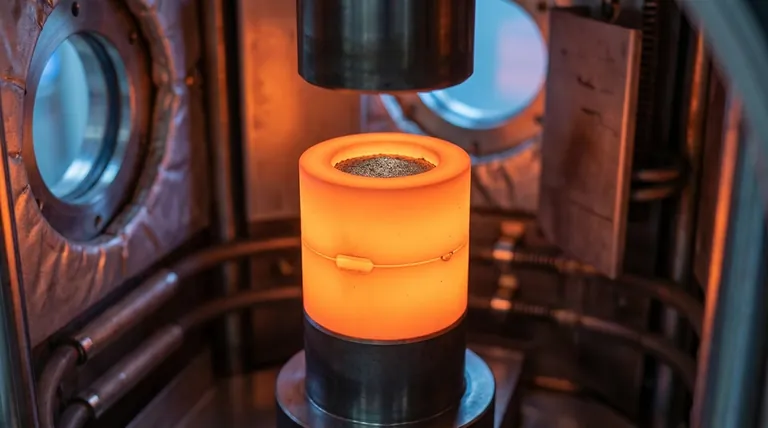
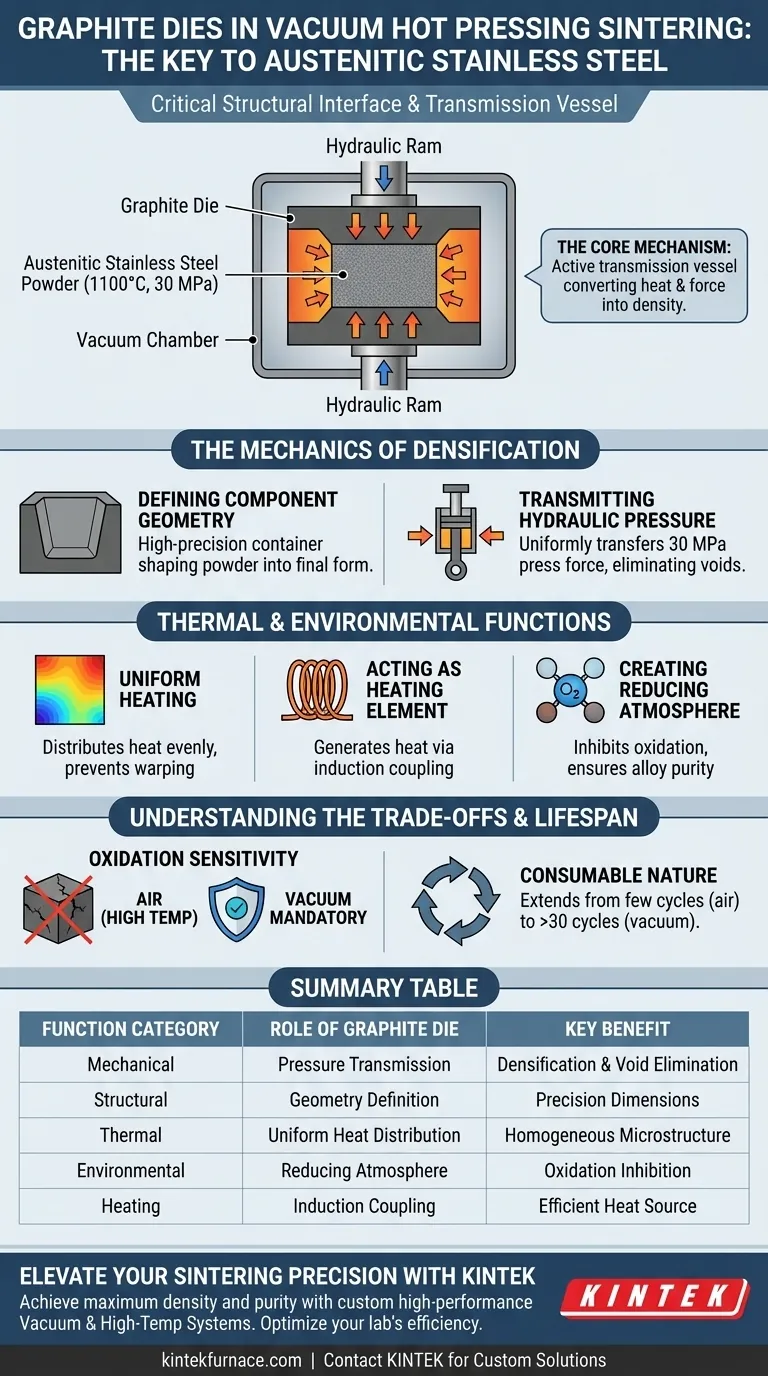
Graphite dies function as the critical structural interface during the vacuum hot pressing of austenitic stainless steel. Their primary role is twofold: they define the macroscopic geometry of the sintered component and serve as the medium for transmitting hydraulic pressure to the powder. This facilitates the densification of particles at high temperatures, typically around 1100°C.
The Core Mechanism The graphite die is not merely a passive container; it acts as an active transmission vessel that converts heat and axial force into material density. It allows for the simultaneous application of pressure (up to 30 MPa) and temperature, forcing the stainless steel powder to undergo plastic deformation and bond into a solid, high-strength structure.
The Mechanics of Densification
Defining Component Geometry
The most immediate function of the graphite die is shaping. It acts as a high-precision container that holds the loose austenitic stainless steel powder. Because the powder does not have a fixed form initially, the die defines the final dimensions and limits of the sintered sample, such as a cylindrical shape.
Transmitting Hydraulic Pressure
For sintering to occur effectively, the powder must be compressed. The graphite die withstands the immense axial force generated by the hydraulic press. It acts as the transfer medium, ensuring that this mechanical pressure is passed uniformly from the press rams to the powder body, which is essential for eliminating voids and achieving high density.
Thermal and Environmental Functions
Facilitating Uniform Heating
Graphite possesses excellent thermal conductivity. During the hot pressing cycle, the die ensures that heat is distributed evenly throughout the stainless steel powder. This uniformity is critical for preventing thermal gradients that could lead to warped components or uneven microstructures within the steel.
Acting as a Heating Element
In systems utilizing induction heating, the graphite die often serves as the heat source itself. Due to its electrical conductivity, the graphite couples with the induction field to generate heat, which is then transferred to the non-conductive or less conductive powder contents.
Creating a Reducing Atmosphere
At elevated temperatures, graphite can create a local reducing environment. This helps inhibit the oxidation of the material inside the die. For stainless steel, maintaining a low-oxygen environment is vital to preserve the purity of the alloy and ensure proper particle bonding.
Understanding the Trade-offs
High-Temperature Oxidation Sensitivity
While graphite is robust in a vacuum, it is highly susceptible to oxidation in air at high temperatures. The vacuum environment is therefore mandatory not only for the stainless steel but to protect the die itself. If exposed to oxygen while hot, the die would degrade rapidly, losing its dimensional accuracy.
Consumable Nature and Wear
Despite their high-temperature strength, graphite dies are considered consumables. They are subjected to significant mechanical stress and thermal cycling, which eventually limits their lifespan. However, using them in a vacuum significantly extends their utility—often from a few cycles in air to over 30 cycles in a vacuum—thereby reducing long-term material costs.
Making the Right Choice for Your Goal
To maximize the effectiveness of graphite dies in your sintering process, consider the following regarding your specific objectives:
- If your primary focus is Dimensional Precision: Ensure your vacuum system maintains a high integrity to prevent oxidation-induced erosion of the die walls, which alters part tolerance.
- If your primary focus is Material Purity: Leverage the graphite die's ability to create a reducing atmosphere, but verify that the process temperature (e.g., 1100°C) is strictly controlled to prevent adverse reactions.
Ultimately, the graphite die is the vessel that enables the transition from loose powder to a high-performance austenitic stainless steel component through the precise application of heat and pressure.
Summary Table:
| Function Category | Role of Graphite Die | Key Benefit for Stainless Steel |
|---|---|---|
| Mechanical | Pressure Transmission | Facilitates densification and eliminates voids up to 30 MPa |
| Structural | Geometry Definition | Ensures high-precision dimensions and final component shape |
| Thermal | Uniform Heat Distribution | Prevents thermal gradients and ensures uniform microstructure |
| Environmental | Local Reducing Atmosphere | Inhibits alloy oxidation and promotes superior particle bonding |
| Heating | Induction Coupling | Acts as a heat source for efficient, high-temperature processing |
Elevate Your Sintering Precision with KINTEK
Are you looking to achieve maximum density and purity in your high-performance alloys? Backed by expert R&D and manufacturing, KINTEK offers high-performance Muffle, Tube, Rotary, Vacuum, and CVD systems, along with specialized lab high-temp furnaces—all fully customizable to your unique sintering needs.
Our advanced thermal solutions ensure the perfect environment for your graphite dies, extending their lifespan and guaranteeing the integrity of your austenitic stainless steel components.
Ready to optimize your lab's efficiency? Contact KINTEK today to discuss your custom furnace solution!
Visual Guide
Related Products
- 2200 ℃ Graphite Vacuum Heat Treat Furnace
- Vacuum Heat Treat Sintering Furnace with Pressure for Vacuum Sintering
- 600T Vacuum Induction Hot Press Vacuum Heat Treat and Sintering Furnace
- Vacuum Hot Press Furnace Machine Heated Vacuum Press Tube Furnace
- 9MPa Air Pressure Vacuum Heat Treat and Sintering Furnace
People Also Ask
- Why are vacuum heat treating furnaces essential for aerospace? Ensure Superior Material Integrity for High-Stakes Applications
- What is the primary application of vacuum heat treating furnaces in aerospace? Enhance Component Performance with Precision
- How does vacuum heat treating work in terms of temperature and time control? Master Precise Material Transformations
- How does a vacuum heat treating furnace improve the condition of metal alloys? Achieve Superior Metal Performance
- What is the process of vacuum heat treating? Achieve Superior Metallurgical Properties















