
A vacuum hot pressing furnace serves as the central processing unit for Alumina Dispersion Strengthened Copper (ADSC) alloys by creating a specific "multi-physics" environment that forces densification while preserving chemical purity. Specifically, it integrates high temperatures (e.g., 950°C), uniaxial mechanical pressure (e.g., 27 MPa), and a high-vacuum environment (e.g., 1.33 x 10^-2 Pa) to eliminate pores and bond particles without allowing the copper matrix to oxidize.
The core value of this technology lies in simultaneity: by applying mechanical force during the heating phase within a vacuum, it achieves diffusion bonding and near-theoretical density that thermal sintering alone cannot match, all while shielding the reactive copper from oxygen.
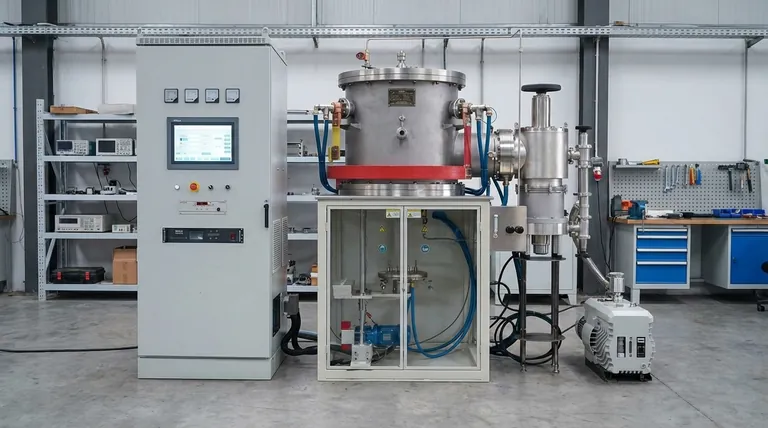
The Mechanics of Multi-Physics Synergy
To understand why this furnace is essential for ADSC alloys, one must look beyond simple heating. It is the convergence of three distinct physical forces that drives the forming process.
Uniaxial Mechanical Pressure
Heat alone is often insufficient to fully densify dispersion-strengthened alloys. The furnace applies uniaxial mechanical pressure (specifically around 27 MPa for this application) directly to the powder compact.
This physical force mechanically overcomes the resistance between particles. It promotes diffusion bonding by forcing powder particles into intimate contact, effectively closing the voids and pores that would remain in a pressureless sintering process.
High-Temperature Kinetics
The furnace elevates the environment to approximately 950°C. At this temperature, the copper matrix becomes sufficiently malleable, and atomic diffusion rates increase significantly.
This thermal energy, combined with the applied pressure, activates the mechanisms necessary for the particles to bond at the atomic level. It creates a solid, cohesive billet from loose powder.
The "Synergy" Effect
The true power of the furnace is not just the heat or the pressure, but their combination. This multi-physics synergy accelerates densification.
By applying pressure while the material is hot, the furnace achieves high density more efficiently than separate heating and forging steps.
The Critical Role of the Vacuum Environment
For copper-based alloys, the atmosphere is just as critical as the temperature. Copper is highly susceptible to oxidation at the temperatures required for sintering.
Preventing Matrix Oxidation
At 950°C, copper would rapidly oxidize in a standard atmosphere, degrading the electrical and thermal properties that make ADSC alloys valuable.
The furnace creates a high-vacuum environment (e.g., 1.33 x 10^-2 Pa). This effectively eliminates oxygen from the chamber, ensuring the copper matrix remains metallic and chemically pure throughout the densification cycle.
Ensuring Structural Integrity
Oxidation doesn't just affect conductivity; it creates brittle inclusions within the metal.
By processing in a vacuum, the furnace ensures the final billet is oxidation-free. This results in a material that maintains the ductility and structural integrity required for high-performance applications.
Understanding the Trade-offs
While vacuum hot pressing is the superior method for high-quality ADSC consolidation, it introduces specific constraints that must be managed.
Throughput Limitations
This is inherently a batch process. Unlike continuous casting or sintering, the furnace must be cycled (pumped down, heated, pressed, cooled, and vented) for each run.
This can limit production volume compared to continuous methods, making it best suited for high-value components where quality supersedes quantity.
Die Constraints
The application of uniaxial pressure requires robust tooling, typically graphite dies.
These dies have geometric limitations. Producing complex, near-net shapes is difficult; the output is typically a simple billet or plate that requires subsequent machining.
Making the Right Choice for Your Goal
The vacuum hot pressing furnace is a specialized tool. Whether it is the right choice depends on the specific performance metrics required for your final component.
- If your primary focus is Electrical Conductivity: Prioritize the vacuum level. A deeper vacuum ($< 10^{-2}\text{ Pa}$) is critical to prevent even trace oxidation that disrupts the copper matrix and lowers conductivity.
- If your primary focus is Mechanical Strength: Prioritize the pressure parameters. Ensure the uniaxial pressure (e.g., 27 MPa) is sustained throughout the peak temperature hold to maximize diffusion bonding and eliminate all porosity.
Summary: The vacuum hot pressing furnace is not merely a heater; it is a consolidation engine that leverages pressure to force density and vacuum to preserve purity, making it the definitive solution for high-performance ADSC alloys.
Summary Table:
| Feature | Parameter Detail | Impact on ADSC Alloy |
|---|---|---|
| Temperature | Up to 950°C | Activates atomic diffusion and matrix malleability |
| Pressure | ~27 MPa (Uniaxial) | Overcomes particle resistance to eliminate pores |
| Vacuum Level | 1.33 x 10⁻² Pa | Prevents copper oxidation and ensures high conductivity |
| Process Goal | Multi-physics Synergy | Achieves near-theoretical density and diffusion bonding |
| Output Quality | Oxidation-free Billet | Maintains high structural integrity and ductility |
Elevate Your Material Performance with KINTEK
Ready to achieve superior densification for your advanced alloys? KINTEK provides industry-leading high-temperature solutions backed by expert R&D and precision manufacturing.
Whether you require Muffle, Tube, Rotary, Vacuum, or CVD systems, our furnaces are fully customizable to meet your unique laboratory or industrial needs. Our vacuum hot pressing technology ensures your ADSC alloys reach near-theoretical density without the risk of oxidation.
Contact KINTEK today to discuss your custom furnace requirements and see how our expertise can drive your innovation forward.
Visual Guide

Related Products
- 600T Vacuum Induction Hot Press Vacuum Heat Treat and Sintering Furnace
- Vacuum Hot Press Furnace Machine for Lamination and Heating
- Vacuum Hot Press Furnace Machine Heated Vacuum Press
- Vacuum Hot Press Furnace Machine Heated Vacuum Press Tube Furnace
- High Pressure Laboratory Vacuum Tube Furnace
People Also Ask
- Why use Vacuum Hot Press (VHP) for ZnS Ceramics? Achieve Superior IR Transparency and Mechanical Strength
- How does a vacuum hot press sintering furnace mitigate copper sintering swelling? Solve Fe-Cu Expansion Issues
- What is the core function of a vacuum hot press sintering furnace in the preparation of high-density RuTi alloys? Achieve Maximum Density and Purity
- What are the key advantages of vacuum hot press sintering furnaces? Achieve Superior Density and Purity in Materials
- What are the benefits of using a vacuum hot press sintering furnace for the preparation of SiCw/2024 aluminum matrix composites? Achieve High-Performance Aerospace Materials



















