
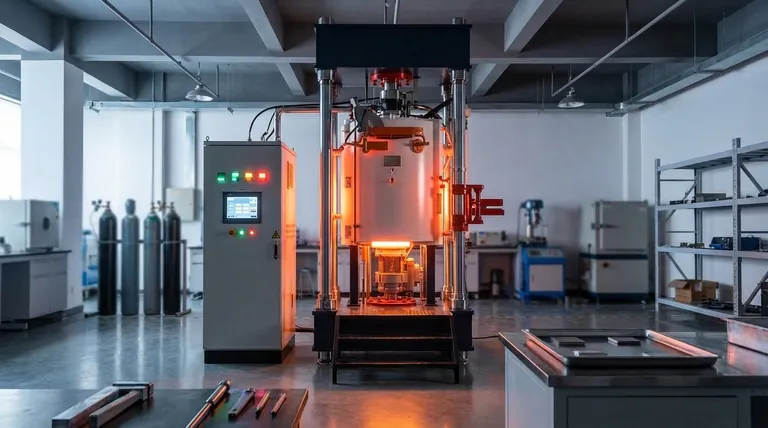
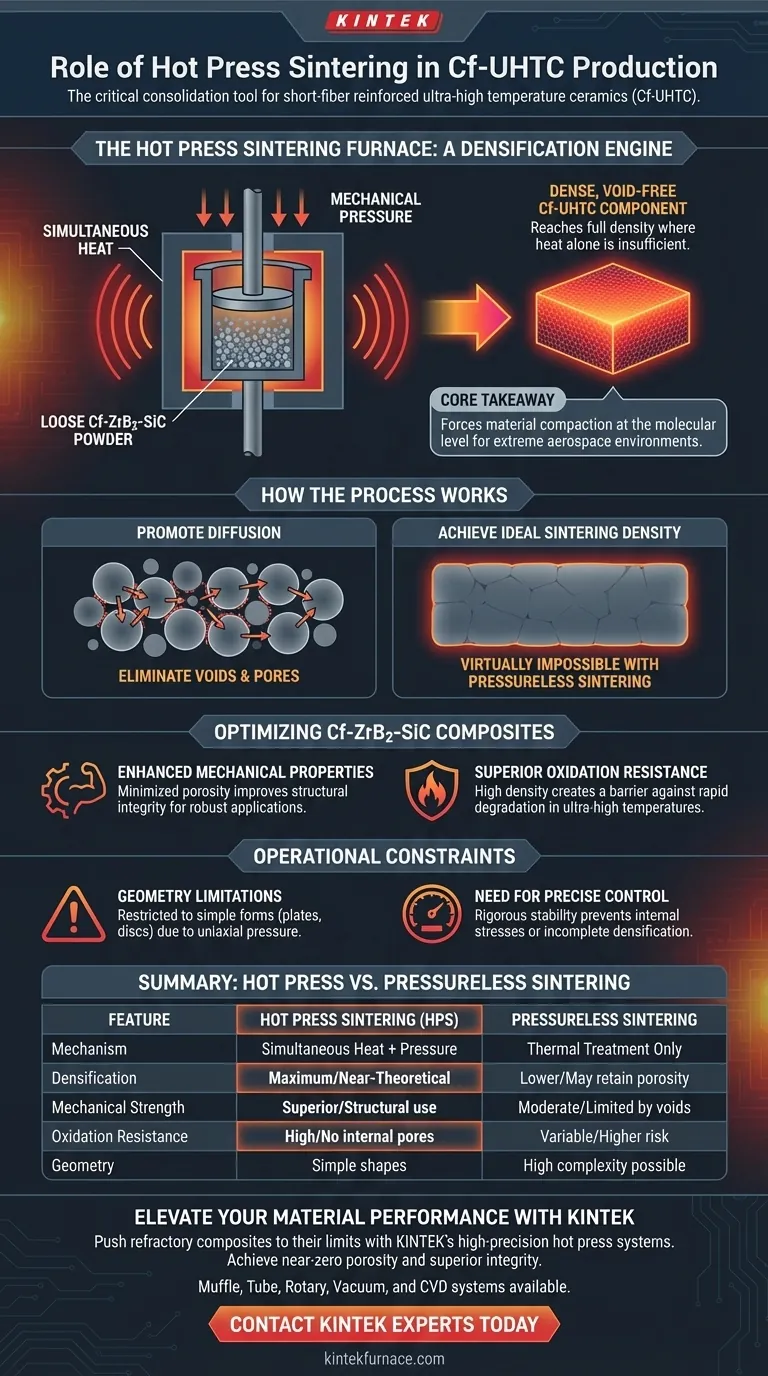
The hot press sintering furnace acts as the critical consolidation tool in the manufacturing of short-fiber reinforced ultra-high temperature ceramics (Cf-UHTC), specifically Cf-ZrB2-SiC composites. It functions by creating a strictly controlled environment that applies simultaneous high temperature and mechanical pressure to ceramic powders, driving the material to reach full density where heat alone would be insufficient.
Core Takeaway While standard furnaces only apply heat, a hot press sintering furnace uses physical pressure to force material compaction at the molecular level. This dual-action process is essential for transforming loose Cf-ZrB2-SiC powders into dense, oxidation-resistant components capable of surviving extreme aerospace environments.
How the Process Works
The production of high-performance ceramics requires more than simple thermal treatment. The hot press furnace addresses the specific physical challenges of sintering complex composites.
Simultaneous Heat and Pressure
The defining feature of this equipment is its ability to apply heat and pressure at the same time.
While the high temperature softens the material, the mechanical pressure forces the particles together.
Promoting Diffusion and Densification
For distinct ceramic powder particles to become a solid mass, atoms must move across particle boundaries.
The furnace promotes this diffusion, effectively eliminating voids and pores between particles. This ensures the material achieves an ideal sintering density, which is virtually impossible to achieve with pressureless sintering for these specific materials.
Optimizing Cf-ZrB2-SiC Composites
The primary reference highlights the specific application of this furnace for Cf-ZrB2-SiC (Carbon fiber reinforced Zirconium Diboride-Silicon Carbide) materials.
Enhancing Mechanical Properties
By minimizing porosity through pressure, the furnace significantly improves the structural integrity of the composite.
The resulting material exhibits superior mechanical properties, making it robust enough for structural applications rather than just thermal insulation.
Ensuring Oxidation Resistance
In ultra-high temperature environments, any internal porosity can lead to rapid material degradation.
The high density achieved via hot pressing creates a barrier that grants the composite superior oxidation resistance. This is a prerequisite for materials intended for re-entry vehicles or hypersonic flight.
Understanding the Operational Constraints
While the hot press furnace is vital for performance, it introduces specific operational factors that must be managed.
Geometry Limitations
Unlike pressureless sintering or muffle furnaces, which can process complex shapes, hot pressing typically restricts component geometry to simpler forms (plates or discs) due to the uniaxial pressure application.
The Need for Precise Control
The primary benefit of this furnace is the "controlled environment."
Deviations in either pressure or temperature curves can lead to internal stresses or incomplete densification. The equipment must maintain rigorous stability to ensure the "ideal" density mentioned in technical specifications is actually reached.
Making the Right Choice for Your Goal
To determine if this specific sintering technology aligns with your manufacturing requirements, consider the following technical priorities:
- If your primary focus is Maximum Density and Strength: You must use a hot press sintering furnace, as simultaneous pressure is required to eliminate voids in refractory ceramics like ZrB2-SiC.
- If your primary focus is Complex Geometry: You may need to explore pressureless sintering techniques, accepting that you will likely sacrifice some density and mechanical strength compared to hot-pressed parts.
The hot press sintering furnace is not merely a heater; it is a densification engine designed to push refractory composites to their theoretical performance limits.
Summary Table:
| Feature | Hot Press Sintering (HPS) | Pressureless Sintering |
|---|---|---|
| Mechanism | Simultaneous Heat + Mechanical Pressure | Thermal Treatment Only |
| Densification | Maximum (Near-Theoretical Density) | Lower (May retain porosity) |
| Mechanical Strength | Superior; ideal for structural use | Moderate; often limited by voids |
| Oxidation Resistance | High; due to lack of internal pores | Variable; higher risk of degradation |
| Geometry Complexity | Simple shapes (plates, discs) | High complexity possible |
Elevate Your Material Performance with KINTEK
Ready to push your refractory composites to their theoretical limits? KINTEK’s high-precision hot press sintering systems provide the rigorous temperature and uniaxial pressure control necessary to achieve near-zero porosity and superior mechanical integrity in Cf-UHTC production.
Backed by expert R&D and world-class manufacturing, KINTEK offers a full suite of Muffle, Tube, Rotary, Vacuum, and CVD systems, all fully customizable to meet your unique laboratory or industrial needs. Don't compromise on density or durability—partner with the leaders in high-temperature technology.
Contact KINTEK Experts Today to discuss your custom furnace requirements.
Visual Guide
References
- Sirui Gong, Yukui Wang. Methodology for Surface Reconstruction and Prediction Based on the Electrical Discharge Machining Removal Mechanism of Cf-UHTC Materials. DOI: 10.3390/ma18020371
This article is also based on technical information from Kintek Furnace Knowledge Base .
Related Products
- 600T Vacuum Induction Hot Press Vacuum Heat Treat and Sintering Furnace
- Vacuum Hot Press Furnace Machine Heated Vacuum Press Tube Furnace
- 9MPa Air Pressure Vacuum Heat Treat and Sintering Furnace
- Vacuum Heat Treat Sintering Furnace with Pressure for Vacuum Sintering
- Vacuum Hot Press Furnace Machine Heated Vacuum Press
People Also Ask
- Why use Vacuum Hot Press (VHP) for ZnS Ceramics? Achieve Superior IR Transparency and Mechanical Strength
- How does a vacuum hot press sintering furnace mitigate copper sintering swelling? Solve Fe-Cu Expansion Issues
- How does the vacuum environment in a vacuum hot press sintering furnace protect chromium-containing ceramics? Find out.
- What are the key advantages of vacuum hot press sintering furnaces? Achieve Superior Density and Purity in Materials
- What is the core function of a vacuum hot press sintering furnace in the preparation of high-density RuTi alloys? Achieve Maximum Density and Purity



















