
The integrity of copper-carbon nanotube (Cu-CNT) composites relies fundamentally on the purity of the sintering environment. A high vacuum is critical because it simultaneously prevents the oxidation of the copper matrix and the nanotubes while actively extracting adsorbed gases from the powder surfaces. Without this controlled atmosphere, the material cannot achieve the atomic-level contact required for high electrical conductivity and superior mechanical strength.
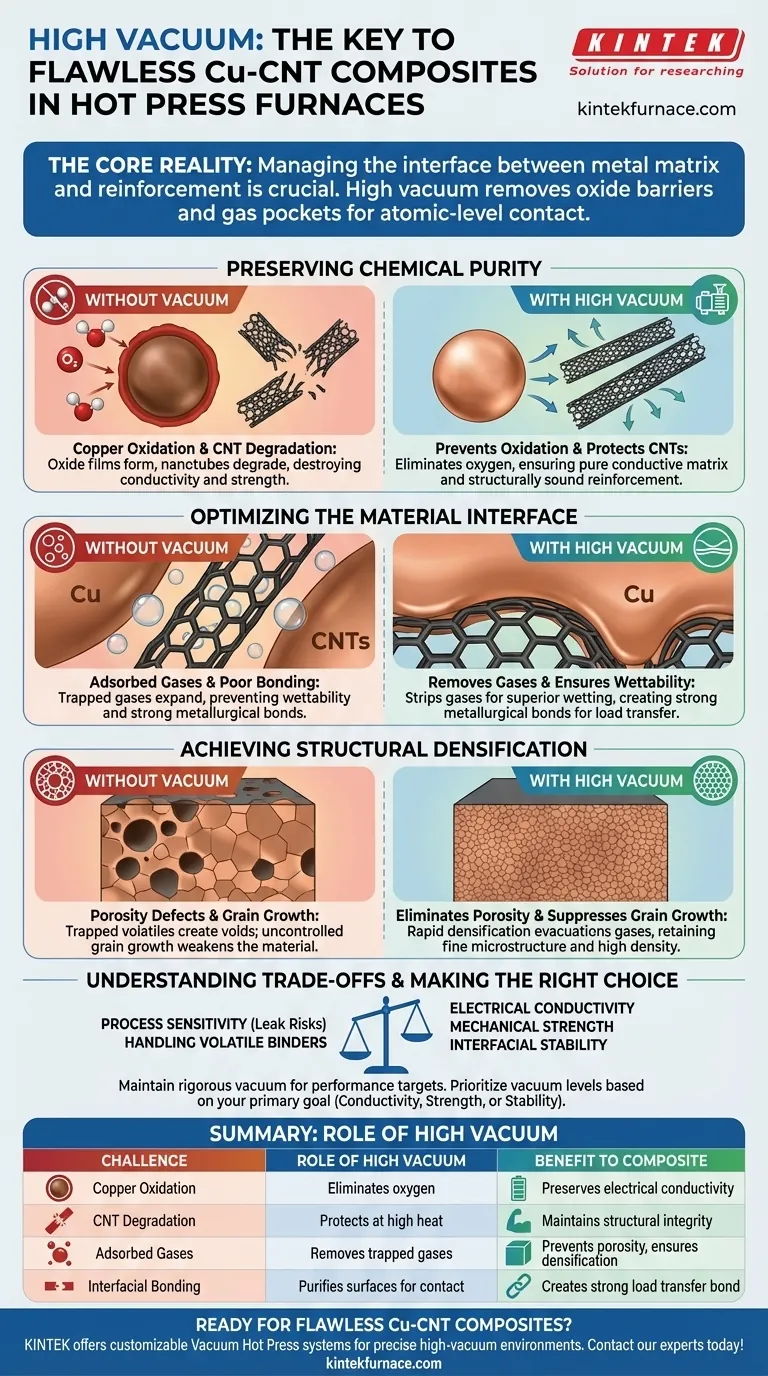
The Core Reality Creating a viable Cu-CNT composite is less about heating the material and more about managing the interface between the metal and the reinforcement. A high vacuum environment is the primary mechanism that removes oxide barriers and gas pockets, facilitating the direct atomic diffusion necessary for a dense, high-performance composite.
Preserving Chemical Purity at High Temperatures
Preventing Copper Matrix Oxidation
At the elevated temperatures required for sintering, copper is highly reactive with oxygen. Without a vacuum, oxide films form rapidly on the surface of the copper particles.
These oxide layers act as electrical insulators and mechanical weak points. A high vacuum environment (often around $10^{-5}$ mbar) eliminates oxygen, ensuring the copper matrix remains pure and conductive.
Protecting the Carbon Nanotubes
Carbon nanotubes (CNTs) act as the reinforcement phase, but they are also susceptible to degradation in the presence of oxygen at high heat.
The vacuum environment protects the structural integrity of the CNTs. This preservation is vital, as any damage to the nanotube structure compromises the mechanical reinforcement they provide to the composite.
Optimizing the Material Interface
Removing Adsorbed Gases
Milled powders, particularly those used in composite preparation, possess high specific surface areas that trap significant amounts of adsorbed gases.
If these gases are not evacuated, they expand during heating. A high vacuum effectively strips these gases from the particle surfaces before the sintering phase begins.
Ensuring Wettability and Bonding
Strong interfacial bonding relies on "wettability"—the ability of the metal to flow over and adhere to the reinforcement.
By purifying the powder surface and removing contaminants, the vacuum improves the wettability between the copper and the CNTs. This leads to a strong metallurgical bond, which is essential for effective load transfer within the composite.
Achieving Structural Densification
Eliminating Porosity Defects
Porosity is the enemy of mechanical strength. Trapped gases and volatiles that are not removed during the initial stages of heating create voids (pores) in the final product.
The vacuum environment evacuates gases from the interstitial spaces between powder particles. This allows the material to densify rapidly and completely while in a thermoplastic state.
Suppressing Grain Growth
While densification is desired, uncontrolled grain growth can weaken the material.
Vacuum hot pressing facilitates rapid densification, which effectively suppresses excessive grain growth. This balance results in a bulk material that retains a fine microstructure and high density.
Understanding the Trade-offs
Process Sensitivity and Leak Risks
While a high vacuum is indispensable, it introduces significant process sensitivity. The equipment requires rigorous maintenance of seals and pumps.
Even a minor leak or a failure to reach the specific vacuum threshold can result in partial oxidation. This is often more detrimental than total failure, as it creates invisible defects inside the composite that lead to unpredictable performance.
Handling Volatile Binders
In some preparation methods involving binders or waxes, the vacuum assists in extracting these volatiles.
However, this requires careful ramp-up rates. If the vacuum pulls too hard too quickly on volatile binders, it can disrupt the powder arrangement before sintering occurs.
Making the Right Choice for Your Goal
When configuring your vacuum hot press parameters, consider your specific performance targets:
- If your primary focus is Electrical Conductivity: Prioritize the highest possible vacuum levels to ensure the complete removal of oxide films, which act as barriers to electron flow.
- If your primary focus is Mechanical Strength: Focus on the evacuation of interstitial gases to minimize porosity, ensuring a fully dense structure that can withstand physical loads.
- If your primary focus is Interfacial Stability: Ensure the vacuum is maintained during the cooling phase to prevent re-oxidation of the surface while the material is still chemically active.
The vacuum is not merely a protective measure; it is an active processing tool that dictates the final quality of the interface between your matrix and reinforcement.
Summary Table:
| Challenge | Role of High Vacuum | Benefit to Composite |
|---|---|---|
| Copper Oxidation | Eliminates oxygen from the chamber | Preserves electrical conductivity of the matrix |
| CNT Degradation | Protects nanotubes from oxygen at high heat | Maintains structural integrity for mechanical reinforcement |
| Adsorbed Gases | Removes gases trapped on powder surfaces | Prevents porosity and ensures complete densification |
| Interfacial Bonding | Purifies surfaces for better metal-to-CNT contact | Creates a strong bond for effective load transfer |
Ready to achieve flawless Cu-CNT composites? The right furnace is critical. Backed by expert R&D and manufacturing, KINTEK offers customizable Vacuum Hot Press systems, including Muffle, Tube, Rotary, and CVD furnaces, designed to deliver the precise high-vacuum environment your research demands.
Contact our experts today to discuss how we can tailor a solution for your unique composite preparation needs.
Visual Guide
Related Products
- Vacuum Hot Press Furnace Machine for Lamination and Heating
- Vacuum Hot Press Furnace Machine Heated Vacuum Press Tube Furnace
- 600T Vacuum Induction Hot Press Vacuum Heat Treat and Sintering Furnace
- Vacuum Hot Press Furnace Machine Heated Vacuum Press
- Vacuum Heat Treat Sintering Furnace with Pressure for Vacuum Sintering
People Also Ask
- What are the primary components of a vacuum hot press furnace? Master the Core Systems for Precise Material Processing
- What are the benefits of the vacuum environment system in a vacuum hot press furnace? Unlock High-Density Sintering
- What safety features are incorporated in vacuum hot press furnaces? Ensure Operator and Equipment Protection
- What industries benefit from the use of vacuum hot press furnaces? Unlock High-Performance Materials for Your Industry
- Which process parameters must be optimized for specific materials in a vacuum hot press furnace? Achieve Optimal Density and Microstructure



















