
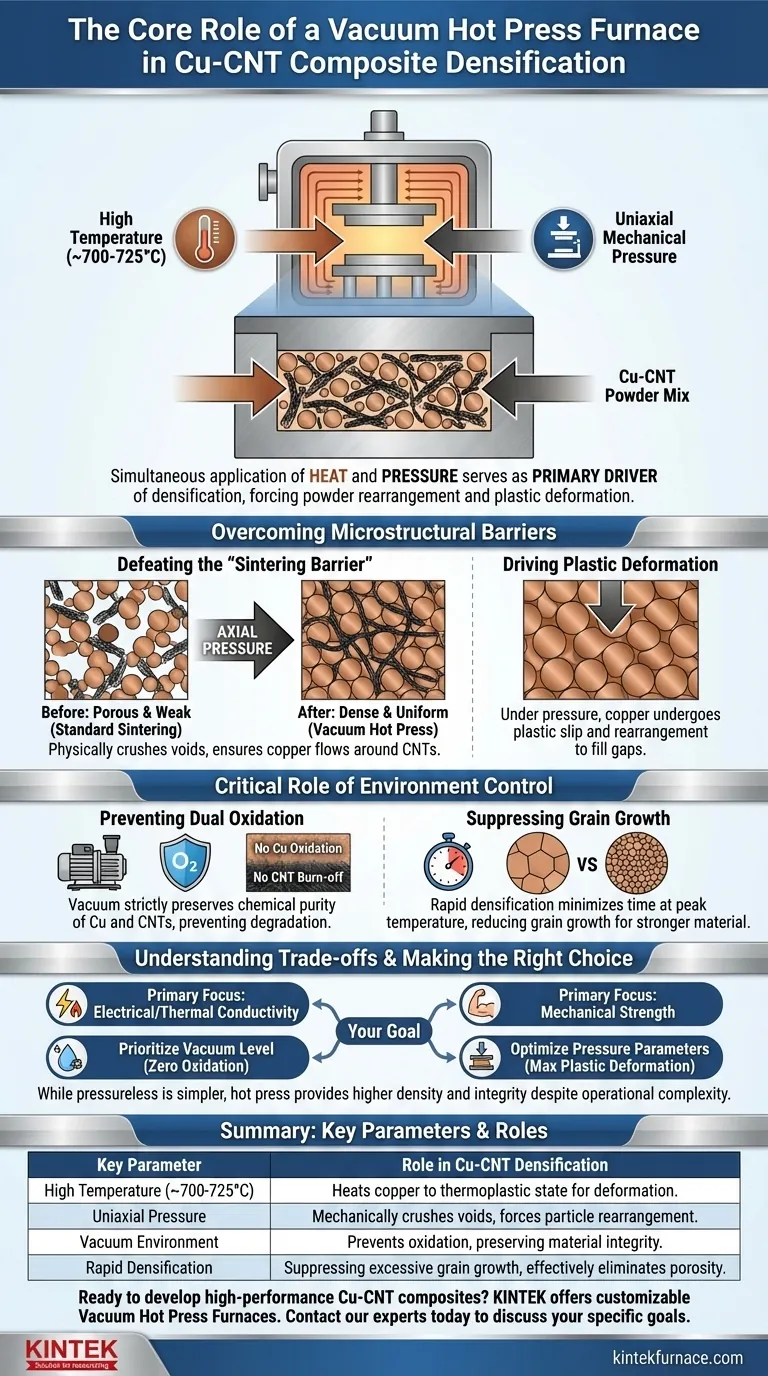
A vacuum hot press furnace serves as the primary driver of densification for copper-carbon nanotube (Cu-CNT) composites by simultaneously applying high heat (approximately 700-725°C) and uniaxial mechanical pressure. This dual-action approach physically forces powder particles to rearrange and undergo plastic deformation, overcoming the natural resistance to sintering created by carbon nanotubes to achieve near-theoretical density.
The core value of this equipment lies in its ability to mechanically eliminate porosity that temperature alone cannot resolve, while the vacuum environment strictly preserves the chemical purity of both the copper matrix and the carbon nanotubes.
Overcoming Microstructural Barriers
Defeating the "Sintering Barrier"
Carbon nanotubes are notoriously difficult to incorporate into metal matrices because they inhibit diffusion and create spacing between particles.
Standard pressureless sintering often fails to close these gaps, resulting in a porous, weak material. The vacuum hot press furnace overcomes this by applying axial mechanical pressure. This force physically crushes the voids and ensures the copper matrix flows around the nanotubes.
Driving Plastic Deformation
The furnace operates by heating the copper to a thermoplastic state.
Under the influence of the applied pressure, the copper particles undergo plastic slip and rearrangement. This mechanism forces the material to fill interstitial spaces, resulting in a dense, uniform structure that is difficult to achieve through diffusion mechanisms alone.
The Critical Role of Environment Control
Preventing Dual Oxidation
The "vacuum" component of the furnace is as critical as the pressure. Copper oxidizes readily at high temperatures, which degrades electrical and thermal conductivity.
Furthermore, carbon nanotubes can degrade or burn away in the presence of oxygen. The high-vacuum environment ensures that neither the matrix nor the reinforcement oxidizes during the heating process, maintaining the integrity of the composite.
Suppressing Grain Growth
Achieving high density often requires high heat, which can lead to excessive grain growth—a side effect that weakens the material.
The hot press method facilitates rapid densification. Because the pressure aids densification so effectively, the material spends less time at peak temperatures compared to conventional methods. This effectively suppresses excessive grain growth while still eliminating pores.
Understanding the Trade-offs
Equipment Complexity vs. Material Quality
While pressureless sintering is simpler, it creates composites with lower density and structural integrity.
The trade-off here is operational complexity for performance. You are exchanging a simple firing process for a system that must manage hydraulics, vacuum integrity, and precise thermal profiles simultaneously. This is necessary because Cu-CNT composites possess high inter-particle friction and covalent bonding characteristics that simple heating cannot overcome.
Limitations of Uniaxial Pressure
It is important to note that hot pressing typically applies pressure in one direction (uniaxial).
While this is excellent for flat plates or simple shapes, it forces particle rearrangement primarily in the direction of the force. For highly complex geometries, this can present challenges compared to isostatic pressing methods, though it remains superior for producing dense bulk billets.
Making the Right Choice for Your Goal
To maximize the utility of a vacuum hot press furnace for your Cu-CNT project, consider your primary performance metrics:
- If your primary focus is Electrical/Thermal Conductivity: Prioritize the vacuum level to ensure zero oxidation of the copper matrix, as oxides act as insulators.
- If your primary focus is Mechanical Strength: Focus on the optimization of the pressure parameters (e.g., 700-725°C range) to maximize plastic deformation and reach theoretical density limits.
Ultimately, the vacuum hot press furnace is not just a heating element; it is a mechanical forming tool essential for forcing reluctant materials into a unified, high-performance composite.
Summary Table:
| Key Parameter | Role in Cu-CNT Densification |
|---|---|
| High Temperature (~700-725°C) | Heats copper to a thermoplastic state for deformation. |
| Uniaxial Pressure | Mechanically crushes voids, forces particle rearrangement and plastic flow. |
| Vacuum Environment | Prevents oxidation of copper and carbon nanotubes, preserving material integrity. |
| Rapid Densification | Suppresses excessive grain growth while effectively eliminating porosity. |
Ready to develop high-performance copper-carbon nanotube composites?
Backed by expert R&D and manufacturing, KINTEK offers a range of customizable Vacuum Hot Press Furnaces designed to overcome the sintering barriers of advanced materials like Cu-CNTs. Our systems ensure the precise control of temperature, pressure, and vacuum environment critical for achieving maximum density, conductivity, and strength.
Contact our experts today to discuss how a KINTEK vacuum hot press furnace can be tailored to your specific research and production goals.
Visual Guide
Related Products
- Vacuum Hot Press Furnace Machine for Lamination and Heating
- 600T Vacuum Induction Hot Press Vacuum Heat Treat and Sintering Furnace
- Vacuum Hot Press Furnace Machine Heated Vacuum Press Tube Furnace
- Vacuum Hot Press Furnace Machine Heated Vacuum Press
- High Pressure Laboratory Vacuum Tube Furnace
People Also Ask
- What are the primary components of a vacuum hot press furnace? Master the Core Systems for Precise Material Processing
- What safety features are incorporated in vacuum hot press furnaces? Ensure Operator and Equipment Protection
- What are the benefits of the vacuum environment system in a vacuum hot press furnace? Unlock High-Density Sintering
- What industries benefit from the use of vacuum hot press furnaces? Unlock High-Performance Materials for Your Industry
- How does the uniaxial pressure applied by a vacuum hot press furnace affect the microstructure of ZrC-SiC materials?



















