
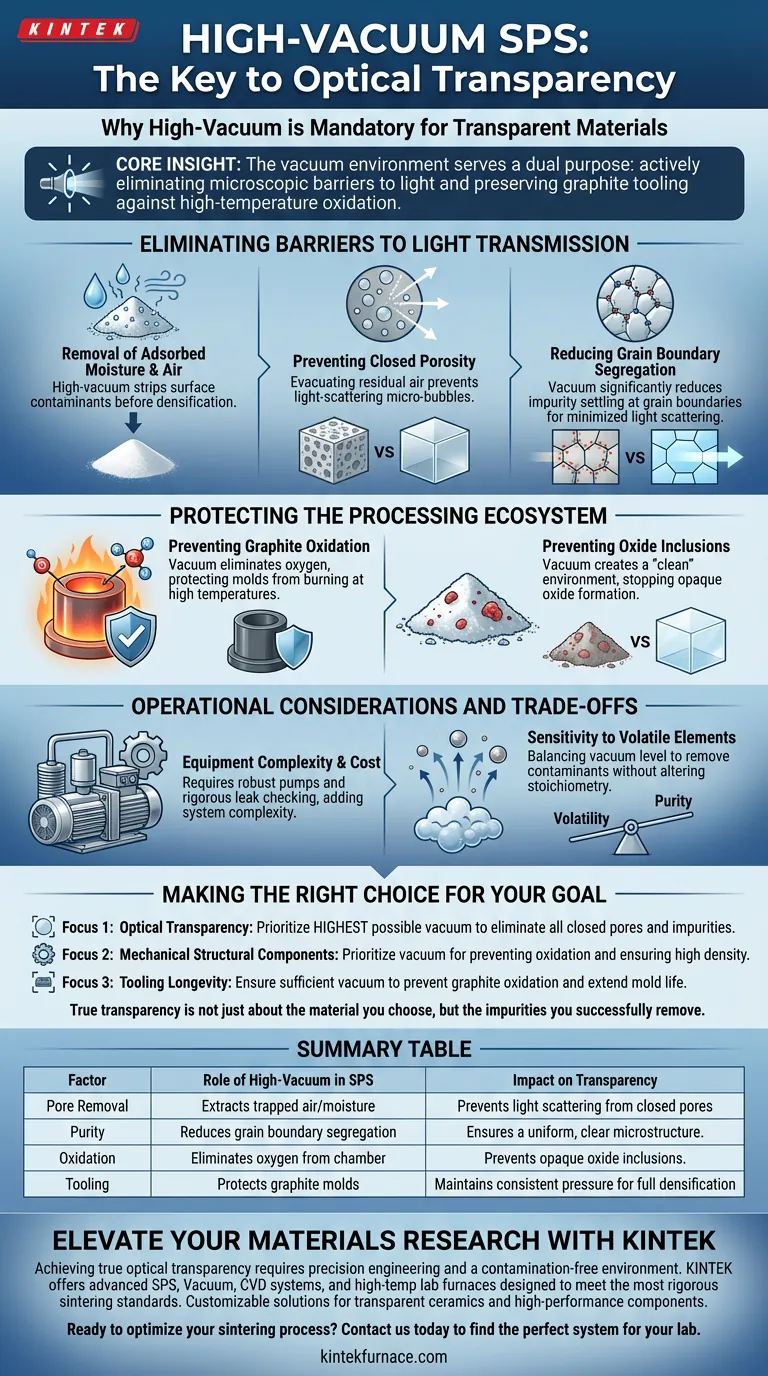
Optical transparency requires distinct microstructural purity. A high-vacuum environment is mandatory during Spark Plasma Sintering (SPS) to forcefully extract residual air and adsorbed moisture from the gaps between powder particles. This process prevents the physical entrapment of gases that would otherwise create light-scattering defects within the material.
Core Insight: The vacuum environment serves a dual purpose: it actively eliminates microscopic barriers to light—such as closed pores and grain boundary impurities—while simultaneously preserving the integrity of the graphite tooling against high-temperature oxidation.
Eliminating Barriers to Light Transmission
To achieve transparency, a material must be free of internal defects that scatter light. The high-vacuum environment addresses the root causes of these defects.
Removal of Adsorbed Moisture and Air
Raw ceramic powders naturally adsorb moisture and air on their surfaces. A high-vacuum environment is required to strip these contaminants away before the sintering process fully densifies the material.
Preventing Closed Porosity
SPS is a rapid sintering technique. If residual air is not evacuated prior to this rapid densification, it becomes trapped between the fusing particles. This results in closed pores—microscopic bubbles inside the solid material that scatter light and render the final product opaque rather than transparent.
Reducing Grain Boundary Segregation
Impurity gases have a tendency to migrate toward and settle at the grain boundaries of the material. Vacuum processing significantly reduces this segregation. Clean grain boundaries are essential for minimizing light scattering and achieving high optical quality.
Protecting the Processing Ecosystem
Beyond the material itself, the vacuum environment is critical for maintaining the equipment and tooling required for the process.
Preventing Graphite Oxidation
SPS relies heavily on graphite molds to conduct current and apply pressure. At the high temperatures required for sintering, graphite oxidizes (burns) rapidly if exposed to oxygen. A high-vacuum environment eliminates oxygen, protecting the molds from degradation and ensuring consistent pressure application.
Preventing Oxide Inclusions
Vacuum conditions prevent the oxidation of the powder material itself during heating. This creates a "clean" sintering environment that stops the formation of oxide inclusions. These inclusions would otherwise act as defects, degrading both the optical clarity and the mechanical integrity of the bulk material.
Operational Considerations and Trade-offs
While a high-vacuum is critical for transparency, it introduces specific challenges that must be managed.
Equipment Complexity and Cost
Maintaing a high-vacuum adds significant complexity to the SPS system compared to standard atmospheric furnaces. It requires robust pumping systems and rigorous leak checking to ensure the vacuum level is sufficient to remove adsorbed volatiles effectively.
Sensitivity to Volatile Elements
While vacuum removes unwanted impurities, it can also lead to the evaporation of desired volatile elements in certain complex compounds. Process engineers must balance the vacuum level to remove contaminants without altering the stoichiometry of the material.
Making the Right Choice for Your Goal
The level of vacuum stringency depends heavily on the final application of your sintered material.
- If your primary focus is Optical Transparency: You must prioritize the highest possible vacuum to eliminate all closed pores and grain boundary impurities that scatter light.
- If your primary focus is Mechanical Structural Components: You may prioritize vacuum primarily to prevent oxidation and ensure high density, as minor optical defects are less critical.
- If your primary focus is Tooling Longevity: You must ensure the vacuum is sufficient to prevent graphite oxidation, which extends the lifespan of your expensive molds.
True transparency is not just about the material you choose, but the impurities you successfully remove.
Summary Table:
| Factor | Role of High-Vacuum in SPS | Impact on Transparency |
|---|---|---|
| Pore Removal | Extracts air/moisture trapped between particles | Prevents light scattering from closed pores |
| Purity | Reduces grain boundary segregation and impurities | Ensures a uniform, clear microstructure |
| Oxidation | Eliminates oxygen from the sintering chamber | Prevents opaque oxide inclusions in the material |
| Tooling | Protects graphite molds from high-temp degradation | Maintains consistent pressure for full densification |
Elevate Your Materials Research with KINTEK
Achieving true optical transparency requires precision engineering and a contamination-free environment. Backed by expert R&D and manufacturing, KINTEK offers advanced SPS, Vacuum, CVD systems, and high-temp lab furnaces designed to meet the most rigorous sintering standards. Whether you are developing transparent ceramics or high-performance structural components, our customizable solutions ensure your materials reach their full potential.
Ready to optimize your sintering process? Contact us today to find the perfect system for your lab.
Visual Guide
References
- Siliang Lu, Zhenqiang Chen. Optimal Doping Concentrations of Nd3+ Ions in CYGA Laser Crystals. DOI: 10.3390/cryst14020168
This article is also based on technical information from Kintek Furnace Knowledge Base .
Related Products
- Spark Plasma Sintering SPS Furnace
- 9MPa Air Pressure Vacuum Heat Treat and Sintering Furnace
- 2200 ℃ Tungsten Vacuum Heat Treat and Sintering Furnace
- 2200 ℃ Graphite Vacuum Heat Treat Furnace
- Vacuum Heat Treat Sintering Furnace Molybdenum Wire Vacuum Sintering Furnace
People Also Ask
- How does the heating mechanism of Spark Plasma Sintering (SPS) function? Enhance TiC/SiC Composite Fabrication
- Why is it necessary to maintain a high vacuum environment during the SPS of SiC? Key to High-Density Ceramics
- What are the technical advantages of using an SPS sintering furnace? Elevate Al2O3-TiC Material Performance
- What are the steps in the discharge plasma sintering process? Master Fast, High-Density Material Consolidation
- What are the advantages of spark plasma sintering (SPS) over traditional forging? Precision Microstructural Control



















