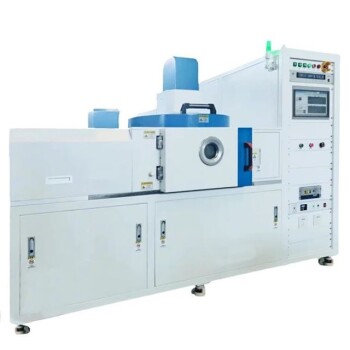
Spark Plasma Sintering (SPS) fundamentally outperforms traditional hot-pressing for high-entropy alloys by utilizing pulsed electric current to generate heat internally rather than relying on external elements. This mechanism allows for rapid heating rates and high pressure (up to 40 MPa) to achieve full material density in a fraction of the time required by conventional methods.
Core Insight: The definitive advantage of SPS is not just speed, but microstructural preservation. By significantly reducing the holding time at high temperatures, SPS prevents the grains within the alloy from growing, thereby retaining the superior mechanical properties of the original nanocrystalline powder.
The Mechanism of Rapid Densification
To understand why SPS is superior for high-entropy alloys, you must look at how energy is delivered to the material.
Internal Joule Heating
Unlike traditional hot-pressing, which heats a sample from the outside in, SPS passes pulsed electric currents directly through the mold and the powder particles.
This generates Joule heat internally within the sample itself. This direct energy transfer results in extremely fast heating rates—potentially as high as 100°C/min—that external heating elements cannot match.
Plasma Activation
The application of pulsed current does more than just heat the material; it creates a plasma discharge between powder particles.
This discharge helps to clean particle surfaces and activate the sintering process. This activation lowers the energy barrier required for densification, allowing the material to bond effectively at lower overall temperatures.
Pressure-Assisted Diffusion
SPS combines this thermal energy with significant axial pressure, often around 40 MPa.
This pressure physically forces particles together while the pulsed current promotes diffusion across grain boundaries. The combination allows the alloy to reach near-theoretical density very quickly.
Preserving Microstructure and Performance
The primary challenge in producing high-entropy alloys is maintaining the delicate structure created during the mixing (mechanical alloying) phase.
Inhibiting Grain Growth
The most significant downside of traditional hot-pressing is the long "holding time" required to sinter the material. Prolonged exposure to heat causes grains to coarsen and grow.
SPS dramatically shortens this holding time. Because the process is so fast, there is insufficient time for abnormal grain growth to occur.
Retaining Nanocrystalline Features
High-entropy alloys often rely on ultra-fine, nanocrystalline grains for their high strength and hardness.
By bypassing the long thermal cycles of traditional methods, SPS "locks in" the metastable, ultra-fine microstructure achieved during mechanical alloying. The result is a finished product that retains the high-performance characteristics of the raw powder.
The Critical Trade-off: Time vs. Structure
In materials science, you usually face a difficult trade-off: to get a dense material, you apply heat for a long time, but this heat degrades the microstructure.
The Failure of Traditional Methods
In traditional hot-pressing (resistance furnaces), achieving complete densification requires high temperatures and extended periods.
The trade-off here is severe: you gain density but lose the fine-grained structure. This leads to a material that is solid but lacks the superior physical properties (like hardness or optical translucency) intended by the alloy design.
How SPS Breaks the Compromise
SPS eliminates this trade-off. It decouples densification from grain growth.
Because the heating is internal and rapid, you achieve high density before the grains have time to coarsen. This allows for the production of materials with isotropic micro-nano fine grain structures, a feat that is nearly impossible with conventional external heating.
Making the Right Choice for Your Goal
When deciding between SPS and traditional hot-pressing, consider your specific material requirements.
- If your primary focus is Microstructural Integrity: Choose SPS to preserve nanocrystalline structures and prevent the degradation of mechanical properties caused by grain growth.
- If your primary focus is Process Efficiency: Choose SPS to significantly reduce cycle times and achieve densification at lower overall temperatures compared to resistance furnaces.
- If your primary focus is Material Density: Choose SPS to achieve near-theoretical density in difficult-to-sinter materials like Ti-6Al-4V or complex high-entropy alloys.
Summary: SPS transforms the production of high-entropy alloys by using internal pulsed current to achieve full density rapidly, ensuring the material remains as strong and fine-grained as the powder from which it was made.
Summary Table:
| Feature | Spark Plasma Sintering (SPS) | Traditional Hot-Pressing |
|---|---|---|
| Heating Source | Internal Joule Heating (Pulsed Current) | External Heating Elements |
| Heating Rate | Ultra-Fast (up to 100°C/min) | Slow and Gradual |
| Sintering Time | Minutes | Hours |
| Microstructure | Preserves Nanocrystalline Grains | Causes Grain Growth/Coarsening |
| Grain Activation | Plasma Discharge Surface Cleaning | Thermal Diffusion Only |
| Material Density | Near-Theoretical (High) | Variable (Limited by Time) |
Elevate Your Materials Research with KINTEK
Unlock the full potential of high-entropy alloys and advanced ceramics with KINTEK’s cutting-edge sintering solutions. Backed by expert R&D and precision manufacturing, KINTEK offers a comprehensive range of Muffle, Tube, Rotary, Vacuum, and CVD systems, along with specialized high-temperature lab furnaces—all fully customizable to meet your unique experimental needs.
Don't compromise on microstructural integrity. Our advanced thermal processing technology ensures you achieve maximum density without sacrificing the fine-grained properties of your materials.
Ready to optimize your lab's performance? Contact KINTEK Today to Discuss Your Custom Solution
Visual Guide

References
- Guiqun Liu, Xiaoli Zhang. Nano-Structure Evolution and Mechanical Properties of AlxCoCrFeNi2.1 (x = 0, 0.3, 0.7, 1.0, 1.3) High-Entropy Alloy Prepared by Mechanical Alloying and Spark Plasma Sintering. DOI: 10.3390/nano14070641
This article is also based on technical information from Kintek Furnace Knowledge Base .
Related Products
- Spark Plasma Sintering SPS Furnace
- 915MHz MPCVD Diamond Machine Microwave Plasma Chemical Vapor Deposition System Reactor
- RF PECVD System Radio Frequency Plasma Enhanced Chemical Vapor Deposition
- Vacuum Heat Treat Sintering Furnace with Pressure for Vacuum Sintering
- 9MPa Air Pressure Vacuum Heat Treat and Sintering Furnace
People Also Ask
- Why is it necessary to maintain a high vacuum environment during the SPS of SiC? Key to High-Density Ceramics
- How does the heating mechanism of Spark Plasma Sintering (SPS) function? Enhance TiC/SiC Composite Fabrication
- What are the technical advantages of using an SPS sintering furnace? Elevate Al2O3-TiC Material Performance
- What are the steps in the discharge plasma sintering process? Master Fast, High-Density Material Consolidation
- What are the advantages of spark plasma sintering (SPS) over traditional forging? Precision Microstructural Control