
The primary purpose of applying vibration to the loaded graphite mold is to stabilize the powder structure before the high-stakes sintering process begins. This mechanical step increases the initial packing density and breaks down "bridging" voids between particles, which is essential for process safety and final material quality.
Vibration serves as a critical stabilization step that prevents powder loss during vacuum evacuation and ensures that the hydraulic pressure applied later is transmitted uniformly. Without this step, the structural integrity of the final TiAl-SiC composite is compromised by uneven densification.
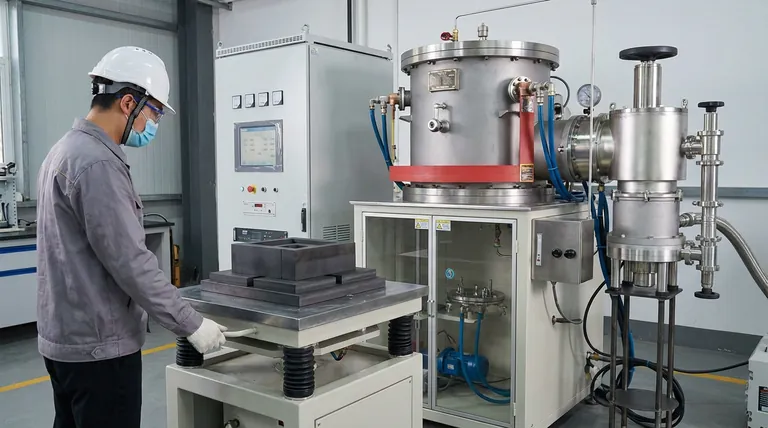
The Mechanics of Powder Preparation
To understand why vibration is necessary, one must look at how loose powders behave within the constraints of a graphite mold.
Increasing Initial Packing Density
When TiAl and SiC powders are poured into a mold, they naturally settle in a loose, disordered state. Applying vibration forces these particles to settle into a tighter configuration. This increases the mass of material within the fixed volume of the mold before any heat or pressure is applied.
Eliminating Bridging Voids
In a loose powder bed, particles often lean against one another, creating empty spaces or "bridges" that do not collapse under gravity alone. Vibration introduces kinetic energy that breaks these bridges. This ensures that the particles interlock properly, removing large air pockets that could cause defects.
Safeguarding the Vacuum Process
The environment inside a hot-press furnace is harsh. Vibration acts as a safeguard against the physical forces generated during the evacuation stage.
Preventing Powder Splashing
Before heating begins, the furnace chamber is evacuated to create a vacuum. If the powder is loosely packed and contains trapped air pockets, the rapid removal of air can cause the powder to erupt or "splash" out of the mold.
protecting Equipment and Composition
This splashing results in material loss, altering the intended composition of the composite. Furthermore, flying powder can contaminate the vacuum system. A vibrated, densely packed bed resists this disruption, keeping the material contained within the graphite mold.
Enhancing Sintering Performance
The graphite mold acts as a force transmission medium, transferring external hydraulic pressure (often up to 20 MPa) to the powder.
Uniform Pressure Transmission
For the graphite mold to transmit pressure effectively, the resistance offered by the powder must be uniform. A vibrated powder bed ensures that when the punch applies load, the force is distributed evenly across the entire sample surface.
Improving Final Density
The ultimate goal of hot-pressing is densification through diffusion and reaction at temperatures up to 1250 °C. By ensuring high initial density and uniform pressure distribution, vibration directly contributes to a higher final density in the cured TiAl-SiC composite.
Understanding the Trade-offs
While vibration is essential, it must be applied correctly to avoid introducing new problems.
Risk of Particle Segregation
TiAl and SiC particles likely have different densities and sizes. Excessive or incorrect vibration can cause these distinct materials to separate (segregate) rather than mix. This would lead to a non-homogeneous composite with uneven mechanical properties.
Mold Wear and Alignment
The graphite mold serves as both a container and a precision tool for pressure transmission. Aggressive vibration handling can potentially damage the mold walls or misalignment the punch, which would compromise the vacuum seal or the direction of pressure application.
Optimizing Your Sintering Preparation
The application of vibration is not merely a packing step; it is a quality control measure that dictates the success of the sintering cycle.
- If your primary focus is Process Safety: Ensure the powder is packed tightly enough to withstand vacuum evacuation without splashing or material loss.
- If your primary focus is Material Uniformity: Use controlled vibration to eliminate voids without inducing segregation between the TiAl and SiC components.
By treating the vibration step as a critical variable rather than a formality, you ensure the consistent production of high-density, defect-free composites.
Summary Table:
| Goal | Mechanism | Benefit |
|---|---|---|
| Structural Stability | Breaks bridging voids | Increases initial packing density |
| Process Safety | Eliminates air pockets | Prevents powder splashing during vacuum evacuation |
| Pressure Efficiency | Creates uniform bed | Ensures consistent force transmission from the punch |
| Final Quality | Maximizes contact | Leads to higher final density and material homogeneity |
Maximize Your Material Density with KINTEK
Achieve unmatched precision in your hot-pressing sintering workflows. Backed by expert R&D and manufacturing, KINTEK offers high-performance Muffle, Tube, Rotary, Vacuum, and CVD systems, plus customizable high-temp lab furnaces tailored to your unique research needs. Whether you are developing advanced TiAl-SiC composites or specialized ceramics, our equipment provides the uniform thermal and pressure control necessary for defect-free results.
Ready to elevate your lab's efficiency? Contact us today to discuss your custom furnace requirements with our technical team!
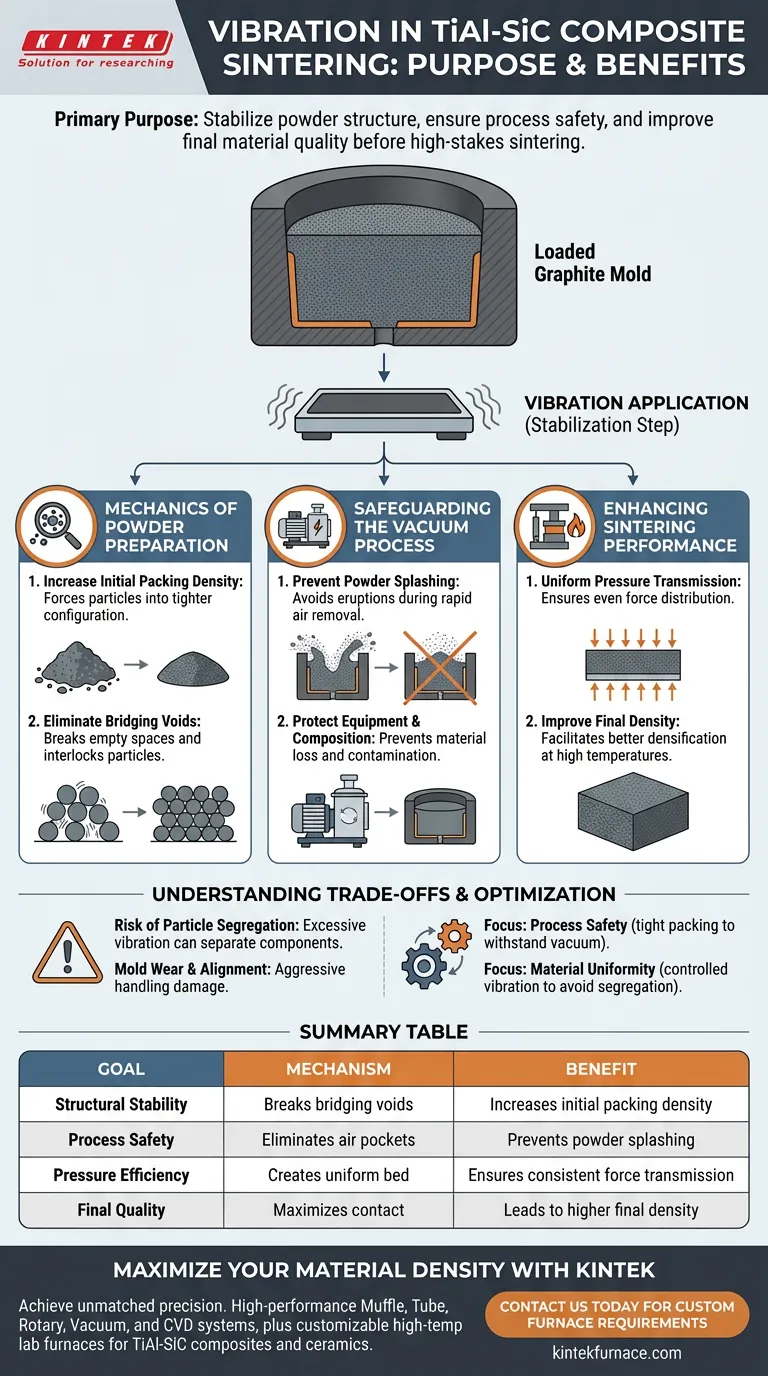
Visual Guide
References
- Microstructure and High-Temperature Compressive Properties of a Core-Shell Structure Dual-MAX-Phases-Reinforced TiAl Matrix Composite. DOI: 10.3390/cryst15040363
This article is also based on technical information from Kintek Furnace Knowledge Base .
Related Products
- Vacuum Heat Treat Sintering Furnace with Pressure for Vacuum Sintering
- 600T Vacuum Induction Hot Press Vacuum Heat Treat and Sintering Furnace
- 9MPa Air Pressure Vacuum Heat Treat and Sintering Furnace
- Vacuum Hot Press Furnace Machine Heated Vacuum Press Tube Furnace
- 2200 ℃ Tungsten Vacuum Heat Treat and Sintering Furnace
People Also Ask
- What are the benefits of using vacuum heat treating furnaces for metal alloys? Achieve Superior Metal Properties and Performance
- How does vacuum heat treating affect the grain structure of metal alloys? Achieve Precise Microstructure Control
- What is one of the most important uses of vacuum heat treating furnaces in aerospace? Achieve Superior Strength in Aircraft Alloys
- What are the key components of a vacuum sintering furnace? Essential Parts for Precision Material Processing
- What is the purpose of setting a mid-temperature dwell stage? Eliminate Defects in Vacuum Sintering



















