
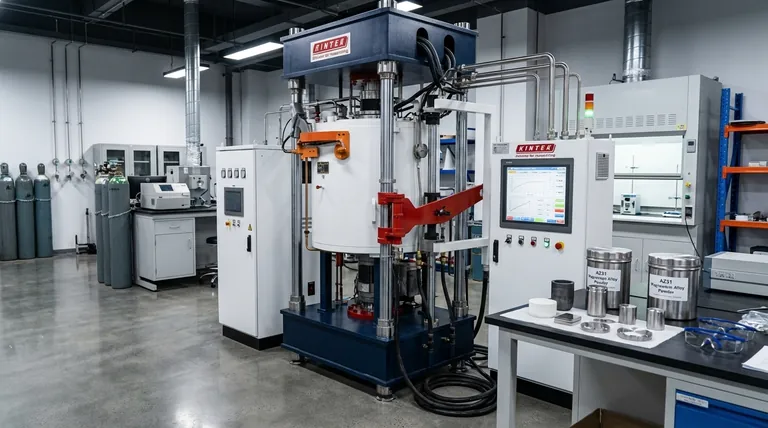
The core processing value of a vacuum hot pressing sintering furnace lies in its ability to force metallurgical bonding where standard methods fail. Specifically for AZ31 magnesium alloys, it utilizes the simultaneous application of high temperature and axial pressure (e.g., 10 MPa) within a vacuum to mechanically rupture stubborn oxide films and physically eliminate porosity.
Core Takeaway Magnesium alloys naturally resist sintering due to stable surface oxide layers and high reactivity. A vacuum hot pressing furnace overcomes this by using external mechanical pressure to break these oxide barriers while the vacuum environment prevents new oxidation, ensuring atomic-level diffusion and near-theoretical material density.
The Mechanism of Oxide Disruption
The primary challenge in sintering AZ31 magnesium alloys is the persistent oxide film on the powder particles.
Breaking the Surface Film
Standard heating is often insufficient to penetrate the oxide layer of magnesium particles. The furnace applies axial mechanical pressure (specifically cited as 10 MPa) to physically shear and break these oxide films during the process.
Enabling Atomic Contact
Once the oxide film is ruptured, "fresh" metal surfaces are exposed to one another. This allows for direct atomic diffusion, creating a strong metallurgical bond that would be impossible if the oxide layer remained intact.
Achieving High-Density Microstructures
Beyond bonding, the furnace ensures the structural integrity and density of the final alloy block.
Forcing Particle Rearrangement
The application of external pressure provides a driving force that exceeds the natural surface tension of the particles. This forces the powder to rearrange into a tighter configuration, actively reducing the volume of void spaces.
Eliminating Residual Pores
The dual action of heat and pressure promotes plastic deformation of the particles. This mechanism effectively squeezes out remaining pores, resulting in a high-density material that is significantly stronger than loose-sintered equivalents.
Vacuum-Assisted Degassing
The high-vacuum environment plays a critical supporting role by evacuating gases from the powder interstices. This prevents gas pockets from becoming trapped inside the material, which would otherwise form internal defects and weaken the alloy.
Critical Operational Trade-offs
While effective, this process requires strict adherence to specific parameters to avoid failure.
Pressure Dependence
The process relies heavily on the mechanical component. If the axial pressure is insufficient, the oxide films will not fracture, and the material will fail to densify regardless of the temperature applied.
Atmosphere Sensitivity
The vacuum environment is not merely for cleanliness; it is a functional requirement. Any lapse in vacuum integrity will lead to immediate oxidation of the magnesium at high temperatures, degrading the material properties rather than enhancing them.
Making the Right Choice for Your Goal
When preparing high-performance AZ31 magnesium alloys, the vacuum hot pressing furnace is a precision tool designed for specific outcomes.
- If your primary focus is Structural Integrity: The simultaneous application of pressure and heat is non-negotiable to achieve high density and eliminate porosity.
- If your primary focus is Material Purity: The high-vacuum capability is essential to prevent the oxidation of alloy elements and reduce inclusions during the heating phase.
By integrating mechanical pressure with thermal energy in a controlled vacuum, you transform a difficult-to-sinter powder into a robust, high-performance engineering material.
Summary Table:
| Key Feature | Impact on AZ31 Magnesium Alloy | Processing Advantage |
|---|---|---|
| Axial Pressure (10 MPa) | Ruptures stubborn surface oxide films | Enables direct atomic-level diffusion |
| Vacuum Environment | Prevents secondary oxidation & gas entrapment | Ensures high material purity and degassing |
| Thermal Energy | Promotes plastic deformation | Eliminates residual pores for near-theoretical density |
| Mechanical Shearing | Exposes "fresh" metal surfaces | Creates strong metallurgical bonds where standard methods fail |
Elevate Your Material Performance with KINTEK
Unlock the full potential of your high-performance alloys with KINTEK’s advanced vacuum hot pressing solutions. Backed by expert R&D and precision manufacturing, we provide high-temperature Muffle, Tube, Rotary, Vacuum, and CVD systems tailored specifically for demanding applications like AZ31 magnesium alloy sintering.
Whether you need to eliminate porosity or ensure absolute material purity, our customizable lab furnaces provide the simultaneous pressure and thermal control your research demands.
Ready to optimize your sintering process? Contact KINTEK today for a custom solution.
Visual Guide

Related Products
- 600T Vacuum Induction Hot Press Vacuum Heat Treat and Sintering Furnace
- Vacuum Hot Press Furnace Machine Heated Vacuum Press Tube Furnace
- Vacuum Heat Treat Sintering Furnace with Pressure for Vacuum Sintering
- 9MPa Air Pressure Vacuum Heat Treat and Sintering Furnace
- Vacuum Heat Treat Sintering Furnace Molybdenum Wire Vacuum Sintering Furnace
People Also Ask
- Why use Vacuum Hot Press (VHP) for ZnS Ceramics? Achieve Superior IR Transparency and Mechanical Strength
- How does a vacuum hot press sintering furnace mitigate copper sintering swelling? Solve Fe-Cu Expansion Issues
- How does the vacuum environment in a vacuum hot press sintering furnace protect chromium-containing ceramics? Find out.
- What are the key advantages of vacuum hot press sintering furnaces? Achieve Superior Density and Purity in Materials
- What is the core function of a vacuum hot press sintering furnace in the preparation of high-density RuTi alloys? Achieve Maximum Density and Purity



















