
A high-vacuum environment is strictly necessary for sintering Cu/Ti3SiC2/C/MWCNTs composites to prevent the destructive oxidation of the material's constituents during high-temperature processing. By eliminating atmospheric oxygen, the vacuum preserves the chemical integrity of the copper matrix and protects the carbon-based reinforcements from degrading, ensuring the final material is dense, strong, and conductive.
Core Takeaway The fundamental role of the vacuum is to maintain a pure, oxygen-free environment that allows the copper matrix to chemically bond with the reinforcing phases (Ti3SiC2 and MWCNTs). Without a high vacuum, oxide barriers form that prevent adhesion, leading to brittle fracture and poor mechanical performance.
Preserving Chemical Integrity
Preventing Matrix Oxidation
At the high temperatures required for sintering (often around 950°C), copper is highly susceptible to oxidation.
If atmospheric oxygen is present, the copper matrix forms oxide inclusions. These inclusions weaken the metal's structure and disrupt the continuity required for both mechanical strength and electrical conductivity.
Protecting Reinforcement Phases
The reinforcing elements, specifically Ti3SiC2 and Multi-Walled Carbon Nanotubes (MWCNTs), are sensitive to oxidative environments.
In the presence of oxygen, MWCNTs can degrade or "burn off" prematurely, losing their unique strengthening properties. A high-vacuum environment shields these components, ensuring they remain intact to reinforce the composite.
Optimizing the Interface
Enhancing Wettability
For a composite to be strong, the metal matrix must "wet" or spread over the surface of the reinforcing particles.
Oxide layers act as a barrier to this process. By preventing surface oxidation, the vacuum ensures the copper liquid can effectively wet the reinforcing phases, leading to a tight, cohesive bond.
Removing Volatile Impurities
Raw material powders often contain adsorbed gases and volatile impurities that can impede densification.
The vacuum environment actively promotes the desorption and removal of these gases. This "purification" of the powder surfaces clears the way for direct atom-to-atom contact between the copper and the reinforcements.
Promoting Densification
Facilitating Plastic Flow
Sintering often involves the simultaneous application of heat and mechanical pressure (e.g., 27.7 MPa).
The vacuum environment aids this process by allowing the copper particles to undergo plastic deformation and flow more easily. This helps the matrix fill the microscopic pores between the hard reinforcement particles, significantly increasing the final density of the composite.
Ensuring Unobstructed Diffusion
Solid-state diffusion is the mechanism that binds the materials together at the atomic level.
A high vacuum ensures there are no oxide films to block these elemental diffusion channels. This results in a clean contact interface, maximizing the bonding strength and reducing interfacial thermal/electrical resistance.
Common Pitfalls to Avoid
The Risk of Partial Vacuum
Simply reducing pressure is often insufficient; a high vacuum (often around $1.33 \times 10^{-2}$ Pa) is critical.
If the vacuum level is inadequate, trace oxygen can still react with active elements. This leads to the formation of "oxide impurity layers" at grain boundaries, which act as crack initiation points and cause the material to fail via brittle fracture under stress.
Compromising Conductivity
While mechanical strength is often the focus, the electrical properties of copper composites are equally reliant on vacuum processing.
Oxidation at the interface creates resistance. Failing to maintain a high vacuum results in a composite with significantly lower electrical conductivity (IACS), negating the benefits of using a copper matrix.
Making the Right Choice for Your Goal
Achieving the desired properties in Cu/Ti3SiC2/C/MWCNTs composites relies on rigorous control of the sintering atmosphere.
- If your primary focus is Mechanical Strength: Ensure the vacuum level is sufficient to prevent oxide layers at grain boundaries, as these are the primary cause of brittle fracture.
- If your primary focus is Electrical Conductivity: Prioritize high-vacuum processing to guarantee clean, oxide-free interfaces that minimize electron scattering and resistance.
Ultimately, the vacuum is not just a processing condition; it is the critical enabler that allows the copper matrix and reinforcements to act as a single, cohesive material.
Summary Table:
| Feature | Impact of High Vacuum | Benefit to Composite |
|---|---|---|
| Oxidation Control | Eliminates atmospheric oxygen | Prevents brittle oxide inclusions and matrix degradation |
| Interface Quality | Enhances wettability and cleaning | Ensures strong bonding between Cu and MWCNTs |
| Densification | Facilitates plastic flow & diffusion | Maximizes final density and structural integrity |
| Reinforcements | Protects Ti3SiC2 and MWCNTs | Preserves mechanical strength and conductivity |
| Impurity Removal | Desorption of adsorbed gases | Minimizes porosity and interfacial resistance |
Elevate Your Advanced Material Synthesis with KINTEK
Precise sintering of complex composites like Cu/Ti3SiC2/C/MWCNTs requires the highest standards of atmospheric control. KINTEK provides industry-leading high-vacuum furnace solutions—including Vacuum, CVD, Muffle, and Rotary systems—engineered to eliminate oxidation and maximize material densification.
Backed by expert R&D and precision manufacturing, our lab high-temperature furnaces are fully customizable to meet your specific research or production needs. Ensure the mechanical strength and electrical conductivity of your materials with our specialized thermal technology.
Ready to optimize your sintering process? Contact KINTEK today for a custom consultation!
Visual Guide
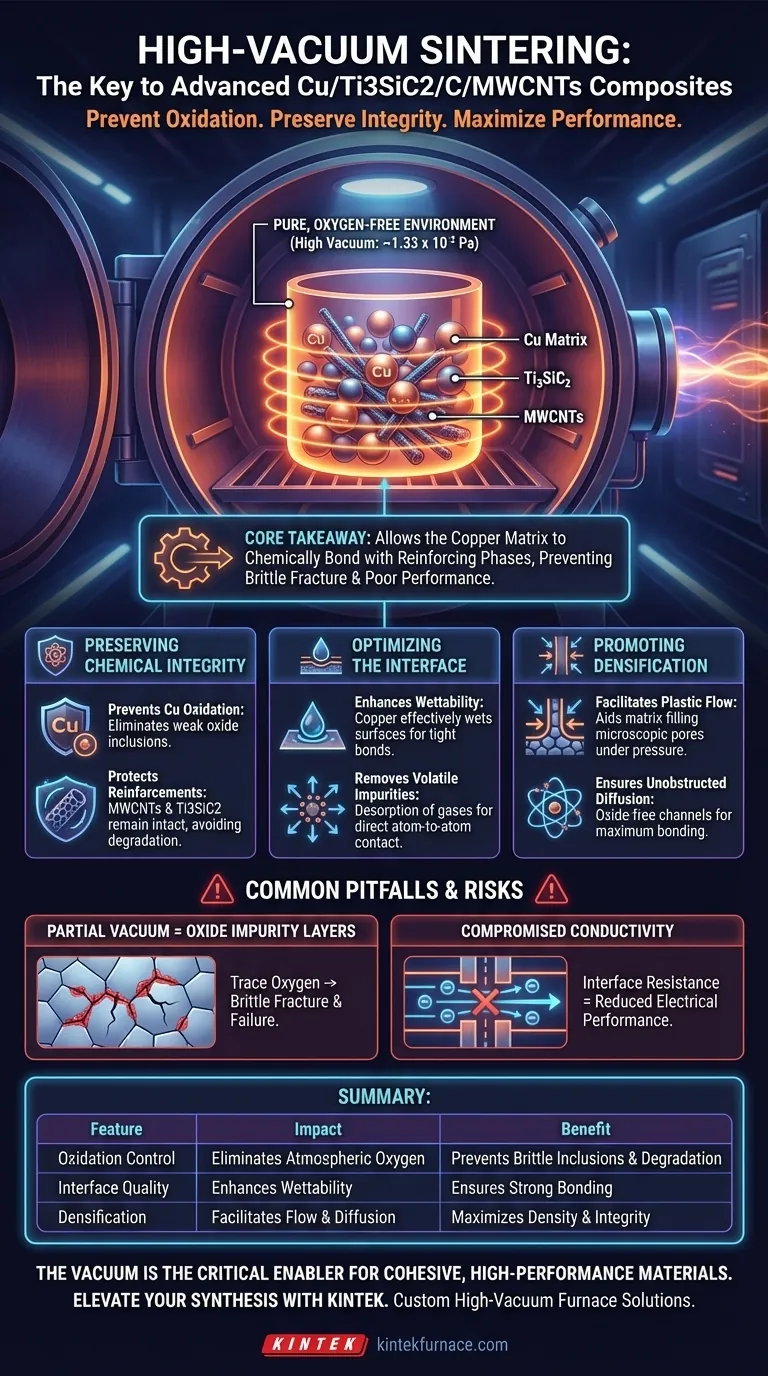
Related Products
- 2200 ℃ Tungsten Vacuum Heat Treat and Sintering Furnace
- 9MPa Air Pressure Vacuum Heat Treat and Sintering Furnace
- 2200 ℃ Graphite Vacuum Heat Treat Furnace
- Vacuum Heat Treat Sintering Furnace Molybdenum Wire Vacuum Sintering Furnace
- 600T Vacuum Induction Hot Press Vacuum Heat Treat and Sintering Furnace
People Also Ask
- How does a tungsten-heated vacuum sintering furnace prepare (TbxY1-x)2O3 ceramics? Achieve 99%+ Density & Purity
- How do compaction pressure and vacuum sintering optimize porous ceramics? Maximize Density & Toughness
- What wear-resistance enhancements are achieved by powder coating? The Role of Vacuum Sintering Furnaces
- What role does a high-temperature vacuum sintering furnace play in the densification of WC-10(Ni, Ni/Co) alloys?
- What core role does a high-temperature vacuum sintering furnace play in Sm:YAG ceramics? Mastering Optical Clarity



















