
Vacuum hot pressing sintering offers a decisive technological advantage by integrating high-temperature thermal treatment with uniaxial mechanical pressure within a controlled vacuum environment. This process directly enhances the quality of rare earth modified copper matrix composites by preventing oxidation and forcibly eliminating porosity to achieve near-theoretical density.
Core Takeaway By coupling thermal and mechanical forces in a vacuum, this method solves the two primary failure modes of copper composites: oxidation of the matrix and structural porosity. It transforms a porous, potentially brittle powder mixture into a dense, high-conductivity material with clean metallic interfaces.
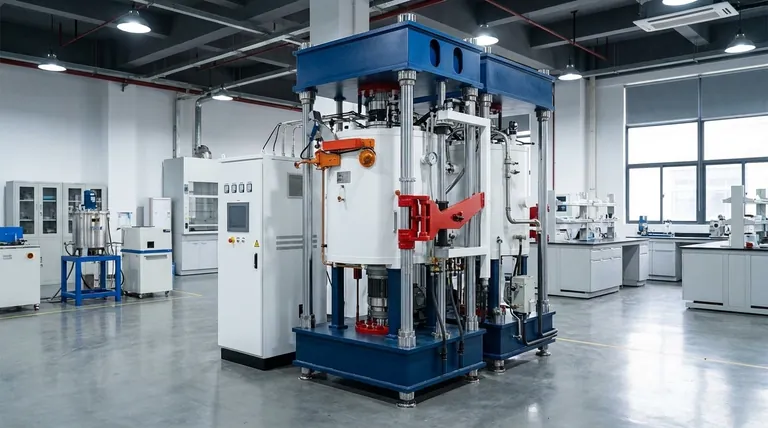
Environmental Control: Preserving Material Purity
Prevention of Matrix Oxidation
The primary chemical challenge in processing copper is its susceptibility to oxidation at high temperatures. The high-vacuum environment provided by the furnace effectively isolates the material from oxygen during the heating phase (e.g., 850°C). This ensures that the copper matrix remains chemically pure and that metallic interfaces are kept clean.
Degassing and Interface Quality
Beyond simple oxidation prevention, the vacuum actively removes adsorbed gases from the surface of the powder particles. This purification minimizes harmful interfacial reactions between the copper matrix and rare earth modifiers. The result is a stronger, cleaner bond at the microscopic level, which is critical for optimizing electrical conductivity.
Mechanical Densification: Overcoming Porosity
Forced Plastic Deformation
Standard sintering relies on atomic diffusion, which often leaves voids; vacuum hot pressing applies uniaxial mechanical pressure (typically 50 MPa) to solve this. This pressure forces the copper powder particles to undergo plastic deformation and flow. This physical rearrangement fills the micro-voids between particles and reinforcements that thermal energy alone cannot close.
Acceleration of Diffusion Bonding
The simultaneous application of heat and pressure accelerates the diffusion bonding process between particles. By bringing particles into intimate physical contact, the process overcomes the kinetic barriers to sintering. This is particularly effective for composite materials where reinforcements (like rare earth elements or particles) might otherwise hinder the growth of sintering necks.
Achieving High Relative Density
The combination of plastic flow and enhanced diffusion leads to a significant increase in the relative density of the composite. While standard sintering might leave a material with significant porosity (low density), vacuum hot pressing drives the material toward a fully dense state. This reduction in porosity is the primary driver for improved mechanical strength.
Understanding the Trade-offs
Equipment Complexity vs. Material Quality
It is important to acknowledge that this process is more complex than pressureless sintering. It requires specialized equipment capable of maintaining 50 MPa of pressure and high vacuum simultaneously at 850°C. However, this complexity is necessary; standard vacuum sintering without pressure typically achieves significantly lower density (often around 71% in comparable systems), rendering it insufficient for high-performance applications.
Making the Right Choice for Your Goal
The advantages of vacuum hot pressing are specific to the performance metrics you need to maximize.
- If your primary focus is Electrical Conductivity: The vacuum environment is your key asset, as it prevents oxide layer formation that would otherwise insulate particles and impede electron flow.
- If your primary focus is Mechanical Strength: The mechanical pressure is the deciding factor, as it eliminates the internal pores and voids that act as crack initiation sites in less dense materials.
Summary: Vacuum hot pressing is not just a heating process; it is a mechanical forming tool that guarantees the structural integrity and chemical purity required for high-performance copper composites.
Summary Table:
| Feature | Vacuum Hot Pressing Advantage | Impact on Composite Performance |
|---|---|---|
| Atmosphere | High-Vacuum Environment | Prevents oxidation and maintains high electrical conductivity |
| Pressure | Uniaxial Mechanical Force (e.g., 50 MPa) | Eliminates internal porosity and ensures high relative density |
| Bonding | Accelerated Diffusion Bonding | Creates stronger, cleaner interfaces between matrix and modifiers |
| Densification | Forced Plastic Deformation | Improves mechanical strength by removing crack initiation sites |
Elevate Your Composite Materials with KINTEK Expertise
Unlock the full potential of your rare earth modified copper composites with high-precision sintering solutions. Backed by expert R&D and manufacturing, KINTEK offers high-performance Vacuum, Muffle, Tube, Rotary, and CVD systems, all fully customizable to meet your unique laboratory or industrial needs. Whether you require precise 50 MPa pressure control or high-vacuum integrity, our systems are engineered to eliminate oxidation and maximize material density.
Ready to optimize your heat treatment process? Contact us today to speak with a specialist about our customizable furnace solutions.
References
- Denghui Li, Qian Lei. Study on the Electrical and Mechanical Properties of TiC Particle-Reinforced Copper Matrix Composites Regulated by Different Rare Earth Elements. DOI: 10.3390/nano15020096
This article is also based on technical information from Kintek Furnace Knowledge Base .
Related Products
- 600T Vacuum Induction Hot Press Vacuum Heat Treat and Sintering Furnace
- Vacuum Heat Treat Sintering Furnace with Pressure for Vacuum Sintering
- 9MPa Air Pressure Vacuum Heat Treat and Sintering Furnace
- Vacuum Hot Press Furnace Machine Heated Vacuum Press Tube Furnace
- 2200 ℃ Tungsten Vacuum Heat Treat and Sintering Furnace
People Also Ask
- Why use Vacuum Hot Press (VHP) for ZnS Ceramics? Achieve Superior IR Transparency and Mechanical Strength
- How does a vacuum hot press sintering furnace mitigate copper sintering swelling? Solve Fe-Cu Expansion Issues
- How does the vacuum environment in a vacuum hot press sintering furnace protect chromium-containing ceramics? Find out.
- What are the key advantages of vacuum hot press sintering furnaces? Achieve Superior Density and Purity in Materials
- What are the benefits of using a vacuum hot press sintering furnace for the preparation of SiCw/2024 aluminum matrix composites? Achieve High-Performance Aerospace Materials



















