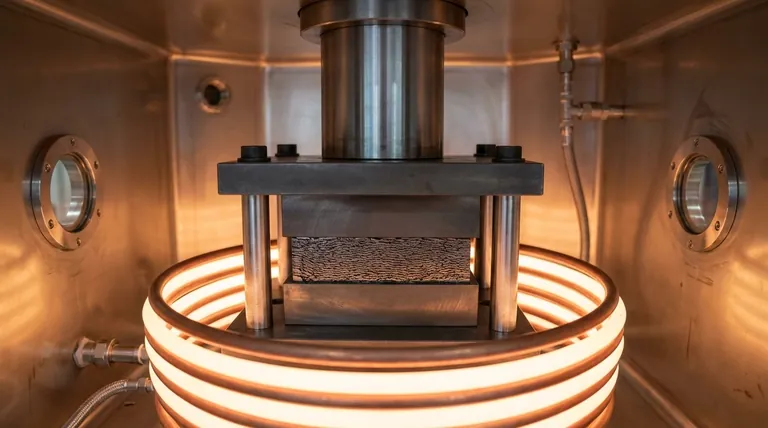
The unidirectional pressure loading system fundamentally alters the material's architecture by creating a highly anisotropic microstructure. Specifically, the axial pressure forces flake graphite to undergo preferential orientation, aligning it perpendicularly to the direction of the applied force within the softened aluminum matrix. This mechanical alignment is the primary driver for the material's specialized thermal and mechanical properties.
The vacuum hot press does not merely densify the powder; it actively reorganizes the reinforcement phase, transforming a random mixture into a texturized, layered composite with directional performance capabilities.
The Mechanism of Preferential Alignment
Force-Induced Reorientation
When the aluminum matrix softens at high temperatures, it becomes compliant. The unidirectional axial pressure acts upon the rigid graphite flakes suspended within this soft matrix.
Because the pressure is applied from a single direction, the flakes are mechanically forced to rotate and slide. They naturally settle into the position of least resistance, which is flat against the pressing plane.
The Resulting Layered Structure
This process results in a microstructure where graphite is distributed perpendicularly to the pressure direction.
Instead of a random dispersion, the composite exhibits a distinct, layered architecture. This structural directionality is the physical basis for enhanced thermal conductivity within that specific plane.
Enhancing Matrix Integrity and Density
Breaking Oxide Barriers
Aluminum powder particles are naturally covered in tough oxide films that inhibit bonding. The continuous uniaxial pressure—often ranging from high loads to moderate maintenance pressures—physically fractures these oxide layers.
This exposes clean metal surfaces, promoting direct diffusion bonding between the aluminum matrix and the graphite reinforcement.
Driven Densification via Plastic Flow
Pressure acts as the external driving force for plastic slippage and rearrangement.
The system forcibly squeezes the softened material to fill voids between particles. This pressure-assisted plastic flow eliminates macroscopic defects and porosity, allowing the composite to achieve near-full density in the solid state.
Controlling Grain Structure
The application of pressure does more than just compact the material; it also restrains microstructure evolution.
By forcing close contact and limiting the space available for expansion, the pressure helps limit abnormal grain growth. This results in a finer, more uniform grain structure compared to pressureless sintering methods.
Understanding the Trade-offs
Anisotropy is a Double-Edged Sword
The alignment mechanism creates significant anisotropy (direction-dependent properties). While thermal conductivity is maximized in the plane perpendicular to the pressing direction, it may be significantly lower in the parallel direction ("through-plane").
Mechanical Bonding vs. Chemical Reaction
The pressure promotes tight physical mechanical bonding between layers rather than relying solely on complex chemical reactions.
While this aids in toughening the material by deflecting cracks along the layers, it requires careful process control. If the pressure is insufficient, the physical bond will be weak, leading to delamination or internal pores.
Making the Right Choice for Your Goal
To maximize the potential of Al-Si/graphite composites produced via vacuum hot pressing, you must align the processing parameters with your application requirements.
- If your primary focus is Thermal Management: Design your component orientation so that the heat source flows along the plane perpendicular to the pressing direction, leveraging the aligned graphite.
- If your primary focus is Structural Integrity: Prioritize sufficient pressure magnitude to ensure oxide film rupture and complete void elimination for maximum density.
- If your primary focus is Dimensional Stability: Account for the anisotropic nature of the grain structure, as thermal expansion behaviors will differ across the perpendicular and parallel axes.
Ultimately, the pressure system is a microstructural design tool; use it to engineer the grain orientation to match your specific performance vector.
Summary Table:
| Mechanism | Impact on Microstructure | Performance Benefit |
|---|---|---|
| Axial Pressure | Forced orientation of graphite flakes | Highly directional (anisotropic) thermal conductivity |
| Oxide Fracturing | Physical rupture of Al oxide films | Enhanced diffusion bonding and matrix integrity |
| Plastic Flow | Elimination of voids and porosity | Near-full material densification |
| Grain Control | Restrains expansion during sintering | Finer, more uniform grain structure |
Elevate Your Material Performance with KINTEK
Unlock the full potential of your composite materials with precision-engineered heat treatment. Backed by expert R&D and manufacturing, KINTEK offers Muffle, Tube, Rotary, Vacuum, and CVD systems, as well as advanced vacuum hot press equipment tailored for Al-Si/graphite and other complex composites.
Whether you need to control grain growth or engineer specific anisotropic properties, our customizable high-temp lab furnaces provide the exact pressure and temperature control your research demands.
Ready to optimize your microstructure? Contact KINTEK experts today to find the perfect thermal processing solution for your unique needs.
Visual Guide

Related Products
- Vacuum Hot Press Furnace Machine for Lamination and Heating
- Vacuum Hot Press Furnace Machine Heated Vacuum Press
- Vacuum Hot Press Furnace Machine Heated Vacuum Press Tube Furnace
- 600T Vacuum Induction Hot Press Vacuum Heat Treat and Sintering Furnace
- Vacuum Heat Treat Sintering Furnace with Pressure for Vacuum Sintering
People Also Ask
- What are the primary components of a vacuum hot press furnace? Master the Core Systems for Precise Material Processing
- What safety features are incorporated in vacuum hot press furnaces? Ensure Operator and Equipment Protection
- What are the benefits of the vacuum environment system in a vacuum hot press furnace? Unlock High-Density Sintering
- What industries benefit from the use of vacuum hot press furnaces? Unlock High-Performance Materials for Your Industry
- How does the uniaxial pressure applied by a vacuum hot press furnace affect the microstructure of ZrC-SiC materials?