
A high-precision laboratory press is essential for establishing the structural integrity of the ceramic "green body" prior to sintering.
It serves the critical function of applying accurately controlled initial pressure to the TiB2-based powder within the mold. This mechanical force expels trapped air between particles and significantly increases the initial packing density, ensuring the material is tightly arranged before it is subjected to heat.
By optimizing particle density and uniformity upfront, high-precision pre-pressing minimizes shrinkage and prevents stress fractures during the subsequent Spark Plasma Sintering (SPS) process.
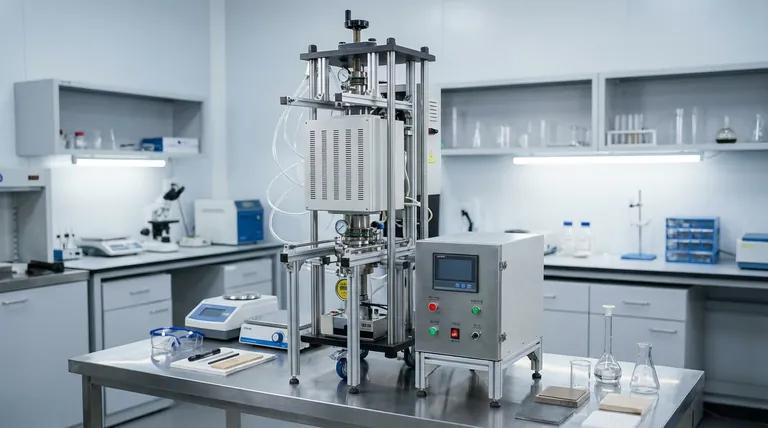
The Mechanics of Pre-Pressing
Optimizing Particle Arrangement
The fundamental role of the press is to manipulate the spatial arrangement of the powder particles. By applying force, the machine compels the particles to settle into a tighter configuration.
This increases the initial packing density of the "green body" (the compacted powder before firing). A higher initial density is crucial for high-performance ceramics like TiB2 composites, as it sets the baseline for the final material properties.
Eliminating Trapped Air
Loose powder naturally contains voids filled with air. If this air remains during high-temperature processing, it can lead to porosity and structural weaknesses.
The laboratory press forces the air out from between the particles. Expelling this air creates a solid, cohesive mass that is ready for the rigorous conditions of sintering.
Impact on Spark Plasma Sintering (SPS)
Controlling Shrinkage Rates
Sintering causes materials to densify and shrink. If the initial powder is too loose, the volume change during sintering is drastic and often unpredictable.
Pre-pressing ensures the material starts closer to its final density. This effectively reduces the shrinkage rate during the Spark Plasma Sintering (SPS) phase, allowing for better control over the final dimensions of the ceramic.
Mitigating Stress Concentration
One of the most common failure modes in ceramic preparation is cracking during the early stages of sintering. This is often caused by non-uniform density, which creates points of stress concentration.
A high-precision press ensures the "green body" has excellent structural uniformity. By eliminating density gradients now, you prevent the localized stresses that lead to cracks when heat is applied.
The Necessity of Precision
The Risk of Inconsistency
The reference specifically notes the use of a "high-precision" press rather than a standard one. This distinction is vital because pressure application must be uniform and repeatable.
Inaccurate pressure can result in a "green body" that looks solid but contains internal density variations. These invisible flaws inevitably manifest as warpage or fractures during the sintering process, wasting valuable raw materials and processing time.
Ensuring Success in Ceramic Preparation
To maximize the quality of TiB2-based composites, you must view pre-pressing as a quality control gate, not just a shaping step.
- If your primary focus is Defect Prevention: Prioritize uniform pressure application to eliminate stress concentrations that cause cracking.
- If your primary focus is Dimensional Control: Ensure maximum consistent packing density to minimize and predict shrinkage rates during SPS.
Precise control during the pre-pressing stage is the single most effective way to secure a defect-free transition into the sintering process.
Summary Table:
| Stage of Process | Primary Function | Impact on Final Ceramic |
|---|---|---|
| Particle Arrangement | Compels particles into tighter configuration | Increases initial packing density |
| Air Elimination | Expels trapped air from powder voids | Reduces porosity and structural weaknesses |
| Shrinkage Control | Establishes baseline density | Minimizes volume change during sintering |
| Stress Mitigation | Ensures structural uniformity | Prevents cracking and stress fractures |
Elevate Your Ceramic Research with KINTEK
Precision is the foundation of high-performance materials. At KINTEK, we understand that the quality of your TiB2-based composites depends on the accuracy of your pre-pressing stage. Backed by expert R&D and world-class manufacturing, we provide high-precision laboratory presses and Spark Plasma Sintering (SPS) systems designed to eliminate structural flaws and ensure repeatable results.
Whether you need Muffle, Tube, Rotary, Vacuum, or CVD systems, our equipment is fully customizable to meet your unique lab requirements. Don't let invisible density variations ruin your sintering process.
Contact KINTEK Today for a Specialized Consultation
References
- I O Poenaru, V Puţan. Research Regarding Advanced Degassing of Steels for Manufacturing Automotive Components. DOI: 10.1088/1742-6596/3153/1/012016
This article is also based on technical information from Kintek Furnace Knowledge Base .
Related Products
People Also Ask
- What factors determine the quality of sintered zirconia restorations? Master Material, Equipment, and Technique
- How do conventional vs rapid sintering in dental furnaces affect zirconia? Optimize Efficiency Without Sacrificing Strength
- What is the purpose of dental sintering furnaces? Transform Zirconia into Durable, High-Quality Dental Restorations
- What precautions should be taken when sintering zirconia in the Fast Slow Dental Sintering Furnace? Master Key Steps for Perfect Results
- What temperature range is used for sintering zirconia ceramics? Achieve Optimal Strength and Translucency
