
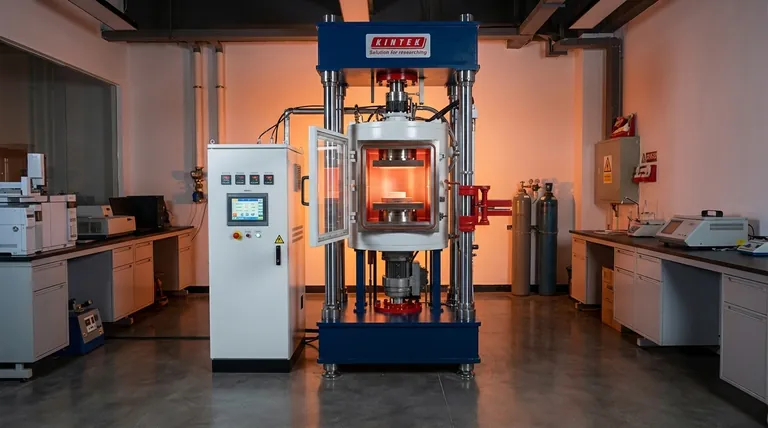
A vacuum hot press sintering furnace is essential for this application because it enables densification at temperatures low enough to preserve the material's nanocrystalline structure.
By applying axial mechanical pressure (e.g., 10 MPa) simultaneously with heat (e.g., 1400°C), this method significantly increases the driving force for sintering. This allows difficult-to-densify magnesium aluminate spinels to achieve high relative density (up to 92.3%) without requiring the extreme thermal energy that causes excessive grain growth in conventional furnaces.
Core Insight: Conventional atmospheric sintering relies solely on thermal energy to remove pores, which inevitably causes grains to coarsen and destroy nanostructures. Vacuum hot pressing substitutes thermal energy with mechanical pressure, allowing you to achieve a dense ceramic while "freezing" the grain size in the desirable 200–500 nm range.
The Mechanics of Preserving Nanostructure
Overcoming Sintering Resistance
Magnesium aluminate spinels are notoriously difficult-to-densify. In a conventional atmospheric furnace, overcoming the material's resistance to densification requires extremely high temperatures or prolonged hold times.
The Problem with Thermal Energy
If you use a conventional furnace to achieve the necessary density, the high thermal energy triggers rapid grain boundary migration. This causes the grains to grow uncontrollably, transforming the material from nanocrystalline to microcrystalline and degrading its unique properties.
The Pressure Advantage
Vacuum hot pressing introduces a critical variable: axial mechanical pressure. By applying pressure (typically around 10 MPa), you physically force particles together. This accelerates the densification process and lowers the required sintering temperature, effectively bypassing the temperature range where rapid grain growth occurs.
The Critical Role of the Vacuum Environment
Protecting Reactive Elements
The specific ceramic composition you are working with contains Chromium (Cr). Chromium and other alloying elements can be highly reactive or susceptible to oxidation at sintering temperatures. A conventional atmospheric furnace exposes the material to oxygen, which can lead to the formation of unwanted oxide inclusions that hinder performance.
Cleaning Particle Surfaces
Nanopowders have a high surface area, making them prone to absorbing gases and volatiles. A high vacuum environment effectively strips adsorbed gases from the powder surfaces.
Enhancing Diffusion
By removing impurities and preventing oxidation, the vacuum creates "clean" grain boundaries. This unobstructed contact between particles facilitates atomic diffusion, which is the fundamental mechanism required to form strong sintering necks and a cohesive bulk material.
Understanding the Trade-offs
Geometry Limitations
While vacuum hot pressing offers superior material properties, it is geometrically restrictive. Because the pressure is applied axially (uniaxially), this method is generally limited to producing simple shapes like flat discs, plates, or cylinders. Complex 3D geometries are difficult or impossible to manufacture directly.
Production Throughput
Conventional atmospheric sintering is a continuous or batch process suitable for mass production. In contrast, vacuum hot pressing is a batch process that is significantly slower and more expensive per unit. It is justified only when the material properties (specifically the nanocrystalline structure) are non-negotiable.
Making the Right Choice for Your Goal
When deciding between sintering methods for Mg(Al1-xCrx)2O4, consider your primary performance metrics:
- If your primary focus is preserving nanocrystalline grain size (200-500 nm): You must use vacuum hot pressing to achieve density without thermal coarsening.
- If your primary focus is material purity and inclusion control: You need the vacuum environment to prevent the oxidation of the Chromium dopant and remove adsorbed gases.
- If your primary focus is complex shaping or low-cost mass production: Conventional sintering is better, but you will likely sacrifice the nanocrystalline structure and maximum density.
Ultimately, for high-performance nanocrystalline ceramics, mechanical pressure is the only reliable substitute for the destructive heat required in conventional sintering.
Summary Table:
| Feature | Conventional Atmospheric Sintering | Vacuum Hot Press Sintering |
|---|---|---|
| Driving Force | Thermal energy only | Thermal energy + Mechanical pressure |
| Grain Size Control | Poor (significant coarsening) | Excellent (preserves nanostructure) |
| Sintering Temp | Extremely high | Significantly lower |
| Environment | Air/Inert (risk of oxidation) | High Vacuum (prevents Cr oxidation) |
| Density | Lower for difficult materials | High (up to 92.3% relative density) |
| Geometry | Complex 3D shapes possible | Simple shapes (discs, cylinders) |
Elevate Your Advanced Material Synthesis with KINTEK
Don't let high temperatures destroy your nanocrystalline structures. Backed by expert R&D and manufacturing, KINTEK offers state-of-the-art Muffle, Tube, Rotary, Vacuum, and CVD systems, alongside specialized Vacuum Hot Press Furnaces designed for difficult-to-densify ceramics. Our systems are fully customizable to meet your unique research or production needs, ensuring precise control over grain growth and material purity.
Ready to achieve superior densification? Contact our experts today to find the perfect high-temperature solution for your lab!
Visual Guide

Related Products
- 600T Vacuum Induction Hot Press Vacuum Heat Treat and Sintering Furnace
- 9MPa Air Pressure Vacuum Heat Treat and Sintering Furnace
- Vacuum Hot Press Furnace Machine Heated Vacuum Press Tube Furnace
- Vacuum Heat Treat Sintering Furnace with Pressure for Vacuum Sintering
- 2200 ℃ Tungsten Vacuum Heat Treat and Sintering Furnace
People Also Ask
- Why use Vacuum Hot Press (VHP) for ZnS Ceramics? Achieve Superior IR Transparency and Mechanical Strength
- How does a vacuum hot press sintering furnace mitigate copper sintering swelling? Solve Fe-Cu Expansion Issues
- What are the key advantages of vacuum hot press sintering furnaces? Achieve Superior Density and Purity in Materials
- What are the benefits of using a vacuum hot press sintering furnace for the preparation of SiCw/2024 aluminum matrix composites? Achieve High-Performance Aerospace Materials
- What is the core function of a vacuum hot press sintering furnace in the preparation of high-density RuTi alloys? Achieve Maximum Density and Purity



















