
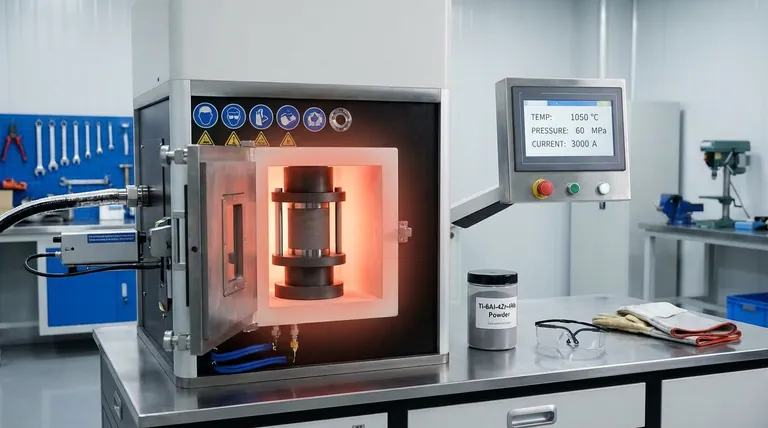
Graphite molds function as the central processing interface in Spark Plasma Sintering (SPS), simultaneously acting as the physical container for the alloy powder and the active heating element for the system. Specifically for Ti-6Al-4Zr-4Nb alloys, these molds facilitate rapid densification by transmitting high axial pressures—ranging from 30 MPa to 90 MPa—while utilizing their electrical conductivity to generate intense internal heat via pulsed currents.
Core Takeaway The graphite mold in SPS is not a passive vessel; it is an active component that converts electrical energy into thermal energy (Joule heating) while sustaining the extreme mechanical pressure required to densify Ti-6Al-4Zr-4Nb powder.
The Electro-Mechanical Functionality
Generating Heat via Electrical Conductivity
In standard sintering, the heat source is external. In SPS, the graphite mold itself acts as the heating element.
Because graphite is electrically conductive, the system passes a high-current pulsed DC signal directly through the mold. This resistance generates Joule heat, which is rapidly transferred to the Ti-6Al-4Zr-4Nb powder inside.
Facilitating Atomic Diffusion
This direct heating method allows for very high heating rates compared to conventional methods.
The rapid rise in temperature promotes atomic diffusion within the titanium alloy powder, accelerating the bonding process between particles without requiring prolonged soak times.
Transmitting Axial Pressure
While the mold heats the material, it also acts as a pressure-transmitting medium.
The hydraulic rams of the SPS system press against the graphite punches. The mold must withstand sufficient force to transfer 30 MPa to 90 MPa of pressure directly to the powder, forcing the particles together to achieve near-theoretical density.
Thermal and Structural Stability
Withstanding Extreme Temperatures
Ti-6Al-4Zr-4Nb alloys require sintering in high-temperature regions, often between the alpha phase (approx. 800 °C) and beta phase (approx. 1100 °C).
Graphite molds are selected for their ability to maintain structural integrity and dimensional stability at temperatures up to 1300°C, ensuring the final part matches the intended geometry.
Ensuring Thermal Uniformity
Graphite possesses excellent thermal conductivity.
As the mold generates heat, it distributes it uniformly across the sample volume. This prevents thermal gradients that could lead to uneven microstructure, such as inconsistent transitions between equiaxed and lamellar structures in the titanium alloy.
Understanding the Trade-offs
The Risk of Carbon Contamination
While graphite is an ideal material for conductivity and strength, it introduces a chemical compatibility issue with titanium alloys.
At high sintering temperatures, carbon atoms from the mold can diffuse into the surface of the Ti-6Al-4Zr-4Nb alloy. This creates a hard, brittle carbide layer on the exterior of the sintered part.
Necessary Post-Processing
This surface interaction effectively alters the mechanical properties of the outermost layer.
To obtain accurate performance data and ensure ductility, this contaminated surface layer must typically be removed via machining or polishing before the part is put into service or tested.
Making the Right Choice for Your Goal
When designing an SPS profile for Ti-6Al-4Zr-4Nb, you must balance the benefits of rapid heating with the limitations of the mold material.
- If your primary focus is Maximum Density: Utilize the upper limits of the mold’s pressure capacity (approaching 90 MPa) to mechanically force particle rearrangement during the heating phase.
- If your primary focus is Microstructural Purity: Account for the inevitable carbon diffusion layer by designing the mold cavity slightly larger than the final part dimensions to allow for surface machining.
By leveraging the graphite mold as both a resistor and a press, you achieve a highly efficient, dual-action densification process.
Summary Table:
| Function | Mechanism | Impact on Ti-6Al-4Zr-4Nb |
|---|---|---|
| Heating | Joule heating via electrical conductivity | Rapid densification and accelerated atomic diffusion |
| Pressure | Axial transmission (30–90 MPa) | Forces particle rearrangement for near-theoretical density |
| Stability | Thermal resistance up to 1300°C | Maintains dimensional accuracy at alpha/beta phase temps |
| Interface | Surface carbon diffusion | Formation of a carbide layer requiring post-process machining |
Optimize Your Advanced Material Sintering Today
Achieving the perfect balance between mechanical pressure and thermal uniformity is critical for high-performance titanium alloys. KINTEK provides the specialized expertise and high-temperature equipment needed to master Spark Plasma Sintering.
Backed by expert R&D and manufacturing, KINTEK offers Muffle, Tube, Rotary, Vacuum, and CVD systems, alongside customizable lab high-temp furnaces tailored to your unique research or production needs.
Ready to elevate your material properties? Contact our engineering team today to find the ideal furnace solution for your application.
References
- Shilong Liang, Yoko Yamabe‐Mitarai. Microstructure Evolution and Mechanical Properties of Ti–6Al–4Zr–4Nb Alloys Fabricated by Spark Plasma Sintering (SPS). DOI: 10.1007/s11661-024-07422-8
This article is also based on technical information from Kintek Furnace Knowledge Base .
Related Products
People Also Ask
- Why is it necessary to maintain a high vacuum environment during the SPS of SiC? Key to High-Density Ceramics
- How does the heating mechanism of Spark Plasma Sintering (SPS) function? Enhance TiC/SiC Composite Fabrication
- What are the technical advantages of using an SPS sintering furnace? Elevate Al2O3-TiC Material Performance
- What are the steps in the discharge plasma sintering process? Master Fast, High-Density Material Consolidation
- What are the advantages of spark plasma sintering (SPS) over traditional forging? Precision Microstructural Control

