
Graphite molds function as the critical interface between extreme processing conditions and the raw alloy material.
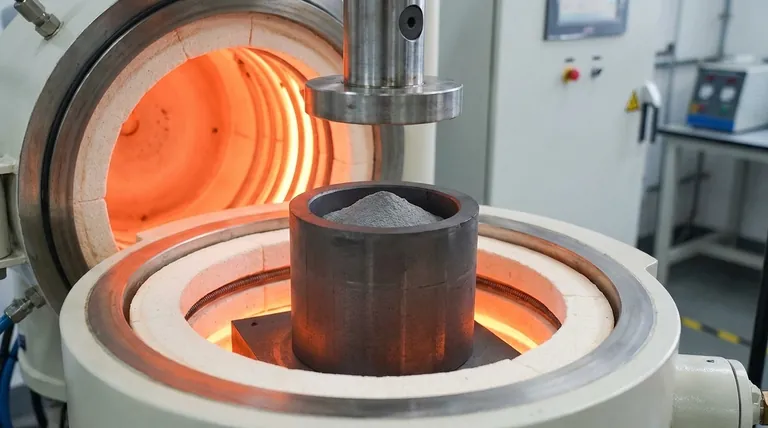
In the hot press sintering of Nb-22.5Cr-5Si alloys, these molds primarily serve as high-temperature resistant forming containers and pressure transmission media. They are designed to withstand temperatures around 1250°C while effectively transferring hydraulic force to the alloy powder, ensuring the final sintered component achieves a regular shape and a uniform density distribution.
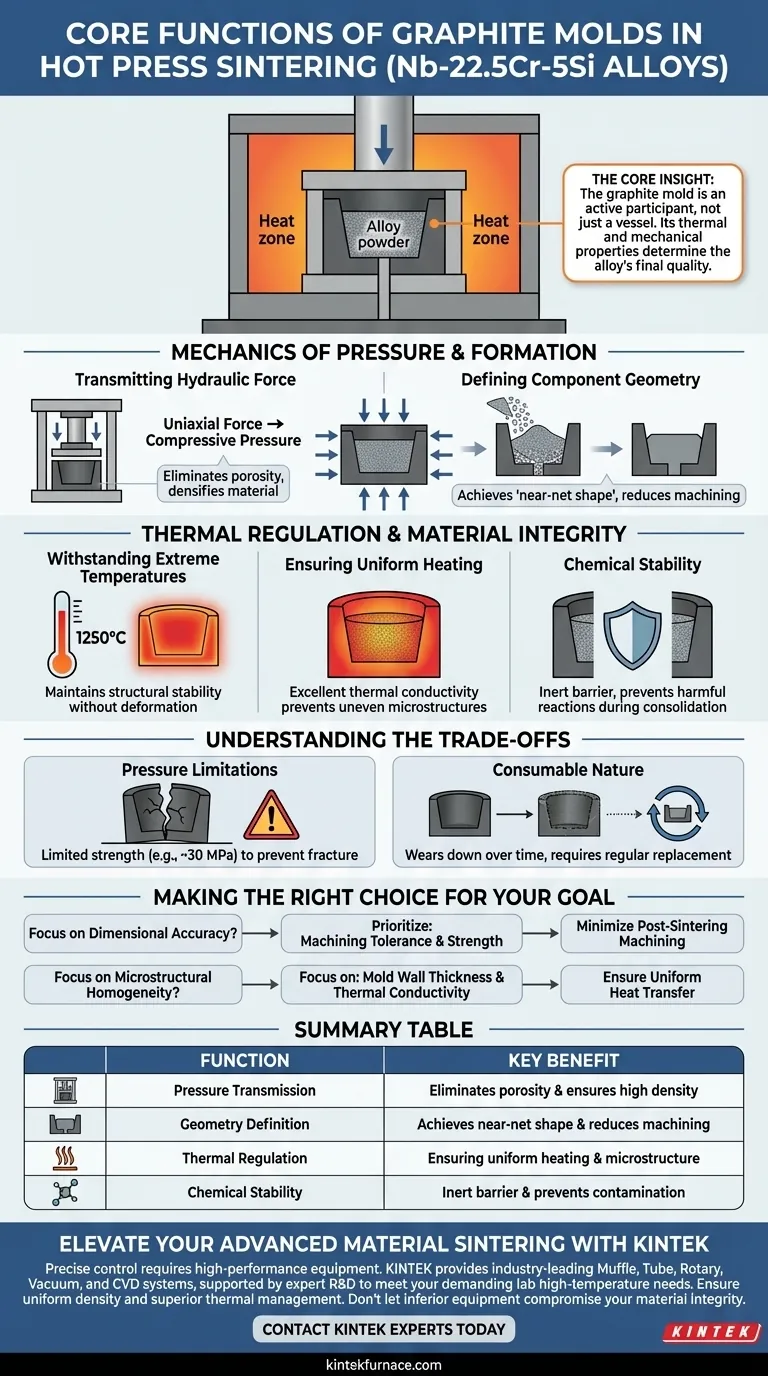
The Core Insight While often viewed simply as a vessel, the graphite mold is actually an active participant in the sintering process. Its thermal and mechanical properties determine whether the alloy powder consolidates into a dense, homogenous solid or fails due to uneven heating and structural inconsistencies.
The Mechanics of Pressure and Formation
Transmitting Hydraulic Force
The primary mechanical function of the graphite mold is to act as a pressure transmission medium. It bridges the gap between the hydraulic press and the loose Nb-22.5Cr-5Si powder.
Because graphite possesses sufficient mechanical strength, it converts the uniaxial force from the press into compressive pressure on the powder. This facilitates the atomic diffusion and plastic flow necessary to eliminate porosity and densify the material.
Defining Component Geometry
Graphite molds serve as precision "constraining containers." They hold the loose alloy powder in a specific configuration during the consolidation phase.
By maintaining its structural integrity under load, the mold ensures the sintered body emerges with a regular shape, often referred to as "near-net shape." This capability significantly reduces the need for extensive post-process machining.
Thermal Regulation and Material Integrity
Withstanding Extreme Temperatures
Sintering Nb-22.5Cr-5Si alloys requires high thermal energy, typically around 1250°C. Graphite is chosen because it maintains its structural stability and does not deform or fail at these elevated temperatures.
Ensuring Uniform Heating
Beyond simply surviving the heat, graphite molds actively manage it. They possess excellent thermal conductivity, which allows heat to pass through the mold and reach the alloy powder evenly.
This uniformity is critical. It ensures that the heat is distributed efficiently to the interior of the powder body, preventing thermal gradients that could lead to uneven microstructures or internal stresses in the final alloy.
Chemical Stability
In this high-temperature environment, the mold must act as an inert barrier. Graphite offers high chemical stability, allowing the alloy powder to fully densify without undergoing harmful reactions with the container walls.
Understanding the Trade-offs
Pressure Limitations
While graphite is strong, it is not infinitely durable. It has a lower mechanical strength compared to metal dies.
In many hot pressing contexts, pressure is typically limited (e.g., to around 30 MPa) to prevent the mold from fracturing. Exceeding the mold's specific strength limit can lead to catastrophic breakage during the pressing cycle.
Consumable Nature
Graphite molds are generally treated as consumables. Due to the harsh environment of high pressure and friction at 1250°C, the mold wears down over time. It sacrifices itself to produce the target shape, meaning regular replacement is a necessary operational cost.
Making the Right Choice for Your Goal
When designing your sintering process for Nb-22.5Cr-5Si, consider which function of the mold is most critical to your specific outcome.
- If your primary focus is Dimensional Accuracy: Prioritize the mold's machining tolerance and strength, ensuring it can maintain a "near-net shape" to minimize expensive post-sintering machining.
- If your primary focus is Microstructural Homogeneity: Focus on the mold's wall thickness and thermal conductivity to ensure the most uniform heat transfer possible into the powder core.
Ultimately, the graphite mold is not just a container; it is the thermal and mechanical regulator that dictates the quality of your sintered alloy.
Summary Table:
| Function | Description | Key Benefit |
|---|---|---|
| Pressure Transmission | Bridges hydraulic press force to alloy powder | Eliminates porosity and ensures high density |
| Geometry Definition | Acts as a high-precision forming container | Achieves near-net shape, reducing machining |
| Thermal Regulation | High thermal conductivity at 1250°C | Ensures uniform heating and microstructure |
| Chemical Stability | Inert barrier between powder and environment | Prevents contamination during consolidation |
Elevate Your Advanced Material Sintering with KINTEK
Precise control in the hot press sintering of alloys like Nb-22.5Cr-5Si requires more than just a container—it requires high-performance equipment. KINTEK provides industry-leading Muffle, Tube, Rotary, Vacuum, and CVD systems, all supported by expert R&D and manufacturing to meet your most demanding lab high-temperature needs.
Our customizable solutions ensure uniform density and superior thermal management for your research and production. Don't let inferior equipment compromise your material integrity.
Contact KINTEK Experts Today to find the perfect furnace for your unique application!
Visual Guide
Related Products
People Also Ask
- Why are vacuum heat treating furnaces essential for aerospace? Ensure Superior Material Integrity for High-Stakes Applications
- What is the primary application of vacuum heat treating furnaces in aerospace? Enhance Component Performance with Precision
- How does vacuum heat treating work in terms of temperature and time control? Master Precise Material Transformations
- How does a vacuum heat treating furnace improve the condition of metal alloys? Achieve Superior Metal Performance
- What is the process of vacuum heat treating? Achieve Superior Metallurgical Properties
