
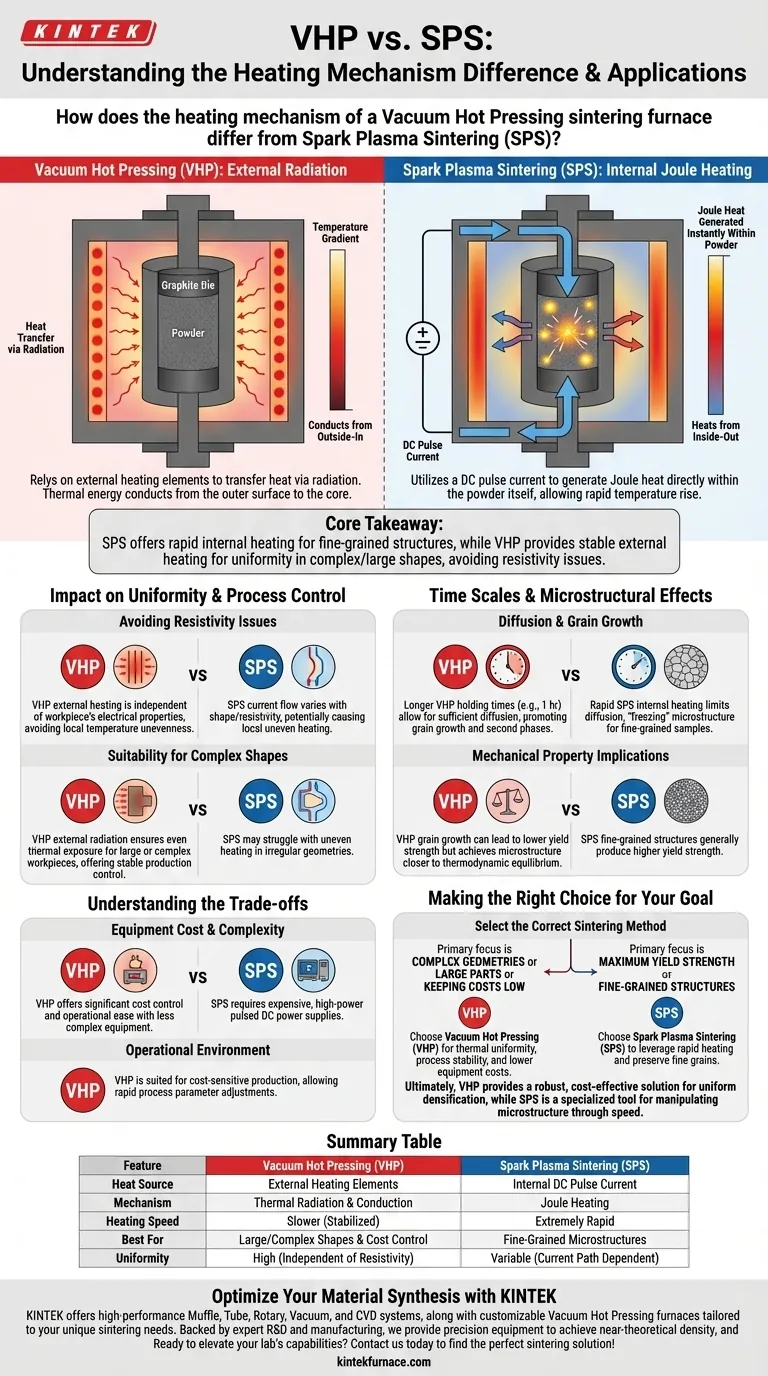
The fundamental difference lies in the origin of the thermal energy. A vacuum hot pressing (VHP) furnace relies on external heating elements to transfer heat via radiation from the outside surface into the powder. In contrast, Spark Plasma Sintering (SPS) utilizes a DC pulse current to generate Joule heat directly within the powder itself.
Core Takeaway While SPS offers rapid internal heating ideal for fine-grained structures, Vacuum Hot Pressing provides a stable, external heating environment. This makes VHP superior for controlling uniformity in complex or large shapes where electrical resistivity variations might otherwise cause uneven heating.
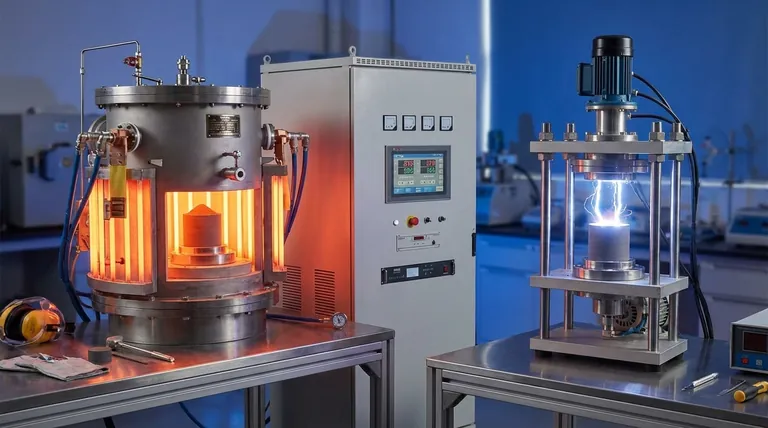
Distinct Mechanisms of Heat Generation
Vacuum Hot Pressing: External Radiation
In a VHP furnace, the heating elements are located outside the mold or pressing area. These elements generate heat which is transferred to the workpiece primarily through radiation.
Because the heat source is external, thermal energy must conduct from the outer surface of the material to its core. This process relies on standard thermal conduction principles to achieve temperature equilibrium throughout the powder compact.
Spark Plasma Sintering: Internal Joule Heating
SPS takes a radically different approach by passing a pulsed direct current (DC) through the graphite die and the powder compact.
This current encounters resistance within the material, generating Joule heat instantly throughout the volume of the powder. Instead of waiting for heat to travel from the outside in, the material heats up from the inside out, allowing for extremely rapid temperature distinct rise rates.
Impact on Uniformity and Process Control
Avoiding Resistivity Issues
A major advantage of the VHP external heating method is its independence from the electrical properties of the workpiece.
In SPS, differences in the workpiece's shape or electrical resistivity can alter how current flows, potentially leading to local temperature unevenness. VHP avoids this completely because the heat is applied environmentally rather than electrically.
Suitability for Complex Shapes
Because VHP does not rely on current paths, it is often more effective for large or complex workpieces.
The external radiation ensures that even irregular geometries receive consistent thermal exposure, making the process easier to control and significantly more stable for production-scale components.
Time Scales and Microstructural Effects
Diffusion and Grain Growth
The heating mechanism dictates the processing time. VHP typically requires longer holding times (e.g., 1 hour) compared to the rapid firing of SPS (approx. 10 minutes).
This prolonged exposure to heat in VHP allows for more sufficient diffusion of alloy elements. This promotes grain growth and the precipitation of second phases, such as the sigma phase, which results in distinct phase compositions.
Mechanical Property Implications
The rapid internal heating of SPS limits diffusion, effectively "freezing" the microstructure. This generally produces fine-grained samples with higher yield strength.
Conversely, the grain growth associated with the slower VHP process may result in lower yield strength, but it achieves a microstructure that is closer to thermodynamic equilibrium.
Understanding the Trade-offs
Equipment Cost and Complexity
While both methods achieve high densification, VHP offers significant advantages in cost control and operational ease.
The equipment required for external radiative heating is generally less complex and less expensive than the high-power pulsed DC power supplies required for SPS.
Operational Environment
VHP is often better suited for cost-sensitive production environments. It allows for the rapid adjustment of process parameters without the volatility associated with managing high-current pulses through changing powder resistances.
Making the Right Choice for Your Goal
To select the correct sintering method, you must weigh the importance of microstructural refinement against process stability and cost.
- If your primary focus is complex geometries or large parts: Choose Vacuum Hot Pressing (VHP) to ensure thermal uniformity and avoid issues caused by varying electrical resistivity.
- If your primary focus is keeping costs low: Choose VHP for its lower equipment costs and operational simplicity while still achieving near-theoretical density.
- If your primary focus is maximum yield strength: Choose Spark Plasma Sintering (SPS) to leverage rapid heating that preserves fine grain structures.
Ultimately, VHP provides a robust, cost-effective solution for uniform densification, while SPS is a specialized tool for manipulating microstructure through speed.
Summary Table:
| Feature | Vacuum Hot Pressing (VHP) | Spark Plasma Sintering (SPS) |
|---|---|---|
| Heat Source | External Heating Elements | Internal DC Pulse Current |
| Mechanism | Thermal Radiation & Conduction | Joule Heating |
| Heating Speed | Slower (Stabilized) | Extremely Rapid |
| Best For | Large/Complex Shapes & Cost Control | Fine-Grained Microstructures |
| Uniformity | High (Independent of Resistivity) | Variable (Current Path Dependent) |
Optimize Your Material Synthesis with KINTEK
Choosing between VHP and SPS is critical for your project's success. Backed by expert R&D and manufacturing, KINTEK offers high-performance Muffle, Tube, Rotary, Vacuum, and CVD systems, along with customizable Vacuum Hot Pressing furnaces tailored to your unique sintering needs. Whether you require the thermal stability of VHP for complex geometries or specialized lab high-temp furnaces, our team provides the precision equipment necessary to achieve near-theoretical density and desired microstructures.
Ready to elevate your lab's capabilities? Contact us today to find the perfect sintering solution!
Visual Guide
Related Products
- 600T Vacuum Induction Hot Press Vacuum Heat Treat and Sintering Furnace
- Vacuum Heat Treat Sintering Furnace with Pressure for Vacuum Sintering
- 9MPa Air Pressure Vacuum Heat Treat and Sintering Furnace
- Vacuum Hot Press Furnace Machine Heated Vacuum Press Tube Furnace
- 2200 ℃ Tungsten Vacuum Heat Treat and Sintering Furnace
People Also Ask
- Why use Vacuum Hot Press (VHP) for ZnS Ceramics? Achieve Superior IR Transparency and Mechanical Strength
- How does a vacuum hot press sintering furnace mitigate copper sintering swelling? Solve Fe-Cu Expansion Issues
- What are the benefits of using a vacuum hot press sintering furnace for the preparation of SiCw/2024 aluminum matrix composites? Achieve High-Performance Aerospace Materials
- What are the key advantages of vacuum hot press sintering furnaces? Achieve Superior Density and Purity in Materials
- How does the vacuum environment in a vacuum hot press sintering furnace protect chromium-containing ceramics? Find out.



















