
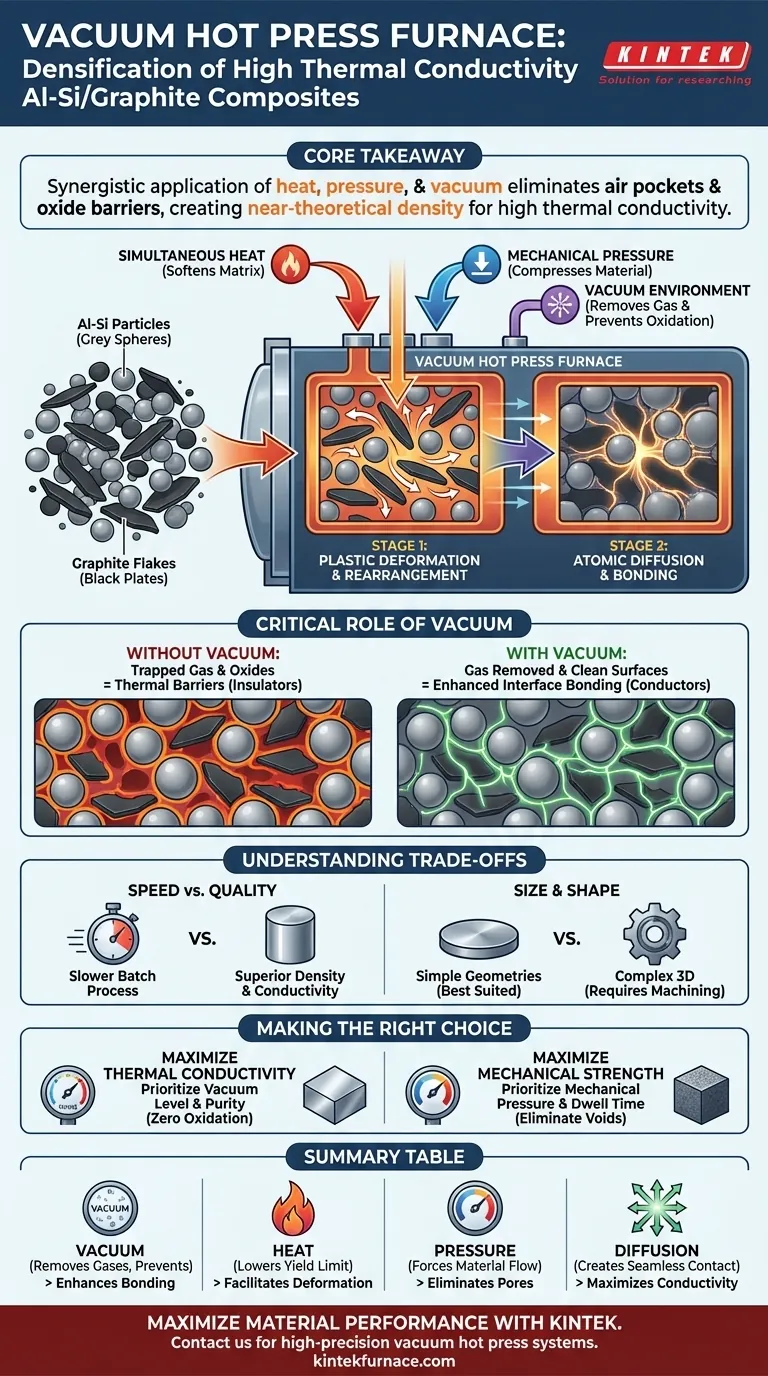
The facilitation of densification in Al-Si/graphite composites is achieved through the simultaneous application of a high-temperature field and mechanical pressure within a vacuum environment. This process utilizes the synergistic effect of heat and force to eliminate microscopic pores, promote the plastic deformation of the aluminum-silicon matrix, and rearrange particles into a tightly packed structure.
Core Takeaway Achieving high thermal conductivity requires eliminating air pockets and oxide barriers that act as insulators. A vacuum hot press furnace solves this by mechanically forcing the matrix to flow into voids while simultaneously stripping away gases and preventing oxidation, resulting in a composite with near-theoretical density.

The Synergistic Mechanics of Densification
Simultaneous Heat and Pressure
The primary driver of densification is the synergistic effect of thermal energy and mechanical force. While heat softens the aluminum-silicon alloy, lowering its yield limit, the mechanical pressure actively compresses the material.
Plastic Deformation
Under these conditions, the Al-Si alloy particles undergo significant plastic deformation. The material becomes pliable enough to change shape without fracturing, allowing it to conform perfectly around the graphite reinforcement.
Particle Rearrangement
The applied pressure forces a rearrangement of particles. The softened metal matrix is physically moved to fill the interstitial spaces between the graphite components, effectively closing the gaps that would otherwise remain in a static sintering process.
The Critical Role of the Vacuum Environment
Elimination of Microscopic Pores
A vacuum environment is essential for removing gases trapped in the interstitial spaces between powder particles. By evacuating these gases before and during the pressing phase, the furnace prevents the formation of internal gas pockets that would result in porosity and reduced thermal conductivity.
Prevention of Matrix Oxidation
Aluminum has a high affinity for oxygen, forming oxide layers that act as thermal barriers. The vacuum environment prevents the oxidation of the Al-Si powder at high temperatures, ensuring the purity of the matrix and facilitating direct metal-to-graphite contact.
Enhanced Interface Bonding
High thermal conductivity relies on a seamless interface between the metal matrix and the graphite. The combination of clean surfaces (due to vacuum) and high pressure induces atomic diffusion, creating a strong bond that facilitates efficient heat transfer.
Understanding the Trade-offs
Production Speed vs. Quality
While vacuum hot pressing yields superior density and conductivity compared to cold pressing, it is a slower, batch-oriented process. The cycle times required for heating, pressing, and cooling in a vacuum are significantly longer than conventional sintering methods.
Size and Shape Limitations
The mechanical nature of the press creates geometric constraints. The process is best suited for simple, flat shapes or discs; producing complex 3D geometries often requires extensive post-process machining, which can be difficult given the abrasive nature of graphite composites.
Making the Right Choice for Your Goal
To maximize the performance of your Al-Si/graphite composite, align your processing parameters with your specific engineering requirements.
- If your primary focus is Maximum Thermal Conductivity: Prioritize the vacuum level and purity to ensure zero oxidation at the interface, as oxides are the primary bottleneck for heat transfer.
- If your primary focus is Mechanical Strength: Focus on maximizing the mechanical pressure and dwell time to ensure complete plastic deformation and the absolute elimination of microscopic voids.
By leveraging the dual power of thermal softening and mechanical compression in a protected environment, you transform a porous mixture into a high-performance, fully dense composite.
Summary Table:
| Feature | Impact on Densification | Benefit for Al-Si/Graphite |
|---|---|---|
| Vacuum Environment | Removes trapped gases and prevents oxidation | Enhances interface bonding and purity |
| Simultaneous Heat | Lowers yield limit of Al-Si alloy | Facilitates easy plastic deformation |
| Mechanical Pressure | Forces material into interstitial gaps | Eliminates microscopic pores/voids |
| Atomic Diffusion | Creates seamless metal-to-graphite contact | Maximizes thermal conductivity |
Maximize Your Material Performance with KINTEK
Are you looking to achieve near-theoretical density and peak thermal conductivity for your advanced composites? KINTEK’s high-precision vacuum hot press systems are designed to provide the perfect synergy of thermal control and mechanical force. Backed by expert R&D and world-class manufacturing, we offer customizable Muffle, Tube, Rotary, Vacuum, and CVD systems tailored to your unique lab and industrial needs.
Take the next step in material excellence—Contact KINTEK today to discuss your specific high-temperature furnace requirements with our specialists!
Visual Guide
Related Products
- Vacuum Hot Press Furnace Machine for Lamination and Heating
- 600T Vacuum Induction Hot Press Vacuum Heat Treat and Sintering Furnace
- Vacuum Hot Press Furnace Machine Heated Vacuum Press Tube Furnace
- Vacuum Hot Press Furnace Machine Heated Vacuum Press
- High Pressure Laboratory Vacuum Tube Furnace
People Also Ask
- What are the primary components of a vacuum hot press furnace? Master the Core Systems for Precise Material Processing
- What safety features are incorporated in vacuum hot press furnaces? Ensure Operator and Equipment Protection
- What are the benefits of the vacuum environment system in a vacuum hot press furnace? Unlock High-Density Sintering
- What industries benefit from the use of vacuum hot press furnaces? Unlock High-Performance Materials for Your Industry
- How does the uniaxial pressure applied by a vacuum hot press furnace affect the microstructure of ZrC-SiC materials?



















