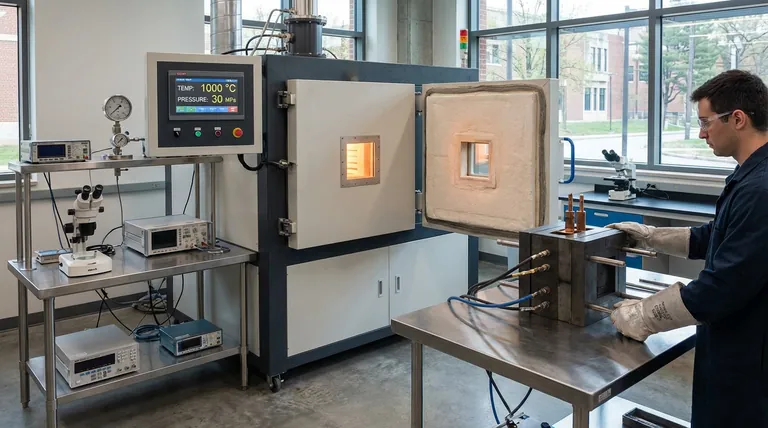
The primary function of a hot-pressing furnace in this context is to create a controlled environment that applies simultaneous heat and mechanical pressure to bond separate Silicon Carbide (SiC) wafers. Unlike standard heating methods, this equipment forces two 4H-SiC single crystal wafers to merge at the atomic level, creating a unified bicrystal with a stable interface.
The hot-pressing furnace facilitates the direct bonding of semiconductor wafers by maintaining a temperature of 1000 °C and a continuous pressure of 30 MPa. This process enables the formation of tight, atomic-scale interfaces without the need for melting the material.
The Mechanics of High-Pressure Bonding
Creating the Necessary Environment
For SiC bicrystals to form, simple heating is insufficient. The furnace must generate a specific set of conditions: a steady temperature of 1000 °C combined with a substantial uniaxial pressure of 30 MPa.
The Role of Mechanical Pressure
The application of continuous pressure is the differentiating factor of this furnace. By pressing the wafers together for an extended period (typically 20 hours), the furnace promotes atomic diffusion across the interface.
This pressure-assisted mechanism ensures the surfaces achieve intimate contact, overcoming surface irregularities that would prevent bonding in a pressureless environment.
Utilizing Graphite Molds
To deliver this pressure effectively, the 4H-SiC wafers are placed inside a graphite mold within the furnace. The mold acts as the medium through which the mechanical load is transferred to the crystals, ensuring the pressure is applied evenly across the wafer surfaces.
Controlling Crystal Orientation
The ultimate goal of this setup is not just adhesion, but specific structural alignment. The furnace environment allows the two single crystals to bond while maintaining a specific orientation difference. This creates a precise grain boundary, which is critical for studying the electronic or mechanical properties of the bicrystal.
Understanding the Operational Trade-offs
Process Duration
Hot pressing is not a rapid manufacturing technique. The process described requires a 20-hour hold time at peak parameters. This long duration is necessary to ensure the bonding is complete and structurally sound at the atomic scale.
Equipment Complexity
Unlike a standard muffle furnace, which primarily manages temperature ramps for melting and cooling, a hot-pressing furnace must manage high-force mechanical systems alongside thermal elements. This increases the complexity of operation and the cost of the equipment compared to pressureless sintering methods.
Throughput Limitations
Because the wafers must be carefully arranged in a graphite mold to ensure uniaxial pressure, this method is generally limited to batch processing. It is optimized for high-quality, precision synthesis rather than high-volume mass production.
Making the Right Choice for Your Goal
When selecting a furnace method for SiC applications, the choice depends on whether you are bonding existing crystals or densifying powders.
- If your primary focus is creating precise bicrystal interfaces: Use the hot-pressing furnace parameters (1000 °C at 30 MPa) to bond pre-existing wafers without melting them.
- If your primary focus is densifying bulk materials: Recognize that hot pressing allows for near-theoretical density at significantly lower temperatures than pressureless sintering.
- If your primary focus is crystal growth from melt: You would likely require a different apparatus, such as a muffle furnace, which specializes in controlled melting and slow cooling for nucleation.
Success in SiC bicrystal synthesis relies on the precise balance of thermal energy and mechanical force to fuse independent lattices into a single, stable structure.
Summary Table:
| Feature | Hot-Pressing Specification for SiC |
|---|---|
| Operating Temperature | 1000 °C |
| Applied Pressure | 30 MPa (Uniaxial) |
| Process Duration | 20 Hours |
| Bonding Mechanism | Atomic Diffusion & High-Pressure Contact |
| Key Component | Graphite Molds for Even Load Transfer |
| Primary Outcome | Controlled Grain Boundary Formation |
Elevate Your Semiconductor Research with KINTEK
Precision SiC bicrystal synthesis requires more than just heat; it demands the exact synchronization of mechanical force and thermal stability. Backed by expert R&D and manufacturing, KINTEK offers high-performance Hot-Pressing, Vacuum, CVD, and Muffle furnaces—all fully customizable to meet your unique laboratory requirements.
Whether you are bonding single crystals or developing advanced densified materials, our engineering team provides the technical edge you need. Contact us today to find the perfect high-temperature solution for your lab!
Visual Guide

References
- Jianqi Xi, Izabela Szlufarska. Coupling of radiation and grain boundary corrosion in SiC. DOI: 10.1038/s41529-024-00436-y
This article is also based on technical information from Kintek Furnace Knowledge Base .
Related Products
- Silicon Carbide SiC Thermal Heating Elements for Electric Furnace
- 1400℃ Muffle Oven Furnace for Laboratory
- Vacuum Hot Press Furnace Machine for Lamination and Heating
- Vacuum Hot Press Furnace Machine Heated Vacuum Press Tube Furnace
- Vacuum Hot Press Furnace Machine Heated Vacuum Press
People Also Ask
- How do the different types of silicon carbide heating elements compare in terms of applications? Find the Best Fit for Your High-Temp Needs
- What are the temperature capabilities and mounting options for silicon carbide heating elements? Unlock High-Temp Flexibility and Durability
- How do silicon carbide heating elements enhance the heat treatment of alloys? Achieve Superior Temperature Control
- What is the recommended surface load for silicon carbide heating elements at different furnace temperatures? Maximize Lifespan & Performance
- What are the advantages of using silicon carbide heating elements in industrial furnaces? Boost Efficiency and Durability