
In short, tailored heat and pressure control is the core mechanism that allows hot pressing to produce materials with superior density and optimized mechanical properties. By precisely manipulating these two variables, you can customize the manufacturing process for a specific powder, ensuring the final component meets the exact demands of its intended application.
The true benefit of tailored control isn't just applying heat and pressure, but orchestrating their synergy. This allows you to achieve near-perfect material consolidation at lower temperatures than other methods, preserving a fine microstructure that is critical for high-performance applications.
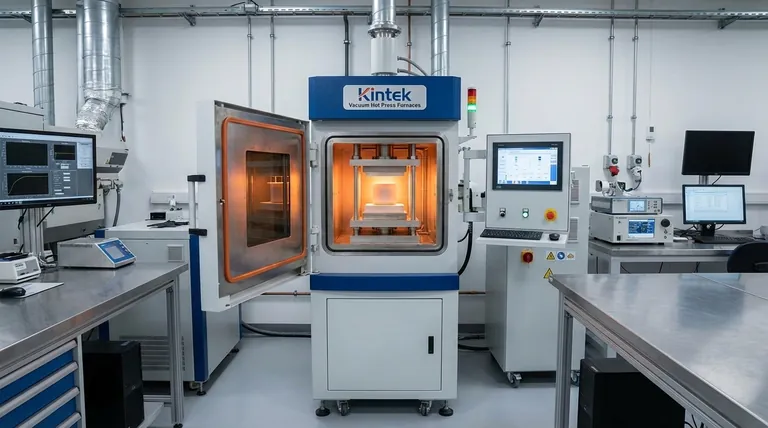
The Fundamental Roles of Heat and Pressure
To understand the benefits of control, we must first understand the distinct role each variable plays in the consolidation of powdered materials.
The Role of Heat: Enabling Material Flow
Heat is the enabler. It provides the thermal energy needed to soften the material particles, making them more plastic and ready to deform.
This increased plasticity is crucial for closing the microscopic voids, or pores, between particles. Heat also activates diffusion and other bonding mechanisms at the particle surfaces.
The Role of Pressure: Forcing Consolidation
Pressure is the driver. It applies a uniform mechanical force that physically pushes the softened particles together, eliminating the remaining porosity.
This intimate, high-pressure contact is what ensures a strong, uniform bond forms throughout the entire component, leading to exceptional density.
The Power of Synergy: Why Control Matters
The true advantage of hot pressing lies not in heat or pressure alone, but in the precise, synergistic control over both throughout the process cycle.
Achieving Full Density at Lower Temperatures
By applying pressure simultaneously with heat, the material becomes much easier to consolidate. This means you can achieve full theoretical density at a significantly lower temperature compared to pressureless sintering.
This is a critical advantage. Lower processing temperatures help prevent undesirable grain growth, which can make materials like ceramics brittle and weak.
Optimizing Microstructure for Superior Properties
The ability to tailor the temperature and pressure profile allows you to engineer the material's final microstructure.
By minimizing time at peak temperature, you can maintain a fine, uniform grain size. This fine-grained structure directly translates to improved mechanical properties, such as higher strength, hardness, and fracture toughness.
Preventing Oxidation and Unwanted Reactions
Modern hot pressing is typically performed in a vacuum or inert gas atmosphere. Precise control of the heating cycle is essential to prevent the oxidation of sensitive materials before the protective atmosphere is fully established.
This controlled environment ensures the purity of the material and prevents the formation of weak oxide layers on particle surfaces that would inhibit proper bonding.
Understanding the Trade-offs
While powerful, the precise control of hot pressing comes with practical considerations that make it unsuitable for every application.
Process Complexity and Cost
Hot pressing equipment is sophisticated and expensive. It requires skilled operators to develop and execute the precise heating and pressure profiles, adding to the overall cost per part.
Slower Cycle Times
Compared to processes like cold pressing followed by sintering, hot pressing is generally a slower, batch-oriented method. The heating, holding, and cooling cycles can take several hours, limiting throughput.
Geometric Limitations
The final component shape is constrained by the die assembly. This makes hot pressing best suited for producing relatively simple geometries like discs, blocks, and cylinders.
Making the Right Choice for Your Goal
Your specific material and performance targets will dictate the ideal hot pressing strategy. Use tailored control to achieve your primary objective.
- If your primary focus is achieving maximum density: Use a temperature just high enough to ensure full material plasticity, allowing pressure to effectively eliminate all porosity.
- If your primary focus is maximizing mechanical strength: Use the lowest possible temperature and shortest possible time needed to reach full density, preserving a fine-grained microstructure.
- If your primary focus is processing a composite material: Design a multi-stage heat and pressure cycle that accommodates the different consolidation behaviors of each constituent without causing degradation.
Ultimately, mastering the interplay of heat and pressure transforms hot pressing from a simple manufacturing step into a precise tool for materials engineering.
Summary Table:
| Aspect | Key Benefit |
|---|---|
| Density | Achieves full theoretical density at lower temperatures |
| Microstructure | Maintains fine grain size for improved strength and toughness |
| Process Efficiency | Reduces oxidation and unwanted reactions in controlled environments |
| Material Customization | Enables tailored profiles for specific powders and applications |
Unlock the full potential of your materials with KINTEK's advanced high-temperature furnace solutions! Leveraging exceptional R&D and in-house manufacturing, we provide diverse laboratories with precision tools like Muffle, Tube, Rotary Furnaces, Vacuum & Atmosphere Furnaces, and CVD/PECVD Systems. Our strong deep customization capability ensures we can precisely meet your unique experimental requirements for hot pressing and beyond. Contact us today to discuss how we can enhance your lab's efficiency and achieve superior results!
Visual Guide

Related Products
- Vacuum Hot Press Furnace Machine for Lamination and Heating
- Vacuum Hot Press Furnace Machine Heated Vacuum Press
- 600T Vacuum Induction Hot Press Vacuum Heat Treat and Sintering Furnace
- Vacuum Hot Press Furnace Machine Heated Vacuum Press Tube Furnace
- High Pressure Laboratory Vacuum Tube Furnace
People Also Ask
- What are the primary components of a vacuum hot press furnace? Master the Core Systems for Precise Material Processing
- What safety features are incorporated in vacuum hot press furnaces? Ensure Operator and Equipment Protection
- What are the benefits of the vacuum environment system in a vacuum hot press furnace? Unlock High-Density Sintering
- What industries benefit from the use of vacuum hot press furnaces? Unlock High-Performance Materials for Your Industry
- Why is a high vacuum environment crucial when preparing copper-carbon nanotube composites in a vacuum hot press furnace? Achieve Superior Composite Integrity






