
Precision molds and laboratory presses are fundamental to the ceramic preparation process because they ensure a uniform initial packing density. By applying strictly controlled pressure to niobium-doped titanium dioxide powders, these tools minimize internal pores and prevent density gradients within the "green body" (the compacted powder before firing). This structural homogeneity is a prerequisite for achieving high-density sintered materials and accurate data in subsequent testing.
The physical integrity of a ceramic is established during the pressing stage, not the firing stage. Precise compaction enables sintered densities reaching 94% of the theoretical limit, which is essential for valid electrical measurements.
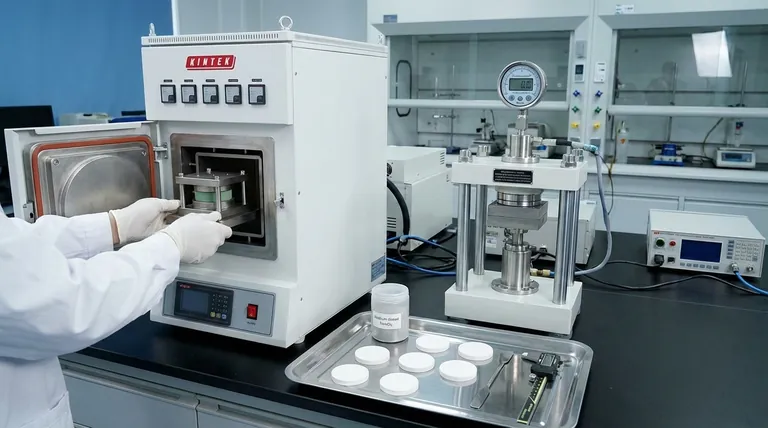
The Mechanics of Powder Compaction
Achieving Uniform Packing Density
The primary goal of using a precision mold is to arrange the loose powder particles into a tightly packed structure. When pressure is applied, particles rearrange to fill void spaces.
Without the geometric accuracy of a precision mold, pressure distribution becomes uneven. This leads to loose clusters of powder that will never properly fuse during sintering.
Minimizing Internal Pores
Laboratory presses are used to apply a specific, consistent force that manual methods cannot replicate. This force is necessary to collapse the air gaps between powder granules.
If the pressure is insufficient or fluctuating, significant porosity remains in the green body. These pores act as flaws that inhibit the material's performance.
Controlling Density Gradients
A major challenge in dry pressing is the friction between the powder and the mold walls. This friction can cause the edges of the sample to be less dense than the center.
Precision equipment helps mitigate this by ensuring the punch moves smoothly and vertically. This alignment reduces lateral stresses that create varying density zones (gradients) within the sample.
The Connection to Sintering Success
The Foundation for High-Temperature Firing
The green body serves as the blueprint for the final ceramic. Any defects introduced during pressing—such as cracks or large pores—will not heal during the sintering process.
To achieve a high-quality result, the initial compaction must be nearly flawless before the material enters the furnace.
Reaching Theoretical Density
According to the primary data, the target sintering temperature for this material is 1200°C. To maximize the effectiveness of this heat treatment, the particles must already be in close contact.
Proper pressing allows the material to reach up to 94% of its theoretical density. Without this high density, the material remains porous and mechanically weak.
Impact on Electrical Characterization
The Necessity of a Continuous Structure
The ultimate purpose of preparing niobium-doped titanium dioxide is often to measure its electrical properties. For these measurements to be accurate, the material must be a solid, continuous mass.
Pores act as insulators or scattering sites for charge carriers. Therefore, a low-density sample will yield erratic or incorrect electrical data.
Ensuring Reproducibility
Scientific rigor requires that experiments can be repeated with the same results. Using precision molds ensures that every sample has the same dimensions and density profile.
This consistency allows researchers to attribute changes in electrical properties to the material itself, rather than variations in sample preparation.
Understanding the Trade-offs
The Risk of Over-Pressing
While density is the goal, applying too much pressure via a laboratory press can be detrimental. Excessive force can cause "spring-back" when the pressure is released, leading to lamination cracks.
Geometric Limitations
Uniaxial pressing (pressing from top and bottom) is highly effective for simple shapes like disks. However, it struggles with complex geometries where pressure cannot be distributed evenly throughout the volume.
Optimizing Your Sample Preparation
To ensure your niobium-doped titanium dioxide samples yield valid data, consider your specific experimental goals.
- If your primary focus is mechanical integrity: Prioritize the use of precision molds to eliminate density gradients that lead to cracking during the 1200°C sintering phase.
- If your primary focus is electrical accuracy: Ensure your laboratory press is calibrated to achieve the highest possible green density, as this directly correlates to the 94% sintered density required for reliable conductivity readings.
The quality of your data is directly proportional to the precision of your preparation.
Summary Table:
| Key Factor | Impact on Green Body | Benefit for Sintering/Testing |
|---|---|---|
| Uniform Packing | Eliminates loose powder clusters | Ensures consistent fusion at 1200°C |
| Pressure Control | Collapses internal air gaps | Reaches up to 94% theoretical density |
| Precision Alignment | Minimizes density gradients | Prevents cracks and structural warping |
| Structural Integrity | Creates a continuous mass | Accurate electrical property measurement |
Elevate Your Ceramic Research with KINTEK
Precision in the green body phase is the foundation of high-performance ceramics. At KINTEK, we understand that your data depends on structural homogeneity. Backed by expert R&D and manufacturing, we provide high-precision Laboratory Presses and Customizable Molds designed to minimize density gradients and maximize sintered density.
Whether you are working with niobium-doped titanium dioxide or advanced CVD systems, our equipment ensures your materials meet the most rigorous scientific standards. Contact us today to discover how our customizable lab high-temp furnaces and pressing solutions can optimize your material preparation workflow.
Visual Guide

References
- Tomoyuki Shiraiwa, Takahisa Omata. Enhanced Proton Transport in Nb-Doped Rutile TiO<sub>2</sub>: A Highly Useful Class of Proton-Conducting Mixed Ionic Electronic Conductors. DOI: 10.1021/jacs.5c05805
This article is also based on technical information from Kintek Furnace Knowledge Base .
Related Products
People Also Ask
- What factors determine the quality of sintered zirconia restorations? Master Material, Equipment, and Technique
- How do conventional vs rapid sintering in dental furnaces affect zirconia? Optimize Efficiency Without Sacrificing Strength
- What is the purpose of dental sintering furnaces? Transform Zirconia into Durable, High-Quality Dental Restorations
- What precautions should be taken when sintering zirconia in the Fast Slow Dental Sintering Furnace? Master Key Steps for Perfect Results
- What temperature range is used for sintering zirconia ceramics? Achieve Optimal Strength and Translucency
