
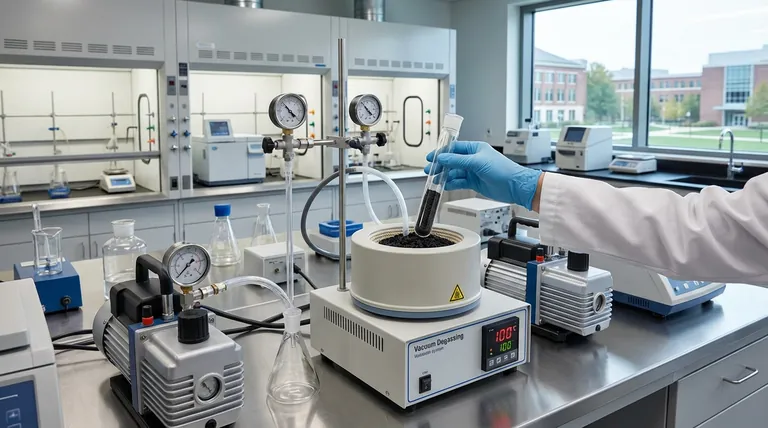
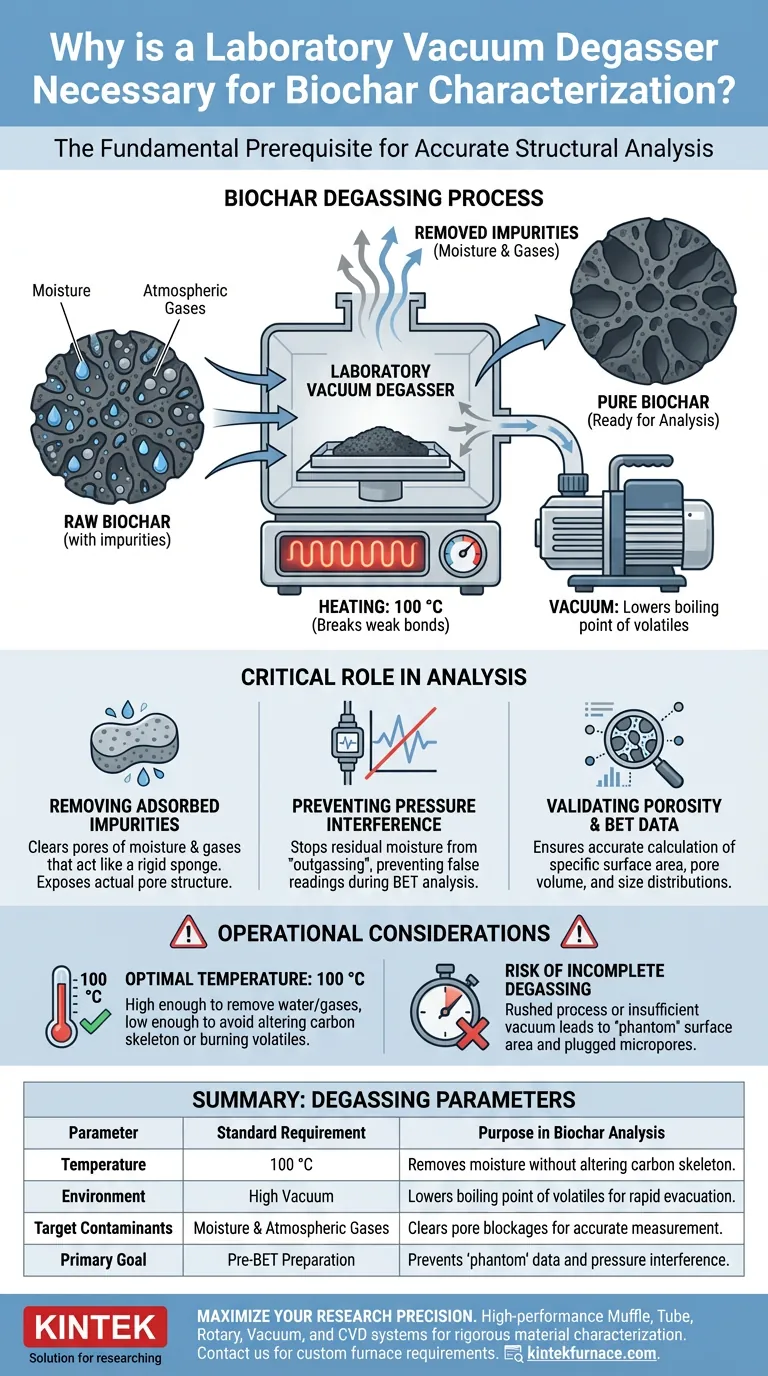
A laboratory vacuum degasser is a fundamental prerequisite for the accurate structural characterization of biochar. Before analysis can begin, this device prepares the sample by subjecting it to vacuum conditions at elevated temperatures—specifically 100 °C—to strip away adsorbed impurities. This process clears the pores of moisture and environmental gases, ensuring that subsequent measurements reflect the true nature of the biochar rather than contaminants.
The purity of the sample dictates the quality of the data. By removing residual moisture and gases that naturally cling to biochar, a vacuum degasser prevents these impurities from skewing sensitive pressure measurements, ensuring reliable surface area and porosity calculations.
The Critical Role of Degassing in Biochar Analysis
To understand biochar structure, you must first eliminate external variables. The vacuum degasser acts as the "reset" button for the material's internal environment.
Removing Adsorbed Impurities
Biochar is highly porous, acting essentially like a rigid sponge. In its natural state, these pores are filled with atmospheric moisture and gases.
If these impurities are left in place, they occupy the very space you are trying to measure. The degasser physically evacuates these substances to expose the actual pore structure.
The Function of Heat and Vacuum
The process relies on a specific combination of thermal energy and negative pressure.
According to standard protocols, the biochar is heated to 100 °C under vacuum. The heat provides enough energy to break the weak bonds holding moisture to the biochar surface, while the vacuum lowers the boiling point of volatiles, facilitating their rapid removal.
Ensuring Accuracy in BET Analysis
The primary reason for degassing is to prepare the sample for Brunauer-Emmett-Teller (BET) analysis, the gold standard for measuring specific surface area.
Preventing Pressure Interference
BET analysis works by measuring how gas interacts with the solid surface at specific pressures.
If the sample contains residual moisture, it will "outgas" during the analysis. This releases extra gas molecules into the system, interfering with the sensitive pressure sensors and creating false readings.
Validating Porosity Parameters
The presence of contaminants does not just affect surface area; it distorts porosity data as well.
Blocked pores cannot be measured. By using a degasser to clear these pathways, you ensure that the calculated pore volume and size distributions are accurate representations of the biochar's physical architecture.
Operational Considerations
While necessary, the degassing process requires careful control to balance cleaning efficiency with sample integrity.
Temperature Constraints
The target temperature of 100 °C is deliberate. It is high enough to drive off water and atmospheric gases but generally low enough to avoid structurally altering the carbon skeleton of the biochar.
Exceeding this temperature significantly could inadvertently activate the biochar further or burn off volatile organic compounds that are part of the sample's actual composition.
The Cost of Incomplete Degassing
Attempting to shorten this step is a common source of analytical error.
If the degassing phase is rushed or the vacuum is insufficient, "phantom" surface area results may occur. The data may show lower porosity than exists in reality because the smaller micropores remain plugged with water molecules.
Ensuring Reliable Characterization Results
To derive meaningful insights from your biochar research, apply the following principles during sample preparation:
- If your primary focus is Data Accuracy: Ensure the degassing protocol strictly maintains 100 °C under vacuum to fully evacuate pores without damaging the sample structure.
- If your primary focus is Process Troubleshooting: Look at the degassing stage first if your BET surface area results appear inexplicably low or inconsistent.
Proper degassing is the invisible foundation upon which all valid structural biochar data is built.
Summary Table:
| Parameter | Standard Requirement | Purpose in Biochar Analysis |
|---|---|---|
| Temperature | 100 °C | Removes moisture without altering the carbon skeleton |
| Environment | High Vacuum | Lowers boiling point of volatiles for rapid evacuation |
| Target Contaminants | Moisture & Atmospheric Gases | Clears pore blockages for accurate measurement |
| Primary Goal | Pre-BET Preparation | Prevents 'phantom' data and pressure interference |
Maximize Your Research Precision with KINTEK
Don't let sample impurities compromise your data integrity. KINTEK provides high-performance laboratory solutions specifically designed for rigorous material characterization. Backed by expert R&D and manufacturing, we offer high-temperature Muffle, Tube, Rotary, Vacuum, and CVD systems, all fully customizable to meet the specific degassing and thermal processing needs of your biochar research.
Ready to achieve superior accuracy in your lab? Contact us today to discuss your custom furnace requirements with our technical specialists.
Visual Guide
References
- Fairuz Gianirfan Nugroho, Abu Talha Aqueel Ahmed. Utilizing Indonesian Empty Palm Fruit Bunches: Biochar Synthesis via Temperatures Dependent Pyrolysis. DOI: 10.3390/nano15010050
This article is also based on technical information from Kintek Furnace Knowledge Base .
Related Products
- Laboratory Vacuum Tilt Rotary Tube Furnace Rotating Tube Furnace
- Small Vacuum Heat Treat and Tungsten Wire Sintering Furnace
- Vacuum Dental Porcelain Sintering Furnace for Dental Laboratories
- High Temperature Muffle Oven Furnace for Laboratory Debinding and Pre Sintering
People Also Ask
- What are the key advantages of using a rotary tube furnace? Achieve Dynamic, Uniform Heating for Powders
- When are rotary tube furnaces not suitable for a process? Avoid Costly Mistakes in Thermal Processing
- What optional features enhance the processing capabilities of rotary tube furnaces? Boost Efficiency with Advanced Customizations
- What other fields utilize rotary tube furnaces? Discover Versatile Heating Solutions for Multiple Industries
- What are the technical advantages of using a rotary tube furnace for hydrochar activation? Achieve Superior Porosity



