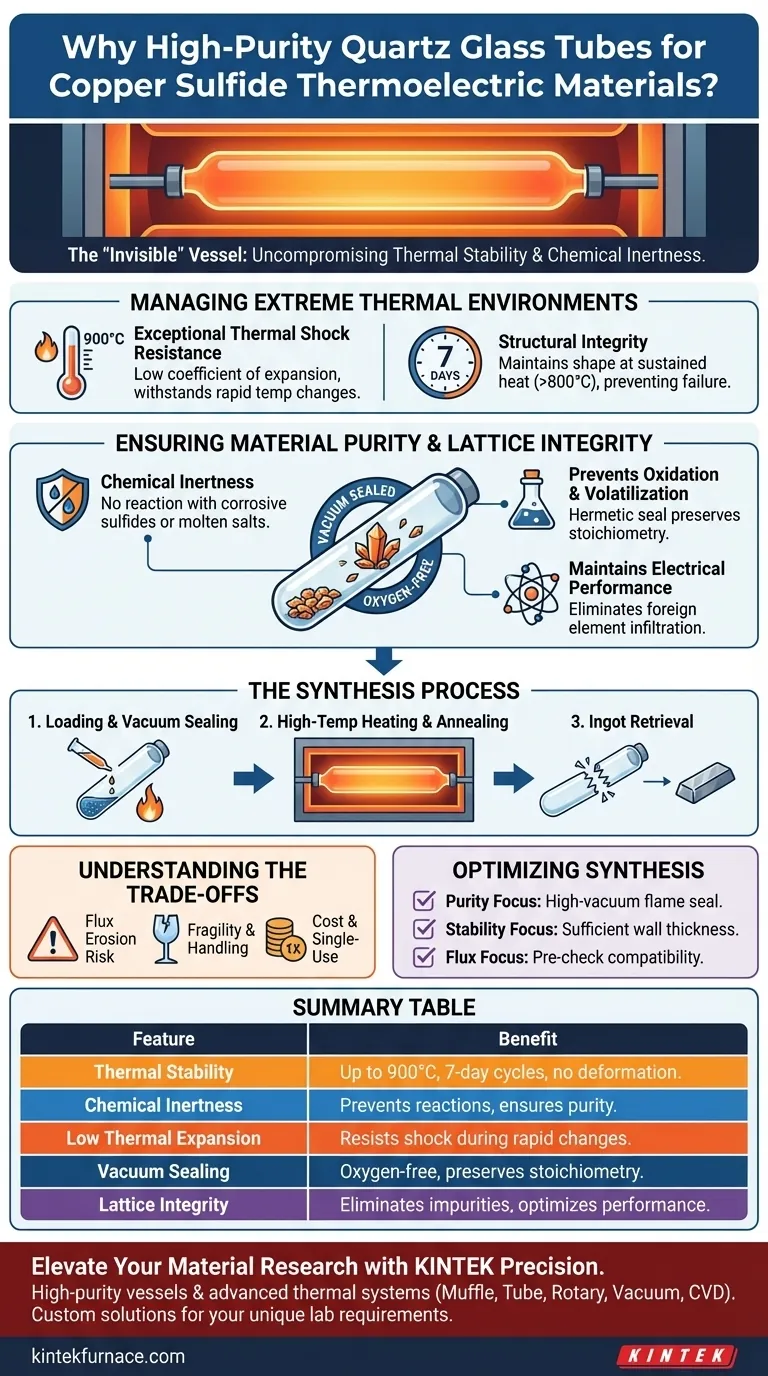
High-purity quartz glass tubes are the standard for synthesizing copper sulfide thermoelectric materials because they provide an uncompromising combination of thermal stability and chemical inertness. These tubes can withstand the extreme temperatures (up to 900°C) and prolonged seven-day annealing processes required for synthesis without cracking or deforming. Most importantly, quartz does not react with corrosive sulfides or molten salts, ensuring the final thermoelectric product reaches the high levels of purity necessary for efficient energy conversion.
The core value of high-purity quartz in this application is its ability to serve as a chemically "invisible" vessel. It maintains a vacuum-sealed, oxygen-free environment that prevents contamination and oxidation, which is critical for preserving the delicate electrical and thermal properties of copper sulfide.
Managing Extreme Thermal Environments
Exceptional Resistance to Thermal Shock
Copper sulfide synthesis involves high-temperature melting followed by extended annealing cycles. High-purity quartz possesses an extremely low coefficient of thermal expansion, allowing it to undergo rapid temperature changes without fracturing.
Structural Integrity at Sustained Temperatures
During the seven-day annealing process, the reaction vessel must remain structurally sound. Quartz maintains its shape and strength even when exposed to continuous heat exceeding 800°C–900°C, preventing vessel failure during long-term experiments.
Ensuring Material Purity and Lattice Integrity
Chemical Inertness Against Corrosive Sulfides
Sulfur vapor and molten salts used in these reactions are highly corrosive to many materials. High-purity quartz is chemically inert to these substances, ensuring that no container-derived impurities infiltrate the copper sulfide crystal lattice.
Prevention of Oxidation and Volatilization
Quartz tubes can be vacuum flame-sealed to create an absolute dry, oxygen-free micro-environment. This hermetic seal prevents the oxidation of copper salts and inhibits the volatilization of reagents, which is essential for maintaining the correct stoichiometry of the material.
Maintaining Electrical Performance
The efficiency of thermoelectric materials depends heavily on their "electrical purity." By preventing the introduction of foreign elements from the vessel wall, quartz glass ensures that the resulting material achieves the specific lattice integrity required for optimal performance.
Understanding the Trade-offs
The Risk of Flux Erosion
In specific synthesis techniques involving active fluxes, quartz can be susceptible to slow erosion. While usually chosen for its inertness, certain molten salt systems (like KOH or specific fluorides) may slowly react with the silica, potentially introducing silicon as an unintended dopant.
Fragility and Handling Requirements
Despite its thermal resilience, quartz remains a brittle material. It is susceptible to physical impact and must be handled with extreme care during the sealing and loading phases to avoid microscopic stress fractures.
Cost and Single-Use Limitations
High-purity quartz is significantly more expensive than standard laboratory glassware. Because these tubes are often flame-sealed and then broken to retrieve the synthesized ingot, the cost of consumables can become a significant factor in large-scale production.
Optimizing Your Synthesis Process
To achieve the best results when using quartz tubes for thermoelectric material preparation, consider your specific experimental goals.
- If your primary focus is maximum material purity: Use high-purity fused quartz and prioritize a high-vacuum flame seal to eliminate all traces of oxygen and moisture.
- If your primary focus is long-term thermal stability: Ensure the quartz tube has a sufficient wall thickness to withstand internal pressure and sustained heat during the seven-day annealing window.
- If your primary focus is preventing contamination from fluxes: Pre-check the compatibility of your molten salt system with silica to ensure no erosion occurs at your target operating temperature.
Selecting the right grade of high-purity quartz is ultimately an investment in the reliability and performance of the resulting thermoelectric material.
Summary Table:
| Feature | Benefit for Copper Sulfide Synthesis |
|---|---|
| Thermal Stability | Withstands temperatures up to 900°C and 7-day annealing cycles without deformation. |
| Chemical Inertness | Prevents reactions with corrosive sulfides and molten salts, ensuring material purity. |
| Low Thermal Expansion | Excellent resistance to thermal shock during rapid temperature changes and melting. |
| Vacuum Sealing | Enables oxygen-free, hermetic environments to prevent oxidation and maintain stoichiometry. |
| Lattice Integrity | Eliminates foreign element infiltration to preserve electrical and thermal properties. |
Elevate Your Material Research with KINTEK Precision
High-performance thermoelectric materials demand uncompromising environments. At KINTEK, we understand that your results are only as good as your tools. Backed by expert R&D and manufacturing, we provide high-purity quartz vessels and advanced thermal systems designed to meet the rigorous demands of material synthesis.
Whether you need Muffle, Tube, Rotary, Vacuum, or CVD systems, our equipment is fully customizable to your unique lab requirements. Ensure the purity, stability, and integrity of your next breakthrough—contact our technical experts today to find your perfect solution.
Visual Guide
References
- Yixin Zhang, Zhen‐Hua Ge. Synergistically optimized electron and phonon transport in high-performance copper sulfides thermoelectric materials via one-pot modulation. DOI: 10.1038/s41467-024-47148-0
This article is also based on technical information from Kintek Furnace Knowledge Base .
Related Products
- High Pressure Laboratory Vacuum Tube Furnace
- Vertical Laboratory Quartz Tube Furnace Tubular Furnace
- 1200℃ Split Tube Furnace Laboratory Quartz Tube Furnace with Quartz Tube
- Magnesium Extraction and Purification Condensing Tube Furnace
- Multi Zone Laboratory Quartz Tube Furnace Tubular Furnace
People Also Ask
- What role does a high vacuum tube furnace play in Co-Al sintering? Master High-Purity Porous Material Synthesis
- What are the different types of tube furnaces available? Find the Perfect Fit for Your Lab's Needs
- What are the main advantages of vacuum tube furnaces in the market? Achieve Purity and Precision in Material Processing
- What is the role of a vacuum tube furnace during the final thermal treatment stage of Fe3O4@CSAC catalysts?
- What conditions do tube furnaces provide for Au-Seeded TiO2 nanowires? Master Precision Thermal Synthesis