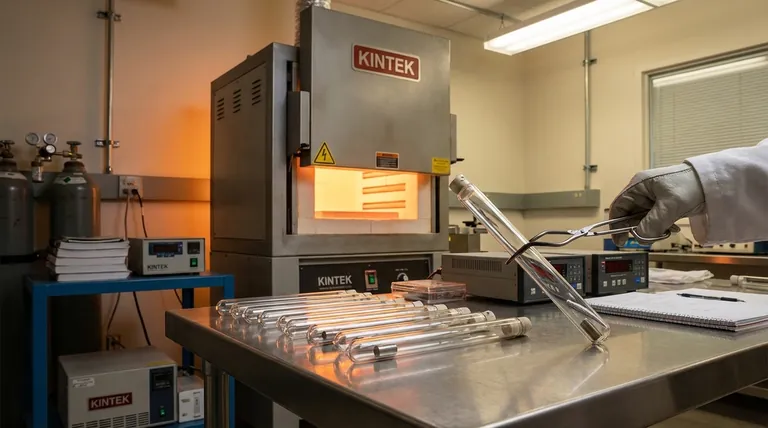
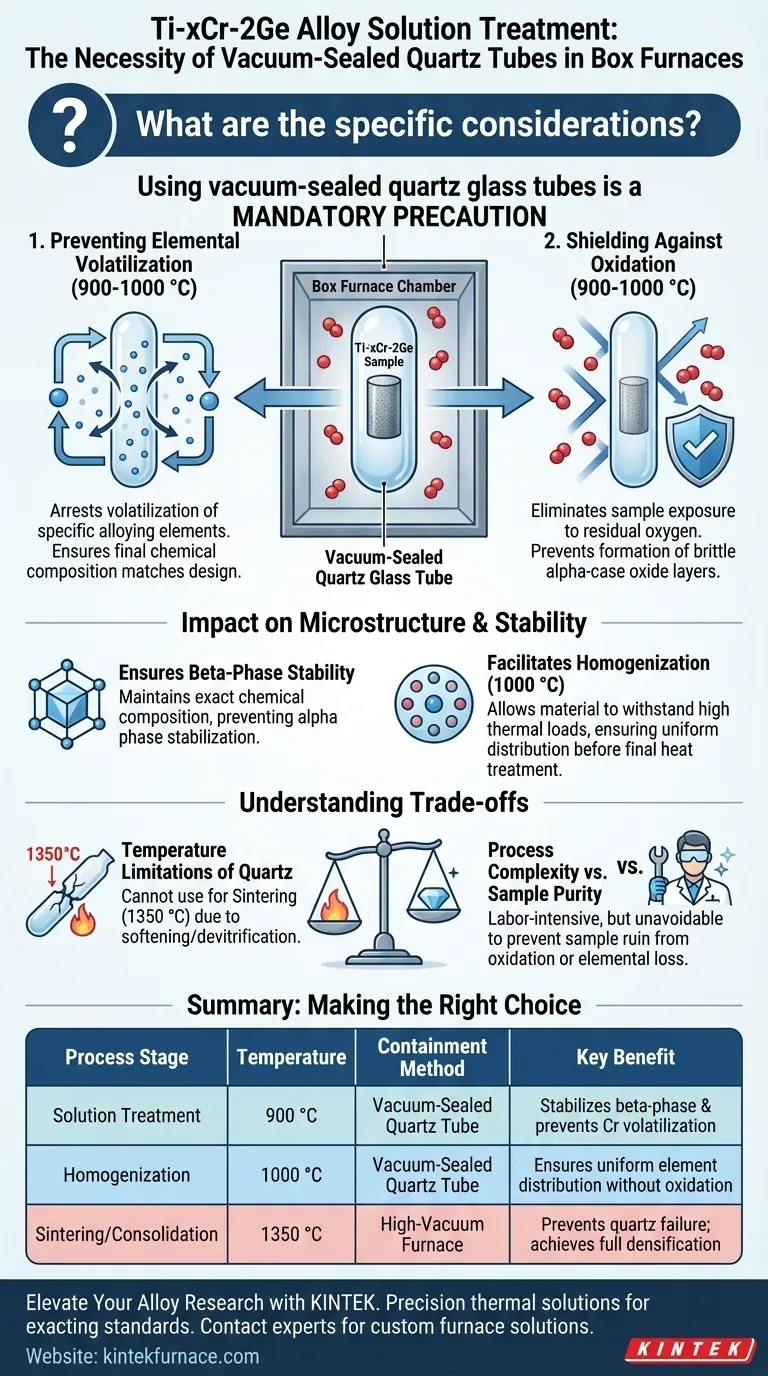
Using vacuum-sealed quartz glass tubes is a mandatory precaution when performing solution treatment on Ti-xCr-2Ge alloys in a box furnace to guarantee the integrity of the alloy's chemical composition and microstructure. This isolation technique serves two critical functions at treatment temperatures of 900 °C: it completely prevents the volatilization of volatile alloying elements and acts as an impermeable barrier against oxidation from residual oxygen inherent in standard box furnaces.
The success of your solution treatment hinges on absolute physical isolation; without the quartz barrier, atomic loss and oxygen contamination will destabilize the beta-phase structure and compromise the alloy's mechanical properties.
The Mechanics of Isolation
Preventing Elemental Volatilization
Solution treatment for Ti-xCr-2Ge alloys typically requires temperatures around 900 °C, with homogenization reaching up to 1000 °C.
At these elevated temperatures, specific alloying elements within the titanium matrix are prone to vaporization. Sealing the sample in a quartz tube creates a closed system that arrests this volatilization, ensuring the final chemical composition matches your initial design.
Shielding Against Oxidation
Titanium alloys are highly reactive to oxygen at high temperatures. Standard box resistance furnaces, even those with inert gas purging, often contain residual oxygen.
The vacuum-sealed quartz tube provides a physical shield. It eliminates the sample's exposure to the furnace atmosphere, preventing the formation of brittle oxide layers (alpha-case) that would otherwise degrade the material's performance.
Impact on Microstructure
Ensuring Beta-Phase Stability
The primary objective of solution treatment is to dissolve alloying elements to achieve a specific phase balance.
According to technical data, the isolation provided by the quartz tube is directly responsible for ensuring the stability of the beta-phase structure. By maintaining the exact chemical composition and preventing oxygen stabilization of the alpha phase, the tube allows the solution treatment to function correctly.
Facilitating Homogenization
Before solution treatment, alloys often undergo homogenization at 1000 °C.
The quartz tube mechanism is equally critical here. It allows the material to withstand these higher thermal loads for extended periods without surface degradation, ensuring a uniform distribution of elements before the final heat treatment.
Understanding the Trade-offs
Temperature Limitations of Quartz
While quartz is excellent for solution treatment at 900 °C and homogenization at 1000 °C, it has thermal limits.
You cannot use quartz tubes for processes requiring significantly higher temperatures, such as sintering at 1350 °C. At those temperatures, quartz will soften or devitrify, leading to catastrophic failure of the seal.
Process Complexity vs. Sample Purity
Using sealed tubes introduces a labor-intensive step to the workflow compared to simply placing samples in a furnace.
However, this trade-off is unavoidable for Ti-xCr-2Ge alloys in a box furnace. The cost of preparation is negligible compared to the risk of ruining the sample through oxidation or elemental loss.
Making the Right Choice for Your Goal
To ensure you are applying the correct thermal processing method for your specific stage of alloy development, consider the following:
- If your primary focus is Solution Treatment (900 °C): Use vacuum-sealed quartz tubes in a box furnace to protect against oxidation and element loss while stabilizing the beta-phase.
- If your primary focus is Homogenization (1000 °C): Continue using the quartz tube method to ensure physical isolation during this high-temperature soak.
- If your primary focus is Sintering/Consolidation (1350 °C): Do not use quartz tubes; instead, utilize a dedicated high-vacuum tube furnace to handle the extreme temperatures required for densification.
By matching the containment method to the temperature regime, you ensure precise control over the alloy's final properties.
Summary Table:
| Process Stage | Temperature | Containment Method | Key Benefit |
|---|---|---|---|
| Solution Treatment | 900 °C | Vacuum-Sealed Quartz Tube | Stabilizes beta-phase & prevents Cr volatilization |
| Homogenization | 1000 °C | Vacuum-Sealed Quartz Tube | Ensures uniform element distribution without oxidation |
| Sintering/Consolidation | 1350 °C | High-Vacuum Furnace | Prevents quartz failure; achieves full densification |
Elevate Your Alloy Research with KINTEK
Precision heat treatment is the backbone of advanced metallurgy. KINTEK provides the high-performance thermal solutions you need to ensure every solution treatment and homogenization process meets exacting standards.
Backed by expert R&D and world-class manufacturing, we offer a comprehensive range of Muffle, Tube, Rotary, Vacuum, and CVD systems. Whether you need standard laboratory high-temperature furnaces or fully customizable systems for unique alloy developments like Ti-xCr-2Ge, our technology ensures absolute control over atmosphere and temperature.
Ready to protect your materials from oxidation and elemental loss?
Contact KINTEK experts today to find your custom furnace solution
Visual Guide
References
- Teddy Sjafrizal, Matthew S. Dargusch. Powder Metallurgy Preparation of Metastable <i>β</i> Ti–Cr–Ge Alloys for Medical Applications. DOI: 10.1002/adem.202500563
This article is also based on technical information from Kintek Furnace Knowledge Base .
Related Products
- High Pressure Laboratory Vacuum Tube Furnace
- Vacuum Sealed Continuous Working Rotary Tube Furnace Rotating Tube Furnace
- Vertical Laboratory Quartz Tube Furnace Tubular Furnace
- Multi Zone Laboratory Quartz Tube Furnace Tubular Furnace
- CF KF Flange Vacuum Electrode Feedthrough Lead Sealing Assembly for Vacuum Systems
People Also Ask
- What role does a high vacuum tube furnace play in Co-Al sintering? Master High-Purity Porous Material Synthesis
- What are the different types of tube furnaces available? Find the Perfect Fit for Your Lab's Needs
- What is the role of a vacuum tube furnace during the final thermal treatment stage of Fe3O4@CSAC catalysts?
- What are the main advantages of vacuum tube furnaces in the market? Achieve Purity and Precision in Material Processing
- What conditions do tube furnaces provide for Au-Seeded TiO2 nanowires? Master Precision Thermal Synthesis