
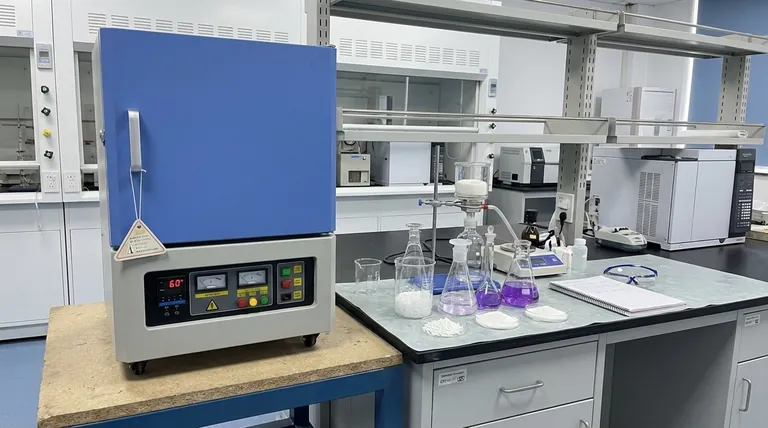
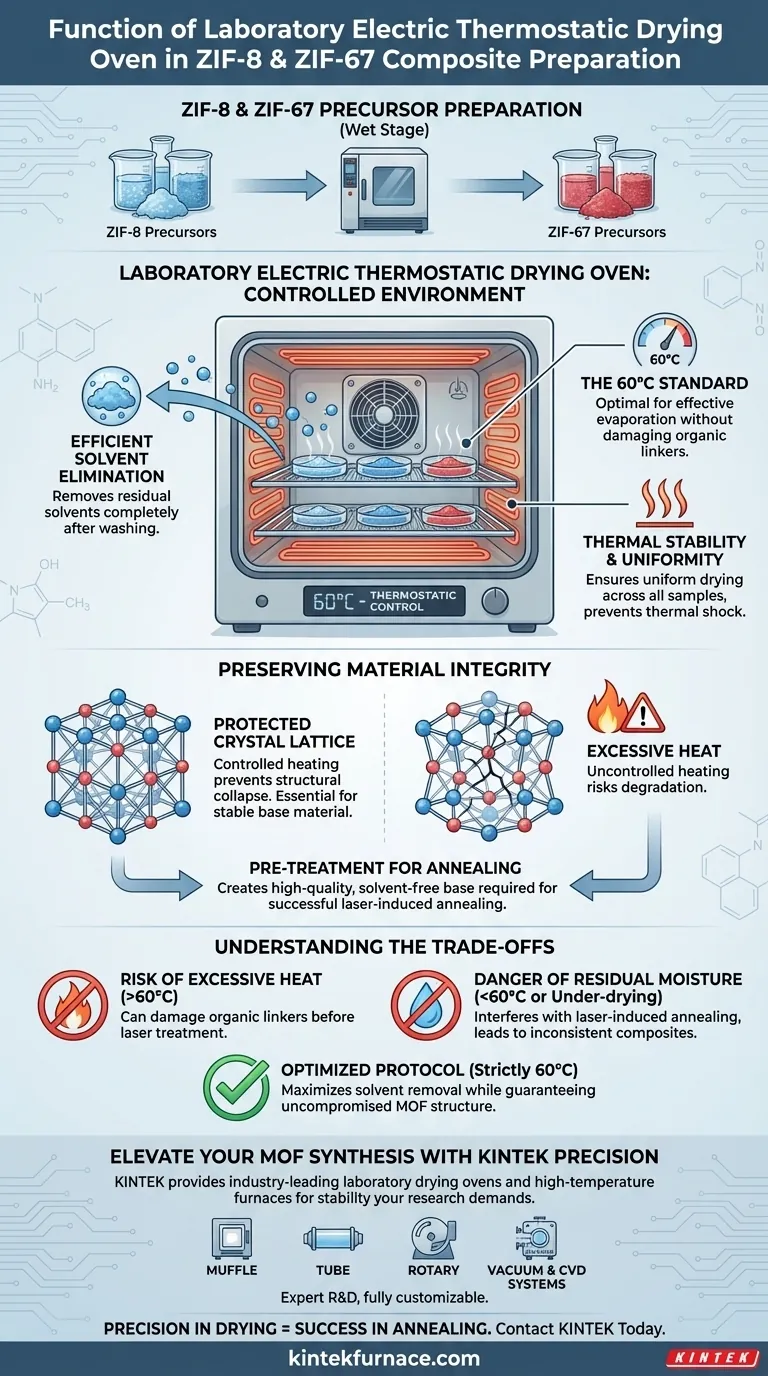
The primary function of a laboratory electric thermostatic drying oven in this context is to provide a controlled environment for the complete removal of residual solvents from ZIF-8 and ZIF-67 precursors. By maintaining a stable, low-to-medium temperature—typically set at 60°C—it ensures the material is thoroughly dried following the washing stage without compromising its structural properties.
Core Takeaway The drying process is a critical quality control step, not just a method of evaporation. By utilizing a thermostatic oven, you ensure the integrity of the Metal-Organic Framework (MOF) crystal structure is preserved, creating the necessary high-quality base material required for successful laser-induced annealing.
The Critical Role of Controlled Heating
Efficient Solvent Elimination
After the initial synthesis and washing of ZIF-8 and ZIF-67, residual solvents remain trapped within the material. The drying oven is employed specifically to drive off these solvents completely.
The 60°C Standard
The reference protocol typically designates 60°C as the optimal operating temperature. This specific setting provides enough thermal energy to evaporate solvents effective while remaining in the low-to-medium heat range.
Stability vs. Speed
Unlike rapid heating methods, a thermostatic oven ensures thermal stability. This consistency is vital for uniform drying across the entire sample batch.
Preserving Material Integrity
Protecting the Crystal Lattice
ZIF-8 and ZIF-67 are Metal-Organic Frameworks (MOFs) with distinct crystal structures. The oven’s controlled environment prevents the structural collapse or degradation that might occur with uncontrolled heating.
Preventing Thermal Shock
Sudden temperature fluctuations can induce stress in the material. The thermostatic function mitigates this risk, ensuring the crystals remain stable during the transition from wet precursor to dry powder.
Pre-Treatment for Annealing
The ultimate goal of this drying phase is to prepare the material for the next step: laser-induced annealing. Only a structurally sound, solvent-free base material will yield high-quality results in the subsequent laser processing.
Understanding the Trade-offs
The Risk of Excessive Heat
While higher temperatures might dry the sample faster, deviating significantly above 60°C carries risks. Excessive heat can damage the organic linkers within the ZIF structure before the material is even subjected to the laser.
The Danger of Residual Moisture
Conversely, under-drying or using temperatures too low leaves solvent residues. This impurity can interfere with the laser-induced annealing process, leading to inconsistent composite formation.
Optimizing Your Synthesis Protocol
To ensure the highest quality ZIF-8 and ZIF-67 composites, apply the following guidelines based on your specific objectives:
- If your primary focus is Crystal Quality: Strictly maintain the temperature at 60°C to maximize solvent removal while guaranteeing the MOF structure remains uncompromised.
- If your primary focus is Process Consistency: Use the thermostatic features to stabilize the environment before introducing samples, ensuring every batch starts with identical thermal conditions for the laser phase.
Precision in the drying phase is the foundation for success in the annealing phase.
Summary Table:
| Feature | Parameter/Function | Benefit to ZIF-8/ZIF-67 Preparation |
|---|---|---|
| Standard Temp | 60°C | Optimal solvent evaporation without organic linker damage. |
| Control Type | Thermostatic | Prevents thermal shock and ensures uniform batch drying. |
| Primary Goal | Solvent Removal | Eliminates impurities that interfere with laser-induced annealing. |
| Structural Impact | Crystal Preservation | Protects the Metal-Organic Framework lattice from collapse. |
Elevate Your MOF Synthesis with KINTEK Precision
High-quality ZIF-8 and ZIF-67 composites require the perfect thermal foundation. KINTEK provides industry-leading laboratory drying ovens and high-temperature furnace systems designed to deliver the stability your research demands.
Backed by expert R&D and manufacturing, we offer specialized Muffle, Tube, Rotary, Vacuum, and CVD systems, all fully customizable to your unique material needs. Ensure your precursors are perfectly prepared for successful laser-induced annealing by partnering with thermal processing experts.
Contact KINTEK Today to Customize Your Laboratory Solution
Visual Guide
References
- Hengyi Guo, Andrew G. Thomas. Laser Synthesis of Platinum Single-Atom Catalysts for Hydrogen Evolution Reaction. DOI: 10.3390/nano15010078
This article is also based on technical information from Kintek Furnace Knowledge Base .
Related Products
- Laboratory Muffle Oven Furnace with Bottom Lifting
- 1200℃ Muffle Oven Furnace for Laboratory
- 1400℃ Muffle Oven Furnace for Laboratory
- 1800℃ High Temperature Muffle Oven Furnace for Laboratory
- High Temperature Muffle Oven Furnace for Laboratory Debinding and Pre Sintering
People Also Ask
- What is the importance of the calcination process? Master High-Purity Calcium Phosphate Nanopowder Production
- What function does a muffle furnace perform in Ba0.75Ca0.25TiO3 calcination? Ensure Phase Purity & Synthesis
- Why is a high-temperature muffle furnace required for FeOx-MOx/TiO2? Engineering High-Performance Nanocomposites
- Why is a high-temperature laboratory muffle furnace essential for the alkali fusion process in zeolite synthesis?
- What are the primary functions of a high-temperature laboratory muffle furnace in the preparation of biosorbent materials?








