The primary advantage of using a platinum crucible for melting alumino-borosilicate glass is its exceptional combination of chemical inertness and high-temperature stability.
At processing temperatures around 1100°C, a platinum crucible creates a non-reactive environment that prevents the vessel from interacting with the molten glass. This is critical for ensuring that the final synthesized glass retains a precise chemical composition and high optical purity, free from structural impurities introduced by the container.
Core Insight: Platinum crucibles are indispensable when material purity is paramount; unlike ceramic alternatives, they eliminate the risk of chemical leaching into the melt, ensuring the final glass product is both chemically accurate and optically transparent.
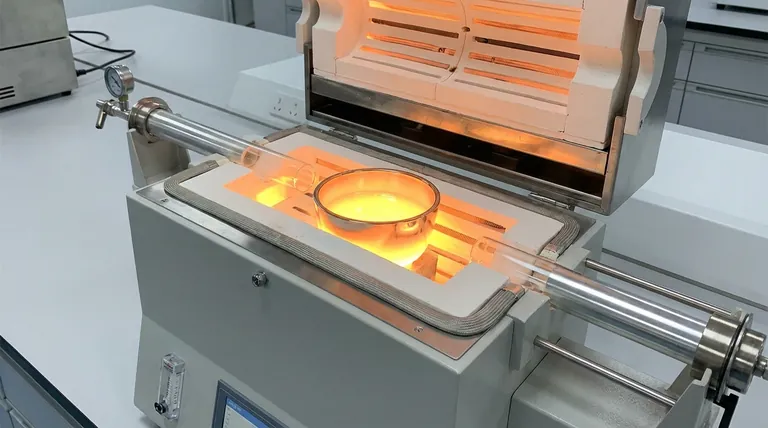
Achieving Chemical and Optical Perfection
Preventing Impurity Leaching
The most significant risk during glass melting is the introduction of foreign materials from the crucible into the melt.
Platinum offers a chemically inert barrier that effectively stops this contamination. By preventing material transfer from the container walls, the melt remains free of external impurities that could compromise the glass's structure.
Maintaining Precise Stoichiometry
Sodium alumino-borosilicate glass requires an exact chemical balance to achieve its desired properties.
Because platinum does not react with the glass melt, the chemical composition you calculate is exactly what you produce. There is no loss of glass components to the crucible walls, nor is there an addition of crucible elements into the glass matrix.
Ensuring Optical Clarity
For applications requiring high optical performance, even trace impurities can cause cloudiness or discoloration.
The use of platinum ensures high optical purity. By isolating the melt from the corrosive effects that degrade lesser materials, the final cooled glass retains the necessary transparency for advanced optical applications.
Performance Under Extreme Heat
Stability at 1100°C
Melting alumino-borosilicate glass requires sustained high temperatures, typically reaching 1100°C.
Platinum is utilized specifically for its ability to withstand these temperatures without structural failure. It maintains its physical integrity where other metals might oxidize or melt, providing a reliable vessel for the synthesis process.
Resistance to Molten Corrosion
Molten glass is a highly corrosive substance that aggressively attacks standard container materials.
Platinum demonstrates exceptional resistance to this corrosive environment. While the melt would rapidly degrade a standard vessel, platinum withstands the chemical attack, ensuring the longevity of the equipment and the integrity of the sample.
Comparative Analysis: Platinum vs. Ceramics
The Limitation of Ceramics
Standard ceramic crucibles are frequently used in general heating applications, but they pose significant risks in high-purity glass synthesis.
Ceramics are prone to material leaching, where elements from the ceramic diffuse into the molten glass. This alters the refractive index and chemical properties of the final product.
The Platinum Advantage
In contrast to ceramics, platinum (and high-grade platinum alloys) provides a "clean" environment.
It allows for the synthesis of glass where the chemical purity and optical transparency are strictly controlled, making it the superior choice over ceramics for precision glass manufacturing.
Making the Right Choice for Your Goal
To determine if a platinum crucible is required for your specific application, consider your primary constraints:
- If your primary focus is Optical Purity: Platinum is essential to prevent leaching that causes haze, discoloration, or refractive errors.
- If your primary focus is Chemical Precision: Platinum is the only choice to ensure the synthesized glass matches the exact theoretical composition without wall reactions.
- If your primary focus is High-Temperature Durability: Platinum provides the necessary stability to contain corrosive molten glass at 1100°C without degrading.
For the synthesis of high-quality sodium alumino-borosilicate glass, platinum is not just an option; it is the definitive standard for achieving uncompromised quality.
Summary Table:
| Feature | Platinum Crucible | Ceramic Crucible |
|---|---|---|
| Chemical Inertness | Exceptionally high; zero leaching | Prone to material diffusion |
| Optical Purity | Maintains maximum clarity | Risk of discoloration/cloudiness |
| Composition Control | Precise stoichiometry maintained | Altered by crucible-melt interaction |
| Thermal Stability | Stable up to 1100°C+ | Potential for structural degradation |
| Corrosion Resistance | Resists aggressive molten glass | Gradually eroded by melt |
Elevate Your Material Purity with KINTEK
Don't let crucible leaching compromise your research or production quality. KINTEK provides high-performance platinum crucibles and advanced heating solutions designed to meet the most stringent laboratory standards.
Backed by expert R&D and manufacturing, KINTEK offers Muffle, Tube, Rotary, Vacuum, and CVD systems, alongside a full range of lab high-temperature furnaces—all fully customizable to your unique glass synthesis needs.
Ready to achieve uncompromised chemical and optical precision?
Contact our specialists today to find the perfect thermal solution for your application.
References
- Sami Soudani, Yann Morizet. The effect of iodine on the local environment of network‐forming elements in aluminoborosilicate glasses: An NMR study. DOI: 10.1111/jace.19764
This article is also based on technical information from Kintek Furnace Knowledge Base .
Related Products
- High Temperature Muffle Oven Furnace for Laboratory Debinding and Pre Sintering
- Multi Zone Laboratory Quartz Tube Furnace Tubular Furnace
- Vertical Laboratory Quartz Tube Furnace Tubular Furnace
- Multi Heating Zones CVD Tube Furnace Machine for Chemical Vapor Deposition Equipment
- Controlled Inert Nitrogen Hydrogen Atmosphere Furnace
People Also Ask
- What thermal phenomena occur during polymer binder burnout in ceramic green bodies? Lab Furnace Guide
- Why is controlled heat treatment in a muffle furnace necessary for calcined clay? Achieve Optimal Pozzolanic Activity
- What role does a high-temperature muffle furnace play in STFO synthesis? Achieve Pure Perovskite Results
- How does a high-temperature muffle furnace facilitate the formation of LaNbxAl1−xO3+δ perovskite structures? Key Roles
- What role does a high-temperature muffle furnace play in the multi-stage synthesis of Li0.5MnFe1.5O4? Key to Pure Spinel