
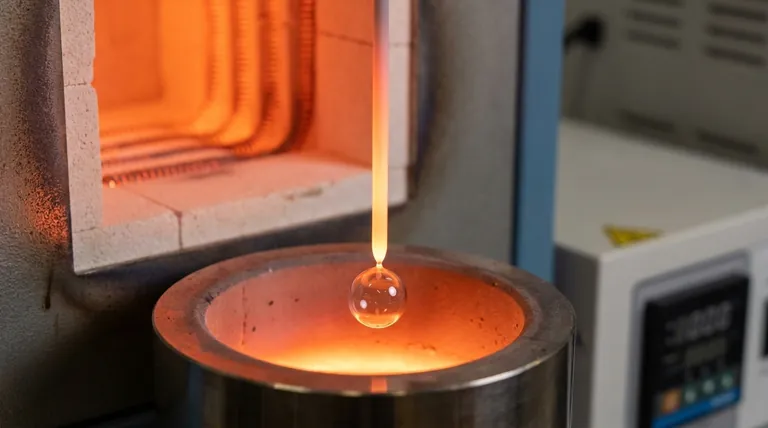
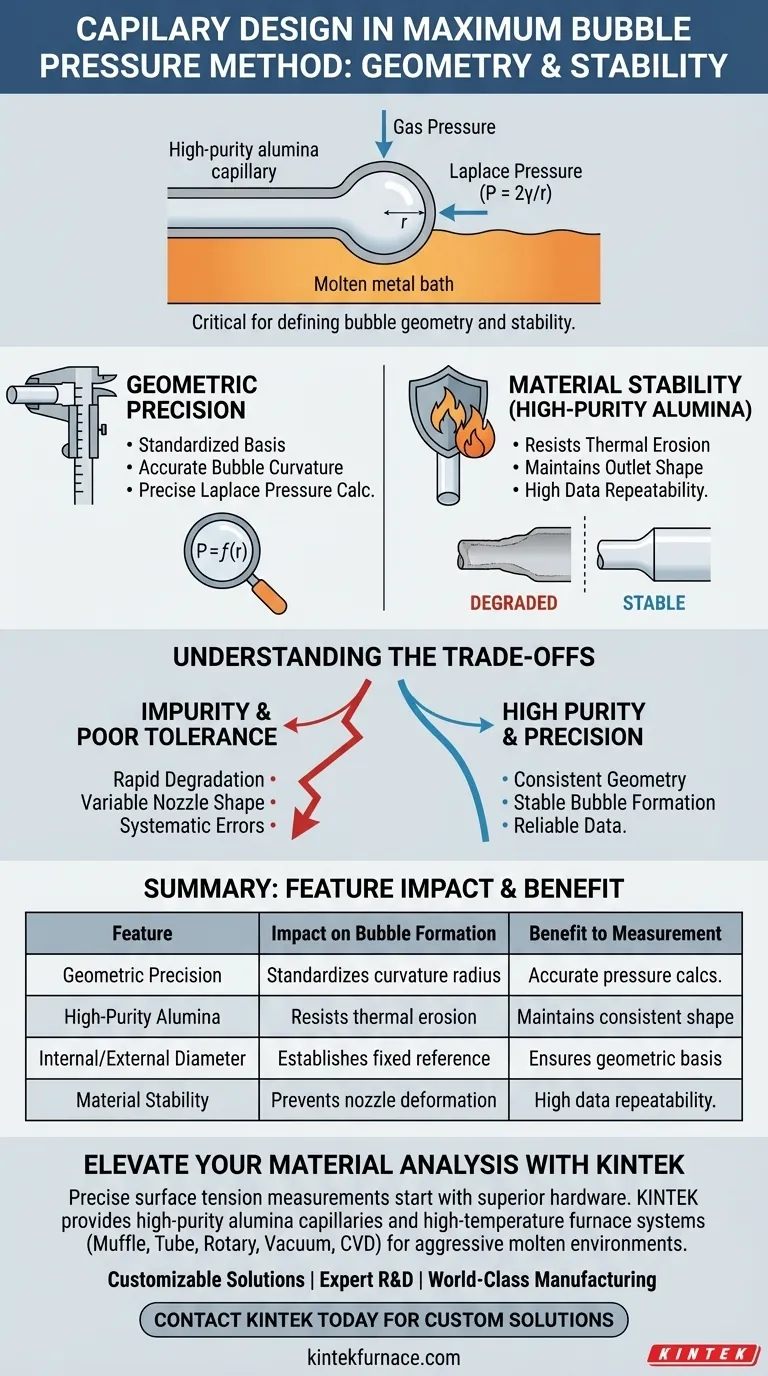
The design of high-purity alumina capillaries is the critical factor in defining the geometry and stability of bubble formation during measurement. By maintaining precise internal and external diameters and resisting high-temperature erosion, these capillaries ensure the bubble curvature radius remains constant, which is essential for accurate Laplace pressure calculations.
In the maximum bubble pressure method, measurement reliability depends entirely on the stability of the nozzle geometry. High-purity alumina prevents physical degradation in molten environments, ensuring that the standardized geometric basis required for calculating surface tension remains consistent over time.
The Role of Geometric Precision
Establishing a Standardized Basis
The capillary acts as the physical reference for the entire measurement system. Precise internal and external diameters provide the standardized geometric basis necessary for the method to work.
Calculating Bubble Curvature
To derive accurate surface tension data, you must calculate the radius of the bubble's curvature. This calculation relies directly on the fixed dimensions of the capillary tip.
Ensuring Pressure Accuracy
The Laplace pressure—the pressure difference across the bubble interface—is a function of the bubble's radius. If the capillary design lacks precision, the pressure readings will not correlate accurately with the surface tension of the melt.
Material Stability in Extreme Conditions
Resisting Thermal Erosion
Molten metals, such as steel, create an aggressive environment that can rapidly degrade standard materials. High-purity alumina is specifically utilized for its resistance to this high-temperature erosion.
Maintaining Outlet Shape
For the measurement to be repeatable, the nozzle outlet must not change shape as bubbles emerge. Alumina's resistance ensures the outlet does not widen or deform during the process.
Improving Data Repeatability
When the nozzle shape remains constant, every bubble forms under identical geometric constraints. This stability is the primary driver for high repeatability in surface tension calculations.
Understanding the Trade-offs
The Cost of Impurity
Using capillaries that lack high purity introduces a risk of rapid degradation. If the material erodes, the nozzle outlet shape changes effectively immediately, rendering subsequent measurements incomparable.
Dependency on Manufacturing Tolerances
The method is highly sensitive to the initial manufacturing quality of the capillary. Even with high-purity material, a lack of precise diameter control during the capillary's production will lead to systematic errors in the Laplace pressure calculation.
Making the Right Choice for Your Goal
To ensure valid data in the maximum bubble pressure method, you must select capillaries that align with the rigorous demands of the environment.
- If your primary focus is Calculation Accuracy: Ensure the capillary features precise, verified internal and external diameters to establish a correct baseline for bubble curvature.
- If your primary focus is Data Repeatability: Prioritize high-purity alumina grades to prevent erosion and maintain a constant nozzle outlet shape throughout the measurement series.
The integrity of your surface tension calculations is directly proportional to the geometric and thermal stability of the capillary you employ.
Summary Table:
| Feature | Impact on Bubble Formation | Benefit to Measurement |
|---|---|---|
| Geometric Precision | Standardizes bubble curvature radius | Accurate Laplace pressure calculations |
| High-Purity Alumina | Resists thermal erosion in molten metals | Maintains consistent nozzle shape over time |
| Internal/External Diameter | Establishes a fixed physical reference | Ensures standardized geometric basis |
| Material Stability | Prevents nozzle deformation | High data repeatability and reliability |
Elevate Your Material Analysis with KINTEK
Precise surface tension measurements start with superior hardware. KINTEK provides high-purity alumina capillaries and high-temperature furnace systems designed to withstand the most aggressive molten environments.
Backed by expert R&D and world-class manufacturing, we offer Muffle, Tube, Rotary, Vacuum, and CVD systems, all customizable to your specific research or industrial requirements. Ensure the integrity of your data with components built for thermal stability and geometric precision.
Ready to optimize your lab's performance? Contact KINTEK today to discuss your custom high-temperature solutions.
Visual Guide
References
- Lukas Neubert, Olena Volkova. Effect of Oxygen on Thermophysical Properties of Molten High-Silicon Electrical Steels and Its Impact on Bubble Formation Behavior. DOI: 10.1007/s11663-025-03594-9
This article is also based on technical information from Kintek Furnace Knowledge Base .
Related Products
- 1400℃ High Temperature Laboratory Tube Furnace with Alumina Tube
- 1700℃ High Temperature Laboratory Tube Furnace with Alumina Tube
- Magnesium Extraction and Purification Condensing Tube Furnace
- Vacuum Induction Melting Furnace
People Also Ask
- How does zone-melting in tube furnaces synthesize bismuth micro-wires? Master Single-Crystal Thermoelectric Growth
- How do high-temperature laboratory tube furnaces ensure environmental stability? Precision Thermal Reduction Tips
- How are high-temperature laboratory tube furnaces applied in long-term vacuum homogenization heat treatments for intermetallic samples?
- How are high-temp tube furnaces used to measure diffusion coefficients per Fick's law? Master Precision Annealing
- How are high-temperature tube furnaces applied in testing ceramic-supported alloy membranes? Insights



