
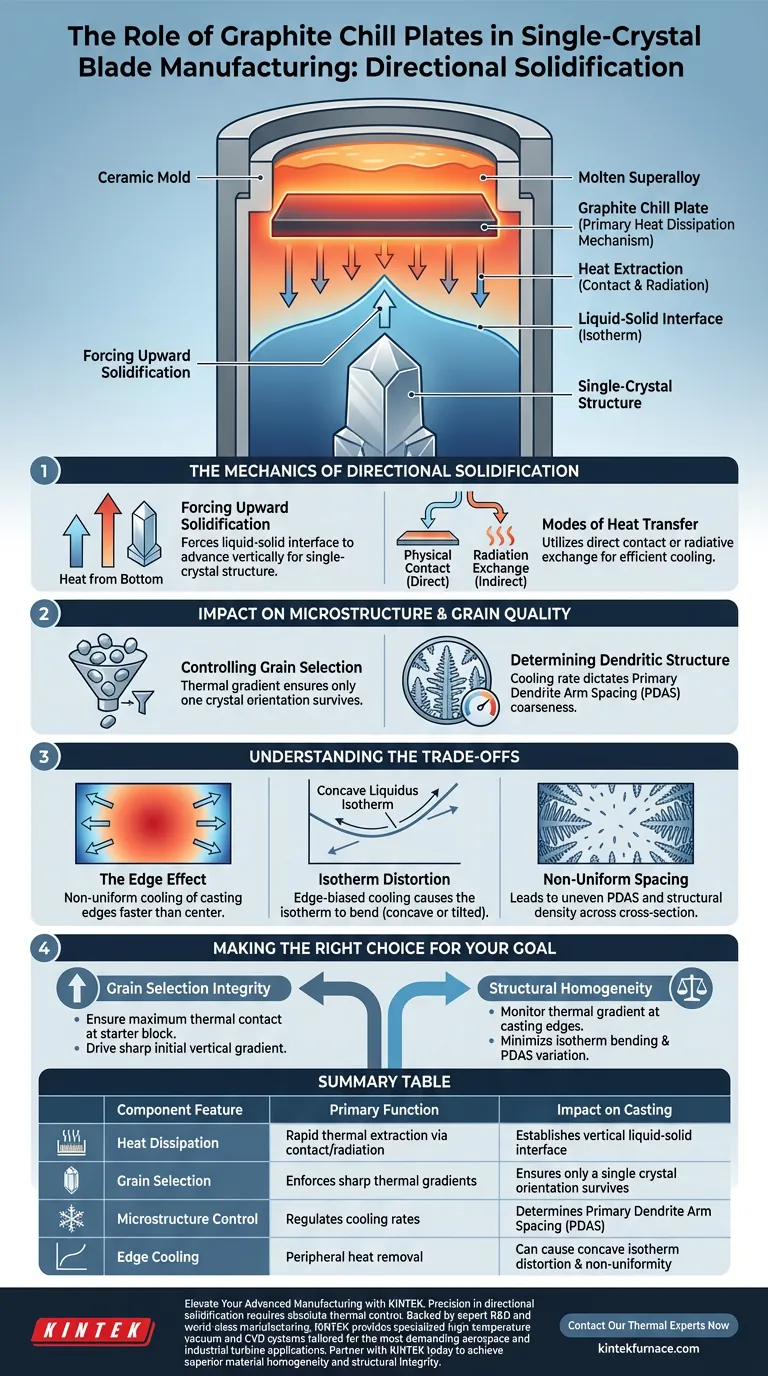
Graphite chill plates and rings act as the primary heat dissipation mechanism within directional solidification systems used for manufacturing single-crystal blades. By engaging in physical contact or radiative heat exchange with ceramic molds, these components rapidly extract heat from the bottom and sides of the casting, driving the liquid-solid interface upward to strictly control the solidification front.
The fundamental role of these components is to enforce a vertical thermal gradient that dictates crystal growth. While they are critical for initial grain selection, their localized cooling effects also introduce complex thermal variations across the blade’s cross-section.
The Mechanics of Directional Solidification
Forcing Upward Solidification
The primary function of graphite chill plates is to create a controlled direction of solidification.
By removing heat rapidly from the bottom of the mold, they force the liquid-solid interface to advance vertically. This directional movement is the foundational requirement for creating single-crystal structures.
Modes of Heat Transfer
These graphite components utilize two specific methods to extract thermal energy.
They operate through either direct physical contact with the mold or through radiation heat exchange. This dual approach ensures efficient cooling at the critical initial stages of the casting process.
Impact on Microstructure and Grain Quality
Controlling Grain Selection
The cooling provided by chill plates directly influences the success of the grain selection process.
The thermal gradient they establish is vital for the proper function of the starter block and grain selector stages. This ensures that only a single, desirable crystal orientation survives to form the blade body.
Determining Dendritic Structure
Beyond the initial selection, the rate of heat extraction dictates the internal structure of the material.
The intensity of the cooling influences the coarseness of the dendritic structure. Specifically, it controls the primary dendrite arm spacing (PDAS), a critical metric for the mechanical properties of the final blade.
Understanding the Trade-offs
The Edge Effect
While chill rings are necessary for rapid cooling, they introduce non-uniformity by cooling the edges of the casting faster than the center.
This enhanced heat exchange at the periphery creates a significant thermal difference between the outer skin and the core of the blade.
Isotherm Distortion
This edge-biased cooling causes the liquidus isotherm—the line separating liquid from solid—to bend.
Instead of a perfectly flat horizontal line, the thermal profile often becomes concave or tilted. This distortion complicates the growth front and can lead to structural defects if not managed.
Non-Uniform Spacing
The variation in cooling rates across the cross-section leads to physical inconsistencies in the material.
Because the heat removal is non-uniform, the primary dendrite arm spacing (PDAS) becomes uneven. You will often observe different structural densities at the edges compared to the center of the casting.
Making the Right Choice for Your Goal
To optimize your directional solidification process, you must balance rapid heat extraction with thermal homogeneity.
- If your primary focus is Grain Selection Integrity: Ensure maximum thermal contact at the starter block to drive a sharp initial vertical gradient.
- If your primary focus is Structural Homogeneity: Monitor the thermal gradient at the casting edges to minimize the bending of the liquidus isotherm and reduce PDAS variation.
Mastering the use of graphite chills is about managing the delicate balance between directional force and cross-sectional uniformity.
Summary Table:
| Component Feature | Primary Function | Impact on Casting |
|---|---|---|
| Heat Dissipation | Rapid thermal extraction via contact/radiation | Establishes the vertical liquid-solid interface |
| Grain Selection | Enforces sharp thermal gradients | Ensures only a single crystal orientation survives |
| Microstructure Control | Regulates cooling rates | Determines Primary Dendrite Arm Spacing (PDAS) |
| Edge Cooling | Peripheral heat removal | Can cause concave isotherm distortion and non-uniformity |
Elevate Your Advanced Manufacturing with KINTEK
Precision in directional solidification requires absolute thermal control. Backed by expert R&D and world-class manufacturing, KINTEK provides specialized high-temperature vacuum and CVD systems tailored for the most demanding aerospace and industrial turbine applications.
Whether you are optimizing grain selection or seeking to eliminate structural defects in single-crystal blades, our customizable lab and industrial furnaces deliver the performance you need. Partner with KINTEK today to achieve superior material homogeneity and structural integrity.
Contact Our Thermal Experts Now
Visual Guide
References
- Effect of Temperature Profile Curvature on the Formation of Atypical Inhomogeneity of Dendritic Microstructure Across the Width of a Single Crystal Blade. DOI: 10.1007/s11661-025-07909-y
This article is also based on technical information from Kintek Furnace Knowledge Base .
Related Products
People Also Ask
- Why are vacuum heat treating furnaces essential for aerospace? Ensure Superior Material Integrity for High-Stakes Applications
- What is the primary application of vacuum heat treating furnaces in aerospace? Enhance Component Performance with Precision
- What is the process of vacuum heat treating? Achieve Superior Metallurgical Properties
- How does vacuum heat treating work in terms of temperature and time control? Master Precise Material Transformations
- How does a vacuum heat treating furnace improve the condition of metal alloys? Achieve Superior Metal Performance
