
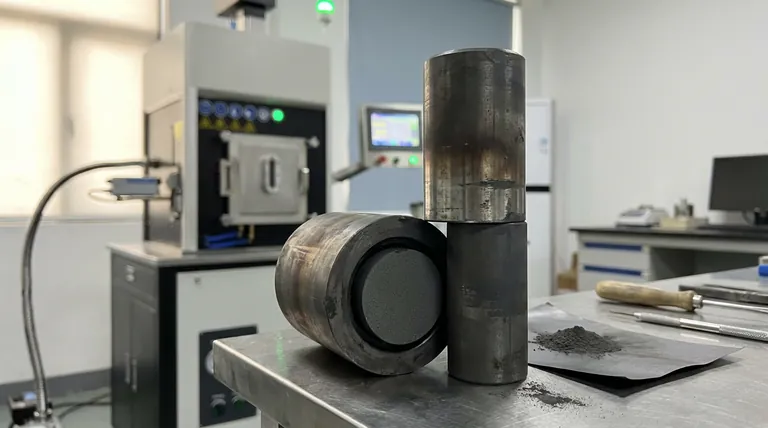
High-purity graphite molds serve a dual purpose as both the primary heating element and the mechanism for mechanical compression. In the Spark Plasma Sintering (SPS) of TiB2 ceramics, these molds conduct pulsed electrical currents to generate internal heat while simultaneously transmitting high axial pressure to the powder sample.
Core Insight: The unique advantage of the graphite mold is its ability to integrate thermal and mechanical forces. By acting as a resistor that generates Joule heat while bearing hydraulic pressure, it allows ceramic powders to overcome diffusion barriers and achieve high density at temperatures lower than those required by conventional sintering.
The Role of Electrical Conductivity and Heating
Generating Internal Joule Heat
The graphite mold is an active component of the electrical circuit, not just a passive container. Pulse currents flow directly through the mold's walls.
Because graphite possesses specific electrical resistance, this current flow generates Joule heat. This mechanism allows thermal energy to be produced immediately surrounding the sample rather than relying on external heating elements.
Achieving Rapid Temperature Increases
The direct generation of heat within the mold enables extremely rapid heating rates.
This efficiency ensures that high temperatures—often exceeding 2000°C—can be reached quickly. This minimizes the time the TiB2 sample spends at intermediate temperatures, effectively controlling grain growth.
Ensuring Thermal Uniformity
Graphite possesses excellent thermal conductivity.
This property helps distribute the generated heat evenly across the sintering zone. Uniform heating is critical for maintaining dimensional precision and ensuring consistent material properties throughout the ceramic sample.
Mechanical Functions and Densification
Transmitting Axial Pressure
The mold acts as the physical interface between the system's hydraulic rams and the ceramic powder.
It must possess high-temperature mechanical strength to withstand significant axial pressures (up to 60 MPa). The mold converts the hydraulic force into compressive stress applied directly to the TiB2 powder.
Overcoming Diffusion Barriers
The combination of pressure and heat is the key driver of densification in SPS.
The compressive stress provided by the mold forces powder particles to rearrange. This mechanical assist helps the material overcome kinetic diffusion barriers, facilitating the consolidation of hard-to-sinter materials like TiB2.
Shaping and Containment
Beyond active processing, the mold serves as the geometric container for the powder.
It maintains the shape of the green body during the initial stages of the process, including debinding (around 600°C). It prevents the powder structure from collapsing before the ceramic particles have bonded.
Understanding the Constraints
Pressure Limitations
While graphite is strong, it has a mechanical limit.
Standard high-purity graphite molds are generally limited to pressures around 60 MPa. Exceeding this limit to force higher density can result in mold fracture or deformation.
Potential for Surface Reactions
At extreme sintering temperatures, there is a risk of the sample adhering to the mold walls.
To mitigate this, graphite paper is often used as a liner between the mold and the sample. This facilitates demolding and prevents carbon diffusion from altering the surface chemistry of the TiB2 ceramic.
Making the Right Choice for Your Goal
To optimize your SPS process for TiB2 ceramics, consider the following:
- If your primary focus is Maximum Density: Ensure the mold design has sufficient wall thickness to handle pressures near 60 MPa without deformation, maximizing the mechanical driving force.
- If your primary focus is Microstructural Control: Leverage the mold's conductivity to utilize faster heating rates, which minimizes grain growth during the ramp-up phase.
- If your primary focus is Dimensional Precision: Prioritize the quality of the graphite machining and the use of liners (graphite paper) to ensure uniform heat transfer and easy removal.
The effectiveness of SPS relies entirely on the graphite mold's ability to act as a robust, conductive pressure vessel that delivers heat and force simultaneously.
Summary Table:
| Function | Role in SPS Process | Benefit for TiB2 Ceramics |
|---|---|---|
| Joule Heating | Acts as a resistor for pulsed currents | Rapid heating rates & grain growth control |
| Pressure Transmission | Delivers axial force up to 60 MPa | Overcomes diffusion barriers for full densification |
| Thermal Conductivity | Distributes heat evenly through the zone | Ensures consistent material properties and precision |
| Geometric Containment | Maintains powder shape during consolidation | Prevents structural collapse during high-temp sintering |
Elevate Your Materials Research with KINTEK
Are you looking to push the boundaries of TiB2 ceramic performance? KINTEK provides the high-performance laboratory equipment necessary for advanced material synthesis. Backed by expert R&D and manufacturing, we offer high-purity graphite components along with Muffle, Tube, Rotary, Vacuum, and CVD systems, all of which are fully customizable to meet your unique sintering requirements.
Our value to you:
- Expert Engineering: Systems designed to withstand the extreme thermal and mechanical stresses of SPS.
- Custom Solutions: Tailored high-temp furnaces that match your specific research goals.
- Proven Precision: Equipment that ensures thermal uniformity and repeatable results.
Contact KINTEK today to optimize your lab's high-temperature processes!
References
- Sha Zhang, Shuge Tian. Spectral characterization of the impact of modifiers and different prepare temperatures on snow lotus medicinal residue-biochar and dissolved organic matter. DOI: 10.1038/s41598-024-57553-6
This article is also based on technical information from Kintek Furnace Knowledge Base .
Related Products
People Also Ask
- Why is it necessary to maintain a high vacuum environment during the SPS of SiC? Key to High-Density Ceramics
- How does the heating mechanism of Spark Plasma Sintering (SPS) function? Enhance TiC/SiC Composite Fabrication
- What are the technical advantages of using an SPS sintering furnace? Elevate Al2O3-TiC Material Performance
- What are the steps in the discharge plasma sintering process? Master Fast, High-Density Material Consolidation
- What are the advantages of spark plasma sintering (SPS) over traditional forging? Precision Microstructural Control

