
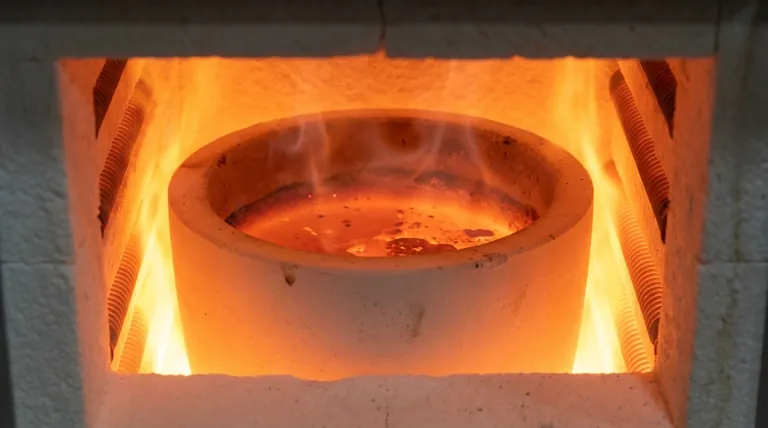
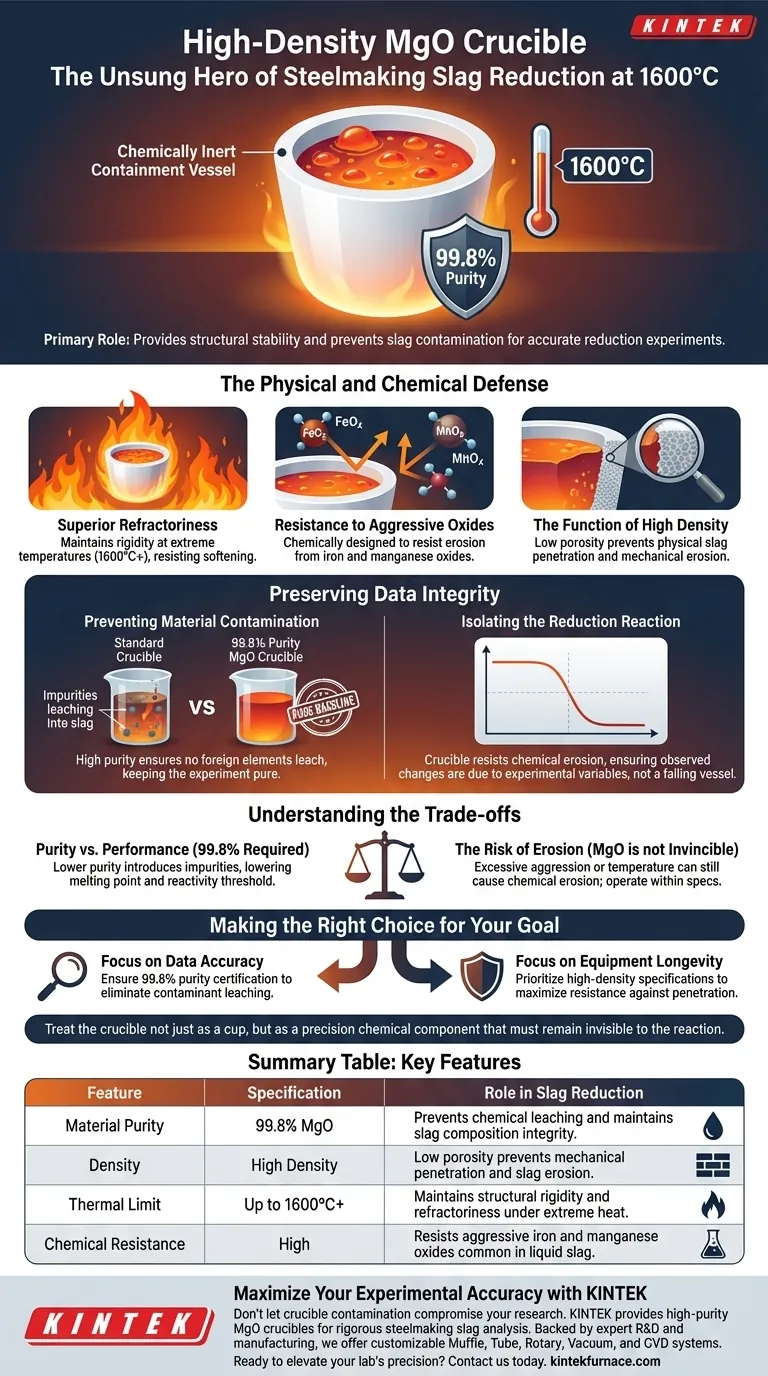
The primary role of a high-density Magnesium Oxide (MgO) crucible in these experiments is to serve as a chemically inert containment vessel. Operating at extreme temperatures of 1600°C, it provides the necessary structural stability to hold liquid steelmaking slag. Crucially, its high purity (99.8%) prevents the crucible itself from reacting with the slag, ensuring that the experimental results reflect only the intended reduction reactions.
The high-density MgO crucible solves the problem of "container contamination." By resisting erosion from aggressive oxides, it ensures that the chemistry of the crucible does not alter the composition of the slag, guaranteeing reliable and accurate experimental data.
The Physical and Chemical Defense
The choice of material for a reaction vessel at 1600°C is not just about heat resistance; it is about survival against chemical attack.
Superior Refractoriness
At 1600°C, many standard refractory materials would soften or melt. Magnesium Oxide is selected specifically for its superior refractoriness, allowing it to maintain rigidity and structural integrity even when holding molten slag at these extreme temperatures.
Resistance to Aggressive Oxides
Liquid steelmaking slag contains highly corrosive elements. The MgO crucible is chemically designed to resist erosion from iron oxide and manganese oxide, which are notoriously aggressive toward containment materials.
The Function of High Density
The "high-density" specification is critical to the vessel's performance. High density implies low porosity, which physically prevents the liquid slag from penetrating the crucible walls, thereby stopping mechanical erosion that often accompanies chemical attack.
Preserving Data Integrity
The ultimate goal of using high-purity MgO is to protect the validity of the scientific data being collected.
Preventing Material Contamination
In reduction experiments, even trace amounts of dissolved crucible material can skew results. By utilizing 99.8% purity MgO, researchers ensure that no foreign elements leach into the slag, keeping the chemical baseline of the experiment pure.
Isolating the Reduction Reaction
The experiment aims to measure the reduction of the slag, not the degradation of the pot. Because the crucible resists chemical erosion, researchers can be confident that observed changes are due to the experimental variables, not a failing vessel.
Understanding the Trade-offs
While high-density MgO is the superior choice for these parameters, understanding its limitations is vital for experimental success.
Purity vs. Performance
The 99.8% purity level is not a luxury; it is a requirement. Using lower-purity MgO would likely introduce impurities that lower the crucible's melting point or reactivity threshold, leading to failure at 1600°C.
The Risk of Erosion
Despite its resistance, MgO is not invincible. If the slag composition becomes excessively aggressive or the temperature exceeds the rated limit, chemical erosion can still occur, emphasizing the need to operate strictly within the material's thermal and chemical specifications.
Making the Right Choice for Your Goal
To ensure your liquid steelmaking slag experiments yield valid results, consider the following recommendations:
- If your primary focus is Data Accuracy: Ensure your crucible certification confirms 99.8% purity to eliminate the risk of leaching contaminants into your melt.
- If your primary focus is Equipment Longevity: Prioritize high-density manufacturing specifications to maximize resistance against penetration by iron and manganese oxides.
The success of high-temperature slag reduction relies on treating the crucible not just as a cup, but as a precision chemical component that must remain invisible to the reaction.
Summary Table:
| Feature | Specification | Role in Slag Reduction Experiments |
|---|---|---|
| Material Purity | 99.8% MgO | Prevents chemical leaching and maintains slag composition integrity. |
| Density | High Density | Low porosity prevents mechanical penetration and slag erosion. |
| Thermal Limit | Up to 1600°C+ | Maintains structural rigidity and refractoriness under extreme heat. |
| Chemical Resistance | High | Resists aggressive iron and manganese oxides common in liquid slag. |
Maximize Your Experimental Accuracy with KINTEK
Don't let crucible contamination compromise your research. KINTEK provides high-purity MgO crucibles designed specifically for the rigorous demands of steelmaking slag analysis. Backed by expert R&D and manufacturing, we offer customizable Muffle, Tube, Rotary, Vacuum, and CVD systems, along with specialized lab high-temp furnaces to meet your unique thermal processing needs.
Ready to elevate your lab's precision? Contact us today to consult with our experts on the perfect high-temperature solution for your application.
Visual Guide
References
- M. A. Levchenko, Olena Volkova. Reduction of Liquid Steelmaking Slag Using Hydrogen Gas as a Reductant. DOI: 10.3390/met15090984
This article is also based on technical information from Kintek Furnace Knowledge Base .
Related Products
People Also Ask
- What are the advantages of using a condensing tube furnace for magnesium extraction? Achieve High Purity and Efficient Metal Recovery
- What are the temperature capabilities of tube furnaces? Find the Perfect Heat for Your Process
- What industrial and research applications are tube furnaces used for? Unlock Precise Thermal Processing Solutions
- Why must Ni-CaO catalysts undergo hydrogen treatment in a tube furnace? Essential Activation for CO2 Conversion
- How does a tube furnace contribute to the chemical activation stage of producing activated carbon? Expert Insights
