
In the synthesis of KCC-1 dendritic silica nanostructures, the magnetic stirrer serves to create a stable microemulsion through uniform dispersion of reactants, while the condenser reflux apparatus maintains critical chemical stoichiometry by preventing solvent evaporation at high temperatures. These two instruments work in tandem to establish the precise physical and chemical environment required for the unique fibrous morphology of KCC-1.
The successful formation of KCC-1 relies on the synergy between rigorous physical mixing to establish a template-guided microemulsion and a closed reflux system that preserves the exact chemical balance required for 3D dendritic growth.
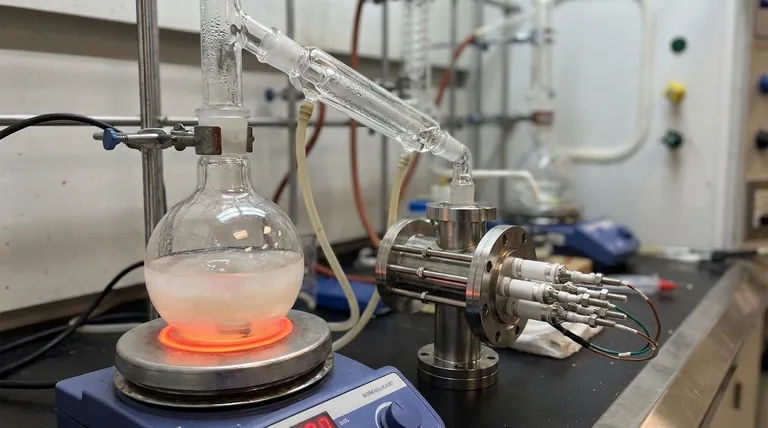
The Role of the Magnetic Stirrer
The magnetic stirrer is the primary driver of physical homogeneity within the reaction vessel. Its function goes beyond simple agitation; it is essential for the formation of the "soft template" system.
Achieving Uniform Dispersion
The synthesis involves a complex mixture of CTAB (the template), urea, TEOS (the silica source), and various solvents. The magnetic stirrer ensures these distinct components are thoroughly mixed rather than settling into separate phases.
Establishing the Microemulsion
By maintaining constant agitation, the stirrer facilitates the formation of a stable microemulsion system. This stability is a prerequisite for the template-directed growth mechanism that defines KCC-1 synthesis.
The Role of the Condenser Reflux Apparatus
While the stirrer handles the physical mixture, the condenser reflux apparatus manages the thermodynamic and chemical environment. It allows the reaction to proceed at elevated temperatures without compromising the mixture's composition.
Maintaining Thermal Stability
The apparatus operates in a constant temperature environment, specifically maintained at 80 °C. This thermal energy is necessary to drive the chemical reaction kinetics required for silica condensation.
Preventing Solvent Evaporation
At 80 °C, volatile solvents would typically evaporate rapidly, leaving the reaction vessel. The condenser captures these vapors, cools them, and returns them to the liquid phase, keeping the system "closed."
Preserving Chemical Stoichiometry
By preventing the loss of solvent, the apparatus ensures the concentration of reactants remains constant throughout the synthesis. This stability maintains the specific chemical stoichiometry required for the reaction to proceed predictably.
The Impact on Nanostructure Morphology
The ultimate goal of using these specific tools is to control the physical shape of the final silica product.
Guiding Dendritic Growth
The combination of a stable microemulsion and fixed stoichiometry ensures the silica grows into nanospheres with a specific three-dimensional dendritic structure.
Facilitating Soft Template Assembly
The precise environment allows the silica precursor to polymerize around the CTAB template correctly. This results in the characteristic fibrous surface area that makes KCC-1 unique compared to solid silica spheres.
Common Pitfalls and Sensitivities
Understanding the sensitivity of this synthesis helps in troubleshooting failed batches or irregular structures.
Inadequate Agitation
If the magnetic stirrer fails to maintain a uniform speed, the microemulsion may destabilize. This lack of homogeneity can prevent the formation of the dendritic network, leading to irregular particle shapes.
Loss of Stoichiometry
If the condenser system leaks or fails to cool vapors efficiently, solvent loss will alter the concentration of reactants. A shift in stoichiometry disrupts the delicate balance needed for the template mechanism, often resulting in non-dendritic or collapsed structures.
Making the Right Choice for Your Synthesis
To ensure high-quality KCC-1 production, focus on the precision of your equipment setup.
- If your primary focus is structural uniformity: Ensure your magnetic stirrer is set to a speed that guarantees a vortex-free but thoroughly dispersed microemulsion.
- If your primary focus is reproducibility: Verify the seal and cooling efficiency of your reflux condenser to guarantee zero solvent loss during the 80 °C reaction phase.
Precise control over mixing dynamics and solvent retention is the non-negotiable key to unlocking the high surface area of dendritic silica.
Summary Table:
| Equipment | Primary Function | Impact on KCC-1 Morphology |
|---|---|---|
| Magnetic Stirrer | Creates stable microemulsion via uniform dispersion | Ensures formation of 3D dendritic structure |
| Condenser Reflux | Prevents solvent evaporation at 80 °C | Maintains stoichiometry for fibrous surface growth |
| Synergy | Physical and chemical stability | Produces high-surface-area nanospheres |
Elevate Your Nanomaterial Synthesis with KINTEK
Precision is non-negotiable when synthesizing complex nanostructures like KCC-1. At KINTEK, we understand that high-quality outcomes depend on rigorous thermal and physical control.
Backed by expert R&D and manufacturing, KINTEK offers a comprehensive range of lab equipment including Muffle, Tube, Rotary, Vacuum, and CVD systems, as well as precision stirring and reflux solutions. Our systems are fully customizable to meet your unique research requirements, ensuring stable microemulsions and perfect stoichiometry every time.
Ready to optimize your lab's performance? Contact us today to discuss how our high-temperature furnaces and lab solutions can enhance your material science breakthroughs.
References
- Farzaneh Edrisi, Nasrin Shadjou. Preparation of an innovative series of respiratory nano-filters using polystyrene fibrous films containing KCC-1 dendrimer and ZnO nanostructures for environmental assessment of SO<sub>2</sub>, NO<sub>2</sub> and CO<sub>2</sub>. DOI: 10.1039/d4ra00176a
This article is also based on technical information from Kintek Furnace Knowledge Base .
Related Products
People Also Ask
- What are the advantages of using a condensing tube furnace for magnesium extraction? Achieve High Purity and Efficient Metal Recovery
- How do tube furnaces contribute to transport reactions and crystal production? Master High-Purity Synthesis with Precision Control
- What makes tube furnaces indispensable in academic and industrial settings? Unlock Precision Heating for Advanced Materials
- What are the differences between solid tube and split type tube furnaces? Choose the Right Furnace for Your Lab
- What factors should be considered when choosing a tube furnace for a lab? Ensure Precision and Safety in Your Experiments
