
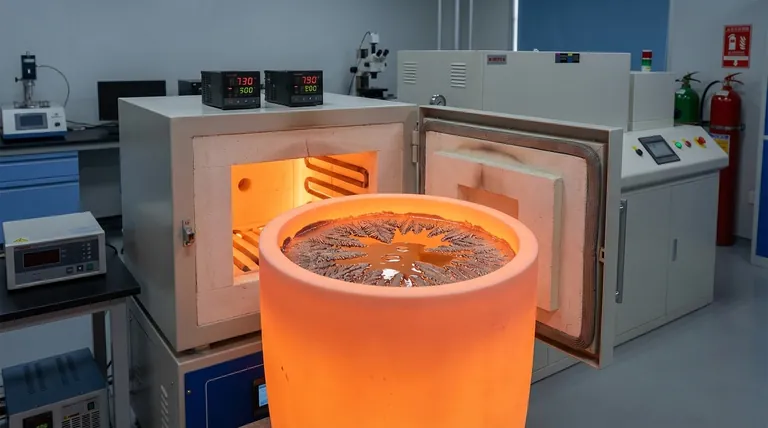
High-purity alumina crucibles provide the critical chemical stability and thermal resistance required for accurate solid-liquid phase equilibrium experiments. They are specifically designed to resist erosion during prolonged contact with molten cast iron, preventing the crucible material from contaminating the alloy and compromising your data.
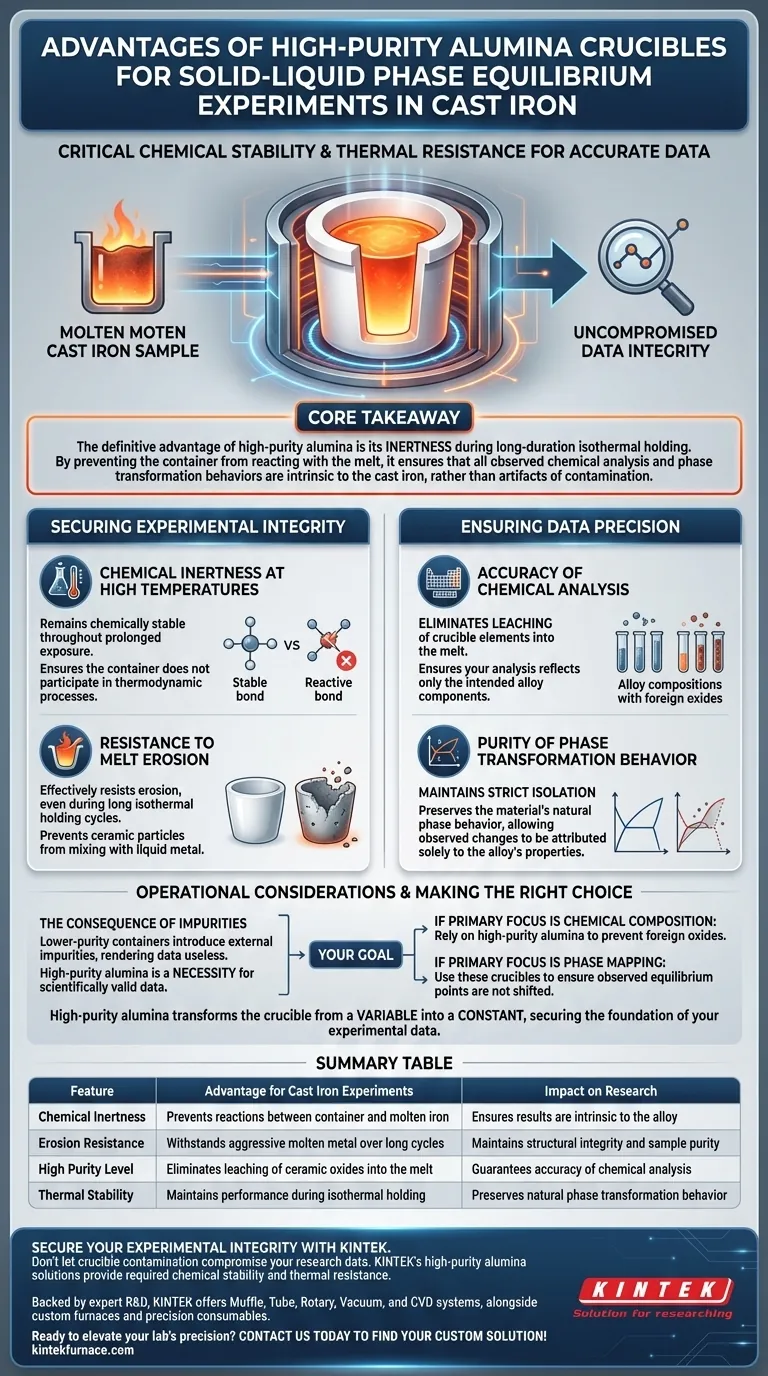
Core Takeaway The definitive advantage of high-purity alumina is its inertness during long-duration isothermal holding. By preventing the container from reacting with the melt, it ensures that all observed chemical analysis and phase transformation behaviors are intrinsic to the cast iron, rather than artifacts of contamination.
Securing Experimental Integrity
Chemical Inertness at High Temperatures
Solid-liquid phase equilibrium experiments often require maintaining molten cast iron at specific temperatures for extended periods. High-purity alumina remains chemically stable throughout this prolonged exposure.
This stability creates a reliable reaction space. It ensures that the container itself does not participate in the thermodynamic processes you are attempting to measure.
Resistance to Melt Erosion
Molten cast iron is aggressive and can erode standard containment materials over time. High-purity alumina effectively resists this erosion, even during long isothermal holding cycles.
By maintaining its structural integrity, the crucible prevents physical degradation. This eliminates the risk of ceramic particles sloughing off and mechanically mixing with the liquid metal.
Ensuring Data Precision
Accuracy of Chemical Analysis
The primary goal of equilibrium experiments is to analyze specific alloy compositions. Prevents leaching of crucible elements into the melt is non-negotiable for valid results.
If a crucible degrades, it introduces oxides or other impurities into the cast iron. High-purity alumina eliminates this variable, ensuring your chemical analysis reflects only the intended alloy components.
Purity of Phase Transformation Behavior
Phase transformation data is highly sensitive to impurities. External contaminants can alter the solidification path, changing the freezing range or the nature of the phases formed.
By maintaining strict isolation between the melt and the container, high-purity alumina preserves the material's natural phase behavior. This allows researchers to attribute observed changes solely to the alloy's properties, not to experimental error.
Operational Considerations
The Consequence of Impurities
While standard ceramic crucibles are useful for general applications, they often fail under the specific demands of equilibrium studies. The use of lower-purity containers introduces external impurities during the heating and holding cycles.
In the context of phase equilibrium, even minor contamination renders the data useless. The "advantage" of high-purity alumina is, therefore, better understood as a necessity: it is the baseline requirement for generating scientifically valid data in this specific field.
Making the Right Choice for Your Goal
To maximize the validity of your cast iron experiments, align your equipment choice with your specific analytical needs:
- If your primary focus is Chemical Composition: Rely on high-purity alumina to prevent the introduction of foreign oxides that would skew elemental analysis.
- If your primary focus is Phase Mapping: Use these crucibles to ensure that observed equilibrium points are not shifted by dissolved crucible material.
High-purity alumina transforms the crucible from a variable into a constant, securing the foundation of your experimental data.
Summary Table:
| Feature | Advantage for Cast Iron Experiments | Impact on Research |
|---|---|---|
| Chemical Inertness | Prevents reactions between container and molten iron | Ensures results are intrinsic to the alloy |
| Erosion Resistance | Withstands aggressive molten metal over long cycles | Maintains structural integrity and sample purity |
| High Purity Level | Eliminates leaching of ceramic oxides into the melt | Guarantees accuracy of chemical analysis |
| Thermal Stability | Maintains performance during isothermal holding | Preserves natural phase transformation behavior |
Secure Your Experimental Integrity with KINTEK
Don't let crucible contamination compromise your research data. KINTEK’s high-purity alumina solutions provide the chemical stability and thermal resistance required for the most demanding solid-liquid phase equilibrium studies.
Backed by expert R&D and manufacturing, KINTEK offers Muffle, Tube, Rotary, Vacuum, and CVD systems, alongside customizable high-temperature lab furnaces and precision consumables designed for your unique needs.
Ready to elevate your lab's precision? Contact us today to find your custom solution!
Visual Guide
References
- Ricardo Queirós, Attila Diószegi. Assessing Pore Formation due to Nitrogen Partitioning in a Hypoeutectic Cast Iron. DOI: 10.1007/s40962-024-01521-3
This article is also based on technical information from Kintek Furnace Knowledge Base .
Related Products
- 1700℃ High Temperature Laboratory Tube Furnace with Alumina Tube
- 1400℃ High Temperature Laboratory Tube Furnace with Alumina Tube
People Also Ask
- How does zone-melting in tube furnaces synthesize bismuth micro-wires? Master Single-Crystal Thermoelectric Growth
- How are high-temp tube furnaces used to measure diffusion coefficients per Fick's law? Master Precision Annealing
- How are high-temperature laboratory tube furnaces applied in long-term vacuum homogenization heat treatments for intermetallic samples?
- How do high-temperature laboratory tube furnaces ensure environmental stability? Precision Thermal Reduction Tips
- How are high-temperature tube furnaces applied in testing ceramic-supported alloy membranes? Insights

