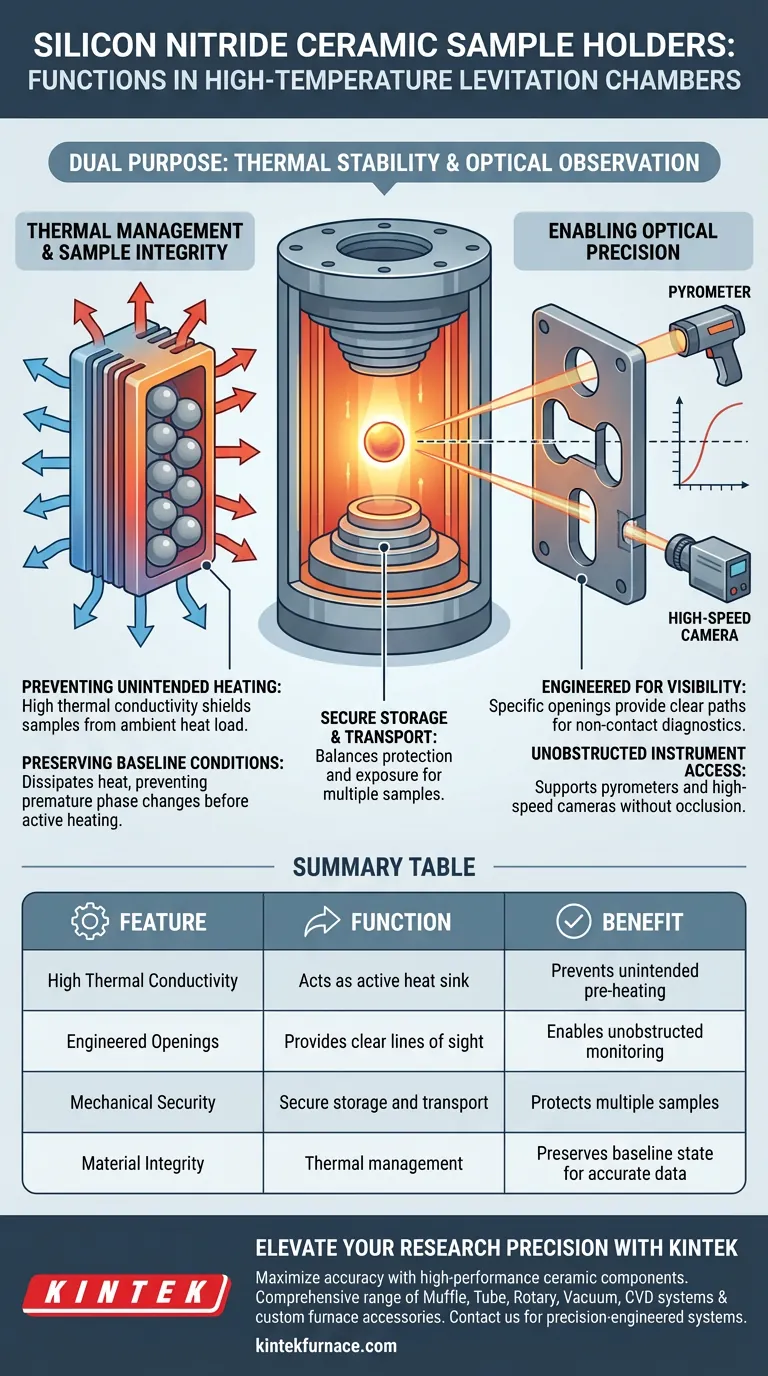
Silicon nitride ceramic sample holders serve a dual purpose within high-temperature levitation chambers: ensuring the thermal stability of stored materials and facilitating precise optical observation. They function as secure, thermally conductive storage units that protect samples from premature heating while providing clear lines of sight for critical measurement instruments.
By leveraging high thermal conductivity, these holders act as active thermal management tools rather than passive containers. They preserve the sample's initial state by dissipating heat, preventing data contamination caused by unintentional pre-heating before the experiment begins.
Thermal Management and Sample Integrity
Preventing Unintended Heating
High-temperature levitation chambers create a thermally aggressive environment. The primary technical function of the holder is to shield stored samples from this ambient heat load before the active experiment begins.
The Role of High Thermal Conductivity
Silicon nitride is selected specifically for its high thermal conductivity. This property allows the holder to act as an effective heat sink, rapidly drawing heat away from the samples it contains.
Preserving Baseline Conditions
By dissipating heat, the holder ensures samples do not undergo unintended temperature increases. This is critical for preventing premature phase changes or structural alterations before the active heating phase initiates.
Enabling Optical Precision
Engineered for Visibility
Levitation experiments rely heavily on non-contact diagnostics. To support this, the sample holders are engineered with specific opening designs rather than being fully enclosed.
Unobstructed Instrument Access
These openings provide a clear, unobstructed path for optical devices. This design ensures that the physical structure of the holder does not interfere with the line of sight required for data collection.
Supporting Pyrometers and High-Speed Cameras
The specific geometry allows instruments such as pyrometers (for temperature measurement) and high-speed cameras (for dynamic observation) to view the levitated samples without occlusion.
Operational Considerations and Trade-offs
Secure Storage and Transport
Beyond thermal and optical properties, the holders must mechanically secure multiple samples. This allows for the transport and storage of several experimental candidates simultaneously within the chamber.
Balancing Protection and Exposure
The design represents a trade-off between shielding and visibility. The holder must be substantial enough to act as a heat sink and secure the sample, yet open enough to allow for sophisticated optical monitoring.
Optimizing Experimental Setup
To maximize the utility of silicon nitride holders in your high-temperature experiments, consider your specific diagnostic needs:
- If your primary focus is material purity: Rely on the holder's high thermal conductivity to maintain a stable, cool baseline temperature for your samples prior to levitation.
- If your primary focus is data acquisition: Ensure the holder's specific opening design aligns perfectly with the viewing angles of your pyrometers and imaging systems to prevent data gaps.
Effective use of these holders ensures that your samples enter the levitation phase in a controlled, pristine state, ready for accurate measurement.
Summary Table:
| Feature | Function | Benefit |
|---|---|---|
| High Thermal Conductivity | Acts as an active heat sink | Prevents unintended pre-heating and premature phase changes. |
| Engineered Openings | Provides clear lines of sight | Enables unobstructed monitoring by pyrometers and high-speed cameras. |
| Mechanical Security | Secure storage and transport | Protects multiple samples and facilitates handling within the chamber. |
| Material Integrity | Thermal management | Preserves the sample's baseline state for accurate data collection. |
Elevate Your Research Precision with KINTEK
Maximize your experimental accuracy with high-performance ceramic components tailored for extreme environments. Backed by expert R&D and manufacturing, KINTEK offers a comprehensive range of lab solutions including Muffle, Tube, Rotary, Vacuum, and CVD systems, along with customizable high-temperature furnace accessories designed to meet your unique research needs.
Ready to optimize your thermal management and data acquisition? Contact KINTEK today to discover how our precision-engineered systems can support your next breakthrough.
Visual Guide
References
- G. Lohöfer, Andreas Meyer. TEMPUS—A microgravity electromagnetic levitation facility for parabolic flights. DOI: 10.1063/5.0182719
This article is also based on technical information from Kintek Furnace Knowledge Base .
Related Products
- High Temperature Muffle Oven Furnace for Laboratory Debinding and Pre Sintering
- 1400℃ Muffle Oven Furnace for Laboratory
- 1200℃ Controlled Inert Nitrogen Atmosphere Furnace
- Small Vacuum Heat Treat and Tungsten Wire Sintering Furnace
- Multi Heating Zones CVD Tube Furnace Machine for Chemical Vapor Deposition Equipment
People Also Ask
- What thermal phenomena occur during polymer binder burnout in ceramic green bodies? Lab Furnace Guide
- Why is controlled heat treatment in a muffle furnace necessary for calcined clay? Achieve Optimal Pozzolanic Activity
- What role does a high-temperature muffle furnace play in STFO synthesis? Achieve Pure Perovskite Results
- How does a high-temperature muffle furnace facilitate the formation of LaNbxAl1−xO3+δ perovskite structures? Key Roles
- What role does a high-temperature muffle furnace play in the multi-stage synthesis of Li0.5MnFe1.5O4? Key to Pure Spinel